
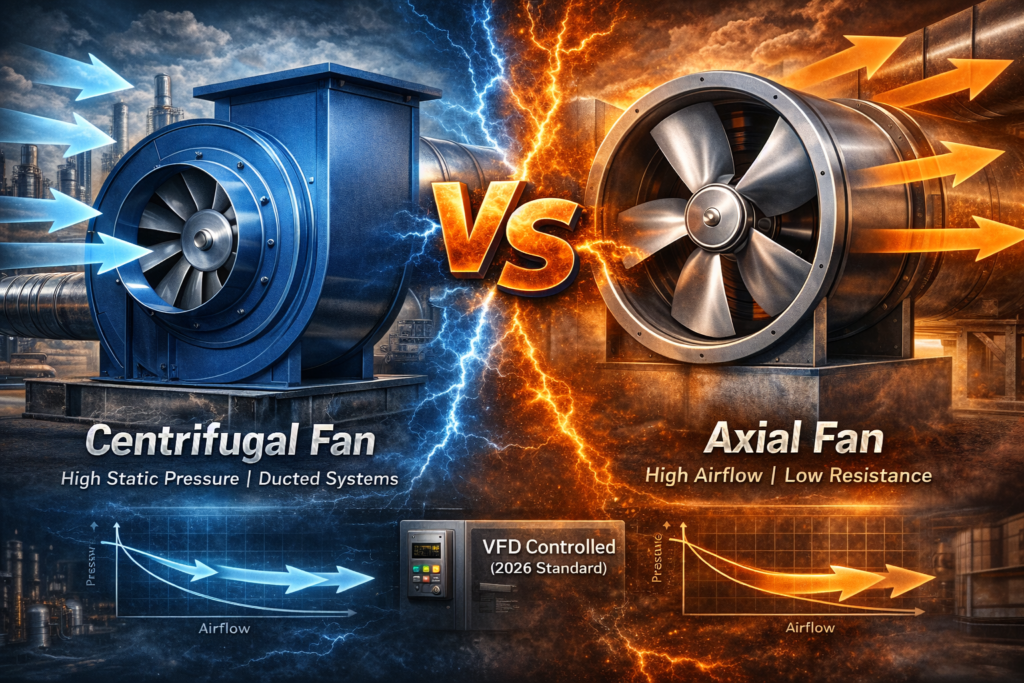
Key highlights of Centrifugal Fan vs Axial Fan
- Centrifugal fans generate higher static pressure by converting kinetic energy through a 90-degree airflow turn.
- Axial fans move air parallel to the shaft axis, suited for high-volume, low-resistance applications.
- Centrifugal fans are preferred in ducted systems, chemical plants, and high-temperature processes.
- In 2026, VFD integration is standard for both types in energy-regulated industrial facilities.
- Selection is governed by system resistance curves, temperature, gas properties, and installation geometry.
Editorial Note: This guide reflects 12 years of hands-on industrial fan and blower selection experience across HVAC, chemical processing, power generation, and heavy manufacturing. References to 2026 energy benchmarking and IE4 motor standards reflect active project work, not theoretical modeling.
Selecting the wrong fan type for an industrial application is not a matter of minor inefficiency. It can mean premature motor failure, inadequate process ventilation, regulatory non-compliance, and significant lifecycle cost overruns. The debate between centrifugal fans and axial fans is one of the most frequently misunderstood decisions in industrial and commercial HVAC engineering, and in 2026, with mandatory energy benchmarking and IE4 motor integration reshaping procurement standards, the stakes are higher than ever.
This guide draws on over a decade of real-world fan system engineering and commissioning to give plant engineers, procurement teams, and facility managers a definitive framework for evaluating the centrifugal fan vs axial fan question across every relevant dimension.
Core Working Principle of Each Fan Type
How a Centrifugal Fan Works
A centrifugal fan, also referred to as a radial fan, operates on the principle of centrifugal force. Air enters the impeller axially, near the center of the rotating wheel, and is then flung outward radially by centrifugal acceleration. This process causes the airflow to exit the fan housing at a 90-degree angle relative to the direction of entry. The scroll-shaped volute casing then converts the high-velocity kinetic energy of the air into static pressure, which is precisely what makes centrifugal fans effective in systems with high resistance to airflow.
The energy conversion process in a centrifugal fan is staged. First, the rotating impeller imparts velocity energy to the air. Then, the expanding volute casing performs the pressure recovery. This two-stage conversion is why centrifugal fans are capable of generating pressure differentials several times greater than axial designs of comparable diameter.
How an Axial Fan Works
An axial fan moves air along a path parallel to the rotational axis of the fan. The blades, mounted on a hub and enclosed within a cylindrical casing or ring, generate lift in the same aerodynamic manner as an aircraft propeller or wing. Air enters and exits along the same axis, without any directional change. This characteristic makes axial fans extremely efficient when the system resistance is low and high airflow volumes are required.
Unlike centrifugal fans, axial fans do not rely on a volute casing for pressure recovery. Pressure generation comes directly from the aerodynamic angle of attack of the blades as they rotate. This limits the maximum static pressure an axial fan can achieve but also reduces the mechanical complexity of the unit.
Key Structural Differences
Beyond their working principles, centrifugal and axial fans differ considerably in physical construction, which has direct implications for installation, maintenance, and application fit.
A centrifugal fan consists of an impeller with forward-curved, backward-curved, or radial blades, a scroll or volute housing, a shaft, bearings, and in most modern configurations, a directly coupled or belt-driven motor. The housing geometry is critical because it governs the efficiency of the kinetic-to-static pressure conversion. The inlet is typically at the front of the unit, and the outlet is oriented at 90 degrees, which has significant implications for duct routing and equipment room layout.
An axial fan has a much simpler structural profile. The blades are fixed or adjustable pitch and are attached to a central hub mounted directly on the motor shaft or via a short drive shaft. The unit fits within a cylindrical ring or duct section, and the inlet and outlet are collinear. This inline geometry simplifies installation in straight-run duct sections and in applications where space is constrained in the radial direction but not the axial direction.
Impeller blade geometry deserves particular attention when comparing these fan types. In a centrifugal fan, backward-curved blades deliver the highest efficiency and are non-overloading, making them the preferred choice for most energy-sensitive applications. Forward-curved blades produce high airflow at low rotational speeds but can overload the motor if system resistance drops unexpectedly. Radial blades are the most robust option for handling dust-laden or particulate-heavy air streams but operate at lower efficiency.
Performance Comparison
The following table captures eight key parameters that govern fan selection decisions. The data reflects typical industrial-grade equipment operating under standard ambient conditions unless otherwise noted.
| Parameter | Centrifugal Fan | Axial Fan |
| Static Pressure Capability | High (50 Pa to 5,000+ Pa depending on design) | Low to Medium (up to ~1,500 Pa for high-performance vane axial) |
| Airflow Volume (CFM/CMH) | Moderate to high; scales with impeller diameter and speed | Very high; optimized for bulk air movement at low resistance |
| Energy Efficiency at Duty Point | High with backward-curved impeller (82-87% peak) | High at low static pressure; drops sharply as resistance rises |
| Noise Generation | Lower noise at equivalent duty; aerodynamically quieter | Higher tonal noise, particularly at high RPM; blade pass frequency prominent |
| Suitability for Ducted Systems | Excellent; designed for high-resistance duct networks | Moderate; suited only for low-resistance inline duct applications |
| Handling of Particulate/Gas Streams | Superior; wide range of blade materials and coatings available | Limited; blade fouling and erosion risk in dirty air streams |
| Physical Footprint | Larger; volute casing adds radial bulk, 90-degree outlet requires clearance | Compact axially; fits within duct cross-sections, minimal footprint |
| Maintenance Complexity | Moderate; bearings, belt drives, and impeller balancing require scheduled attention | Lower; fewer moving parts, simpler blade access in most designs |
Market Context: The industrial processes segment accounts for 38.5% of the global centrifugal blower market in 2024, growing at a CAGR of 5.4% through the forecast period (GMInsights, 2025). This trajectory reflects expanding demand in chemical, pharmaceutical, and power generation sectors where centrifugal technology remains the engineering default for high-pressure process air.
Application Suitability by Industry
The right fan type is rarely determined by a single parameter. Industry context, process gas characteristics, and system geometry collectively govern the selection. Below is a summary of how each fan type aligns with major industrial verticals.
HVAC and Building Services
In commercial HVAC ducting, centrifugal fans dominate air handling unit (AHU) configurations where external static pressure requirements commonly exceed 400 Pa. Multi-zone systems with variable air volume (VAV) boxes, extended duct runs, and multiple terminal units all create cumulative resistance that only centrifugal technology can manage efficiently. Axial fans appear in roof extract applications, toilet ventilation, car park exhaust, and spot cooling where duct runs are short and resistance is minimal.
Chemical and Process Industries
Process industry applications involving corrosive vapors, high temperatures, or explosive gas streams almost universally specify centrifugal fans. The ability to specify glass-reinforced polymer (GRP) casings, Hastelloy impellers, or PTFE-coated internals makes the centrifugal design inherently more adaptable. Working with an experienced industrial centrifugal fan manufacturer is essential in these environments because off-the-shelf axial fans simply do not offer the material configuration range required for safe process duty.
Power Generation
Induced draft (ID) and forced draft (FD) fans in boiler systems are invariably centrifugal in design. The pressure requirements of stack gas extraction and combustion air supply, often exceeding 2,000 Pa, are beyond the reliable operating range of standard axial configurations. Primary air (PA) fans handling pulverized coal transport require the pressure head and erosion resistance that only centrifugal designs deliver.
Data Centers and Electronics Cooling
Precision cooling in data centers increasingly uses axial fan arrays in direct server-bay cooling and rack-mounted applications, where high airflow with minimal system resistance allows axial fans to operate at peak efficiency. Centrifugal fans appear in CRAC (computer room air conditioning) units and perimeter cooling systems where ducted air distribution is required.
Mining and Tunneling
Main ventilation fans in mining operations with long tunnel runs are typically large-diameter axial fans operating in series or parallel configurations. The tunnel itself acts as a low-resistance conduit, matching the operating range of axial technology. However, auxiliary fans serving branch development headings often revert to centrifugal types when resistance in the secondary circuit is elevated.
When to Choose a Centrifugal Fan
After 12 years of specifying fans across industrial, commercial, and process environments, the following conditions consistently point toward centrifugal selection as the correct engineering decision.
Centrifugal Fan: Strong Indicators
- System external static pressure exceeds 300 Pa
- Duct network is long or complex with multiple fittings
- Air stream carries dust, moisture, or chemical vapor
- Operating temperatures exceed 80 degrees Celsius
- Noise constraints in occupied zones require acoustic control
- Continuous 24/7 process duty with minimal downtime tolerance
- Multiple fan sizes needed to match variable system curves
Centrifugal Fan: Limitations
- Higher initial cost and larger physical footprint
- 90-degree outlet complicates space-constrained installations
- Belt drive variants require regular tension and alignment checks
- Volute casing cleaning is labor-intensive in dirty gas applications
Centrifugal fans are also the technology of choice for backward-pressure applications where the fan must operate reliably across a wide range of system resistance. Backward-curved impellers in particular produce a steep, stable pressure-volume curve that resists surging, making them the preferred option for systems where resistance varies significantly with load. Specifying the right impeller type through a qualified centrifugal blower manufacturer ensures that the fan will operate safely at all points on the system curve, not just at the design duty.
When to Choose an Axial Fan
Axial fans are frequently under-specified in their natural domain because engineers familiar with centrifugal technology default to what they know. This results in oversized, over-pressured installations with unnecessary energy consumption. Axial fans are the correct choice under the following conditions.
Axial Fan: Strong Indicators
- System resistance is consistently below 250 to 400 Pa
- Large airflow volumes required with minimal duct restriction
- Inline duct installation with collinear inlet and outlet
- Cooling applications: condensers, cooling towers, heat exchangers
- Space constrained radially but not axially
- Low-cost installation with simple mounting requirements
Axial Fan: Limitations
- Efficiency collapses rapidly as system resistance increases
- Stall risk if operated significantly off design point
- Higher tonal noise generation at elevated RPM
- Poor resistance to particulate-laden or corrosive gas streams
One area where axial fans have made significant technical advances in recent years is in variable pitch axial designs for mine ventilation and tunnel applications. Controllable pitch blades allow the fan to maintain efficiency across a broad range of duty points, partially closing the flexibility gap with centrifugal technology in applications where resistance varies over the operational life of the installation.
Custom Centrifugal Fan and Blower Solutions for Your Industry
Envigaurd provides end-to-end centrifugal fan design, engineering, and global supply. Our team handles specification to commissioning.
Get a Free Fan Selection Consultation
Energy Efficiency in 2026: VFD Integration, IE4 Motors, and AI-Assisted Selection
The regulatory and technological landscape surrounding industrial fans has shifted substantially in the past three years, and 2026 represents a clear inflection point for facilities operating in markets subject to mandatory energy benchmarking.
IE4 Motor Integration
IE4 (Super Premium Efficiency) synchronous reluctance and permanent magnet motors are now specified as the minimum standard for fan motors above 7.5 kW in a growing number of regulated markets, including the European Union under EU MEPS 2023/2024 updates and several Indian industrial zones under the Bureau of Energy Efficiency (BEE) star-rating framework. For both centrifugal and axial fans, transitioning to IE4 motors offers measurable reductions in full-load copper losses, typically 10 to 15 percent over IE2 equivalents, with the gains most significant in applications running above 4,000 hours per year.
For centrifugal fans, the case for IE4 is particularly compelling because they often operate continuously in process duty. A 75 kW centrifugal fan running 8,000 hours per year at 94 percent loading will recover the IE4 motor premium over IE2 within 18 to 24 months through energy savings alone, based on average industrial electricity tariffs in India in 2026.
Variable Frequency Drive Integration
VFD integration is no longer optional in energy-regulated industrial facilities. For centrifugal fans, the affinity laws make VFD control exceptionally powerful: reducing fan speed by just 20 percent reduces power consumption by nearly 49 percent. In HVAC applications with variable loads, such as AHUs serving occupancy-driven zones, this translates to significant reductions in annual energy spend. Axial fans benefit similarly from VFD control, particularly in cooling tower and condenser fan applications where ambient conditions vary significantly across seasons.
Modern VFD packages now include integrated power factor correction, harmonic filtering, and motor protection relay functions that were previously specified as separate components. For new installations in 2026, specifying a centrifugal or axial fan without accounting for the drive configuration is an incomplete engineering exercise.
AI-Assisted Fan Selection Tools
AI-assisted fan selection platforms have emerged as practical engineering tools in 2025 and 2026, moving beyond generic duty-point matching to incorporate system curve modeling, site altitude corrections, gas property adjustments, and lifecycle cost projections in a single workflow. Leading industrial fan and blowers manufacturers now offer proprietary selection software that interfaces with BIM platforms and energy simulation tools, enabling designers to evaluate fan selection decisions within the context of whole-building or whole-plant energy models rather than in isolation.
The practical implication for procurement and engineering teams is that the old method of selecting a fan by duty point alone, without modeling the system curve or lifecycle energy cost, is increasingly difficult to defend in facility audits, green building certifications, and vendor evaluation processes.
2026 Selection Benchmark: Any axial fan manufacturer or centrifugal fan supplier should be able to provide a performance certification at the rated duty point, a motor efficiency class declaration (IE3 minimum, IE4 preferred above 7.5 kW), and a VFD compatibility statement as part of standard tender documentation. Facilities running under ISO 50001 energy management systems increasingly require these documents at the bid stage.
Comparison Summary Table
| Criterion | Centrifugal Fan | Axial Fan | Recommended Choice |
| Static Pressure > 400 Pa | Fully suited | Not recommended | Centrifugal |
| High Volume, Low Resistance | Over-specified | Ideal operating zone | Axial |
| Corrosive or Hot Gas Streams | Material options available | Limited applicability | Centrifugal |
| HVAC Ducted Air Distribution | Standard specification | Short runs only | Centrifugal |
| Cooling Tower / Condenser Fan | Oversized for duty | Industry standard choice | Axial |
| Noise-Sensitive Installations | Lower broad-band noise | Higher tonal signature | Centrifugal |
| Energy Efficiency at Partial Load | Excellent with VFD | Good with VFD at low resistance | Application-dependent |
| Installation in Space-Constrained Radial Envelope | Requires radial clearance for volute | Fits within duct cross-section | Axial |
Frequently Asked Questions
What is the difference between a centrifugal fan and an axial fan?
A centrifugal fan draws air in axially and discharges it radially at 90 degrees to the inlet, using centrifugal force and a scroll casing to convert velocity energy into static pressure. An axial fan moves air parallel to its rotational shaft, generating airflow through blade lift without any directional change. Centrifugal fans produce higher static pressure and handle resistance-heavy systems; axial fans deliver high volume airflow with minimal pressure rise and suit open or low-resistance applications.
Which is better, an axial or centrifugal fan?
Neither type is universally superior. The correct choice depends on the system resistance curve and required duty. Centrifugal fans are better for ducted systems, high-temperature processes, and applications requiring sustained static pressure. Axial fans are better for cooling towers, mine ventilation main airways, and any application requiring bulk air movement against low resistance. Specifying the wrong type results in poor efficiency, potential instability, and shortened equipment life.
Why is a centrifugal fan used instead of an axial fan in industrial processes?
Industrial process environments typically involve extended duct networks, high system resistance, elevated temperatures, and particulate or chemically aggressive air streams. Centrifugal fans can handle all of these conditions through appropriate impeller geometry, material selection, and casing configuration. Axial fans lose efficiency rapidly as system resistance increases and have limited options for handling corrosive or dirty gas streams, making them unsuitable for most continuous process duty applications.
What is an axial centrifugal fan?
The term axial centrifugal fan typically refers to a mixed-flow fan, a design that combines elements of both technologies. Air enters axially and exits at an intermediate angle, neither fully radial nor fully axial. Mixed-flow fans occupy the performance space between axial and centrifugal types, offering moderate pressure capability with higher airflow than a centrifugal fan of equivalent diameter. They are used in applications such as duct booster fans, inline ventilation units, and some HVAC configurations where a compact form factor and moderate pressure head are both required.
How does VFD integration affect centrifugal fan selection in 2026?
VFD integration is now a baseline requirement in most energy-regulated facilities and significantly affects centrifugal fan selection by enabling precise matching of fan output to system demand at any given operating condition. The affinity laws governing centrifugal fan behavior mean that even modest speed reductions produce substantial energy savings. In 2026, selecting a centrifugal fan without accounting for VFD compatibility, motor class (IE4 preferred), and the drive’s harmonic mitigation strategy would be considered an incomplete specification in most audit-grade or certified facility projects.
Conclusion
The centrifugal fan vs axial fan question is not reducible to a simple better or worse judgment. It is a function of engineering context, and the consequences of getting it wrong play out over the entire operational life of the installation in the form of energy waste, maintenance burden, process inefficiency, or outright system failure.
Centrifugal fans remain the definitive choice for industrial processes, chemical plants, power generation auxiliaries, and complex HVAC duct systems where static pressure demands, gas quality, and continuous duty requirements set the engineering baseline. Axial fans are highly effective and cost-efficient in their proper domain: high-volume, low-resistance applications including cooling towers, condenser fans, tunnel ventilation main airways, and short-run extract systems.
In 2026, the selection framework must also account for energy benchmarking obligations, IE4 motor compatibility, VFD integration planning, and the emerging role of AI-assisted selection tools in producing lifecycle-cost-optimized specifications. These are not peripheral considerations. They are now central to compliance, sustainability targets, and total cost of ownership calculations in regulated industrial facilities globally.
Envigaurd has supported engineers and procurement teams across chemical, power, pharmaceutical, and heavy manufacturing sectors for over 12 years with tailored centrifugal fan and industrial fans and blowers solutions. If your project requires a specification-grade fan selection supported by system curve analysis, material engineering, and commissioning expertise, our technical team is available to provide a no-obligation consultatio