Skip to content
As a senior engineer at Envigaurd, I have spent years designing and optimizing air pollution control systems for some of the most demanding industrial environments like Pharma, Food Processing, Gold Mining, Cement, Aerospace and many R&D. In the landscape of industrial air quality management, the complexity of exhaust streams, from high-particulate furnace off-gases to corrosive acid fumes, rarely lends itself to a “one-size-fits-all” solution. This is where advanced engineering comes into play. A multi stage wet scrubbing system is often the only viable technical solution to meet today stringent emission standards.
At Enviguard, we define this technology not just as a filter, but as a sophisticated chemical engineering process designed to achieve mass transfer and separation efficiencies that single-stage units simply cannot touch. In this article, I will break down the technical mechanics, operational principles, and critical industrial applications of these systems.
What is a Multi-Stage Wet Scrubbing System?
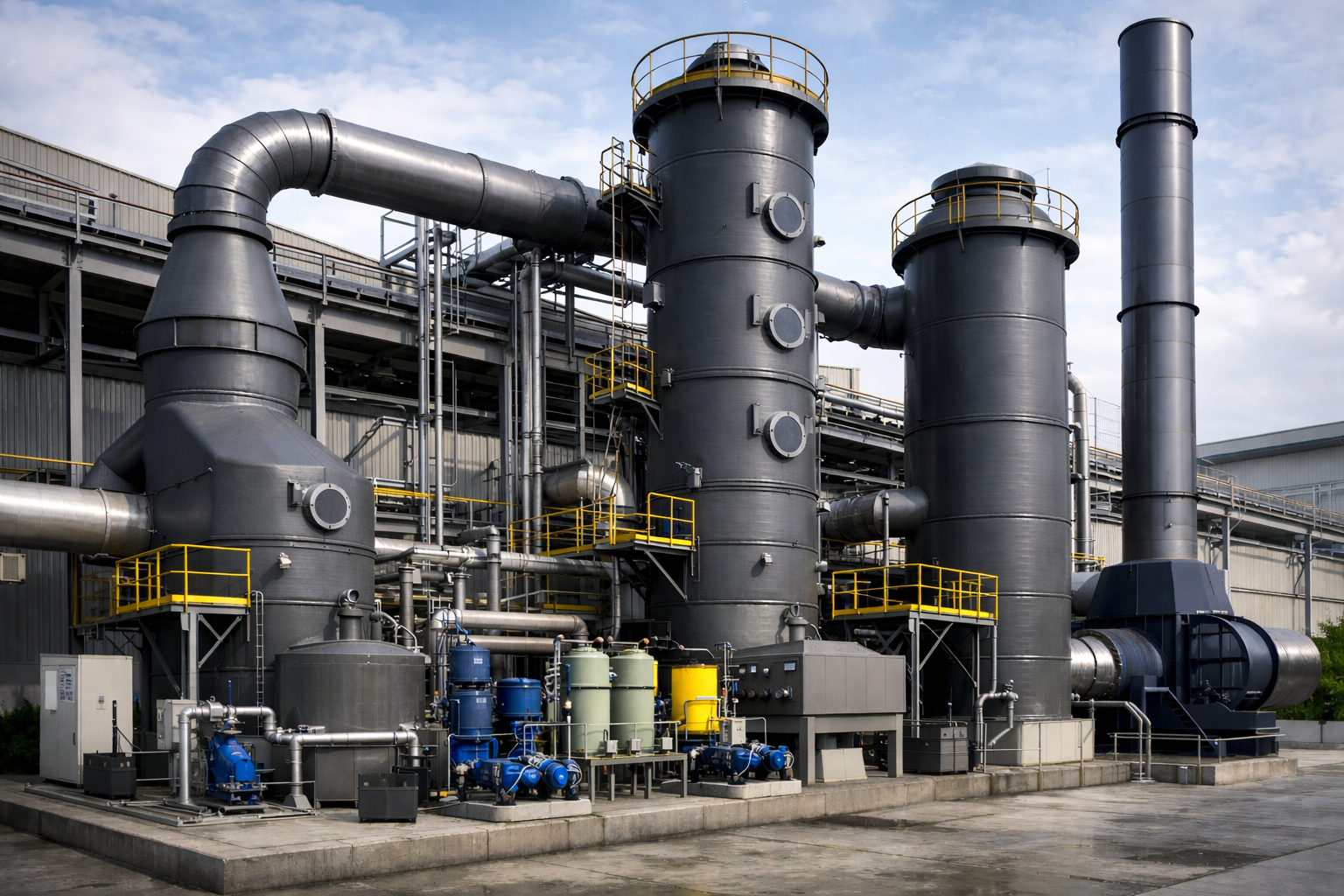
In the realm of industrial gas cleaning, the multi stage wet scrubbing system represents the pinnacle of particulate and gas phase removal technology. Unlike basic units that rely on a single mechanism, a multi stage scrubber system integrates sequential operations within a single vessel or connected series of vessels. This allows us to target specific pollutant characteristics, such as particle size distribution, solubility, and chemical reactivity, in a sequential manner.
Definition of a Multi-Stage Wet Scrubber
To answer the question, what is multi stage wet scrubber: it is an air pollution control device that utilizes two or more distinct scrubbing technologies to remove multiple contaminants from an industrial exhaust stream. By combining mechanisms, such as inertial impaction for particulates and absorption for gases, the multi stage scrubber meaning centers on the optimization of the liquid-to-gas ratio (L/G) and contact time for specific pollutant targets. This ensures that each stage operates at its peak efficiency rather than compromising on parameters to treat a mixed stream.
How a Multi-Stage System Differs from a Single-Stage Wet Scrubber
The distinction lies in the physics and chemistry involved. A single stage vs multi stage wet scrubber comparison often highlights the compromise made in single-stage units. A single-stage unit, such as a simple spray tower, might be adequate for large dust particles but fails miserably on sub-micron particulate or acid gas absorption.
In a multi stage scrubbing system, we segregate the processes. We might dedicate the first stage to high-velocity momentum transfer (for heavy dust) and the second stage to high-surface-area packing (for gas absorption). This prevents the “blindness” of packing media caused by dust loading and allows for precise pH control in the absorption stages that would be impossible if mixed with high-solids scrubbing water.
How Does a Multi-Stage Wet Scrubber Work?
The multi stage wet scrubber working principle relies on a sequence of mass transfer operations. When we design a system at Enviguard, we calculate the pressure drop and residence time required for each stage. The gas flows through the system in a defined path: first quenching, then particulate removal, followed by chemical absorption, and finally mist elimination.
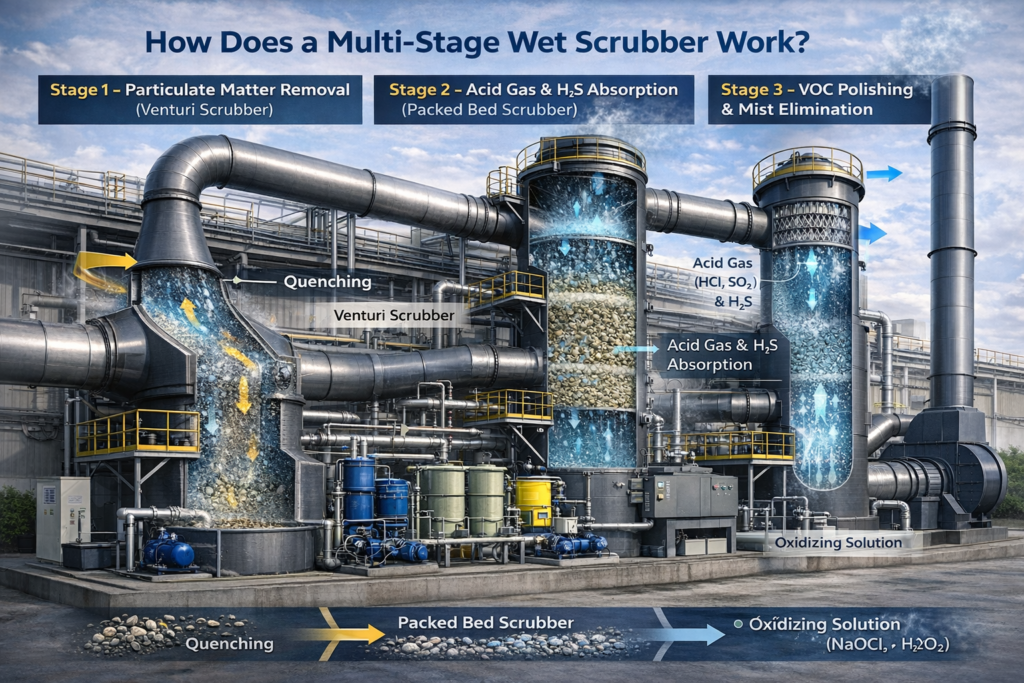
Stage 1 – Particulate Matter Removal (Venturi / Spray Scrubber)
The first line of defense is typically a high-energy device. As a wet scrubber for particulate matter removal, we often utilize a Venturi scrubber. The gas is accelerated to a high velocity in the Venturi throat, where it collides with a scrubbing liquid injected at a perpendicular angle. This creates a turbulent zone where the multi stage wet scrubber working principle of inertial impaction dominates. Heavy particles cannot follow the gas streamlines and are driven into the liquid droplets.
For less aggressive dust loads, we may use a high-pressure spray tower. Regardless of the specific device, this PM control wet scrubber stage is critical to prevent fouling of downstream sensitive components.
Stage 2 – Acid Gas & H₂S Absorption (Packed Bed Scrubber)
Once the particulates are removed, the gas, now saturated and cooler, enters the chemical absorption stage. This is a highly effective wet scrubber for H2S removal and acid gas neutralization (e.g., HCl, SO2, HF). Here, we use a packed bed wet scrubber filled with high-surface-area media (like Pall rings or structured packing).
The gas flows upward while a recirculated scrubbing slurry, often containing a caustic solution (NaOH) or slaked lime (Ca(OH)₂), flows downward over the packing. The acid gas wet scrubber function relies on maximizing the interfacial area between the gas and liquid. The large surface area of the packing ensures long contact times, allowing for the diffusion of pollutant molecules into the liquid phase where they are chemically neutralized.
Stage 3 – VOC Polishing & Mist Elimination
The final stage addresses entrainment and volatile organic compounds (VOCs). An efficient VOC wet scrubber system may utilize an oxidizing chemistry in this stage, such as sodium hypochlorite or hydrogen peroxide, to chemically destroy remaining organic contaminants. However, the mechanical priority here is the mist eliminator scrubber function.
After passing through the packing, the gas carries fine droplets of scrubbing liquid. These droplets contain the captured pollutants. If released, they constitute a visible plume and secondary pollution. We employ chevron-style or mesh-pad mist eliminators to capture these droplets via inertial impaction. This step is vital for the performance of any multi pollutant wet scrubber, ensuring only clean, dry vapor exits the stack.
Why Industries Use Multi-Stage Wet Scrubbing Systems
The adoption of multi stage scrubber for industrial emissions is driven by necessity. As environmental regulations tighten (e.g., EPA NESHAP or EU Industrial Emissions Directive), the allowable limits for particulate matter, heavy metals, and acid gases are often below single-digit milligrams per normal cubic meter (mg/Nm³).
Simultaneous Removal of PM, H₂S, and VOCs
Industries rarely generate a single pollutant. A combined PM and gas scrubber is essential for operations like rendering, wastewater treatment, or chemical processing where exhaust streams contain a complex cocktail of solids, hydrogen sulfide, and organic odors. A multi pollutant wet scrubber system is engineered to treat this complexity in one continuous flow, eliminating the need for multiple separate devices.
High Efficiency for Complex and High-Load Emissions
Standard scrubbers plug up or fail when subjected to “high dust and corrosive gas” loads simultaneously. A high efficiency wet scrubber system designed by Enviguard stages the removal process. We handle the bulk solids first, protecting the delicate packing media required for fine acid gas removal. This results in a scrubber for high dust and corrosive gas that maintains uptime and efficiency where others would clog or corrode.
Compliance with Industrial Emission Standards
Achieving compliance is non-negotiable. A robust industrial emission control system ensures that facilities avoid costly fines and shutdowns. The precise chemistry control and high removal efficiencies (often >99% for target pollutants) make these systems the gold standard for air pollution control equipment.
Key Components of a Multi-Stage Wet Scrubber System
Understanding the hardware is essential for proper maintenance and operation. The multi stage scrubber design integrates several critical subsystems.
Gas Collection and Quench Section
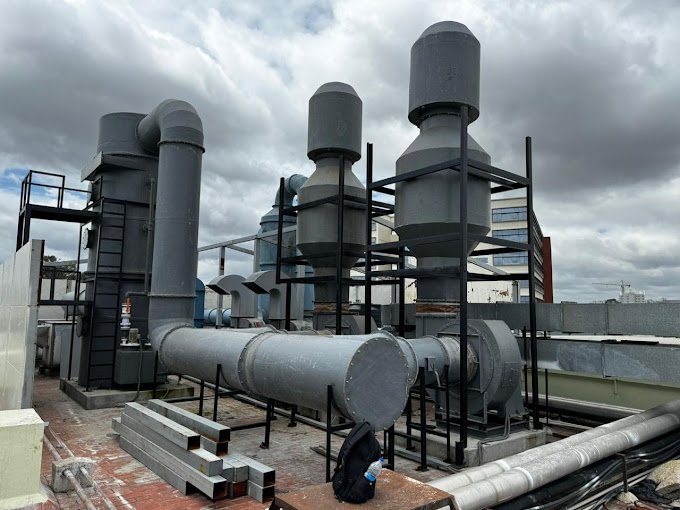
Before any scrubbing can occur, the gas must be conditioned. The scrubber for hot flue gas typically begins with a quench section. If the gas enters from a furnace or thermal oxidizer at temperatures exceeding 600°F, we must evaporative cool it to adiabatic saturation temperature (usually around 180°F) to protect the FRP (Fiber Reinforced Plastic) or alloy internals of the furnace exhaust scrubber. This rapid cooling also causes some condensation of heavy metals and organic vapors, aiding their removal.
Scrubbing Stages (Venturi, Packed Bed, Tray Scrubber)
The heart of the system involves the selected contactors.
- Venturi Scrubber with Packed Bed: This combination is classic. The Venturi acts as the roughing filter for solids, while the packed bed acts as the polishing filter for gases.
- Tray Type Wet Scrubber: In some applications where solids loading is moderate, we use tray towers where gas passes through perforated plates and bubbles through a liquid pool. This offers specific advantages for handling variable gas flows.
Recirculation System, Chemical Dosing & Mist Eliminator
The lifeblood of the wet scrubber circulation system is the recirculation pumps. We design separate loops for each stage to maintain optimal chemistry (e.g., a pH loop for the acid gas stage and a solids-handling loop for the particulate stage). Automated chemical dosing systems maintain the setpoints. Finally, the mist eliminator wet scrubber section ensures the physical separation of the cleaned gas and the dirty liquid.
Industrial Applications of Multi-Stage Wet Scrubbers
The versatility of the multi stage scrubber applications allows them to be deployed across diverse sectors.
Glass Manufacturing and Furnace Emission Control
Glass melting furnaces produce high particulate loads (condensable sulfates and raw materials) combined with acid gases like SOx and HF. A specialized wet scrubber for glass industry must handle these high temperatures and complex chemistries. The glass furnace wet scrubber typically utilizes a hot gas quench followed by a Venturi and high-efficiency packed bed to meet stringent opacity and emission limits. (Learn more about our solutions for the [Glass Industry Solutions Page]).
Chemical, Pharmaceutical, and Process Industries
In the wet scrubber for chemical plant sector, processes often release toxic fumes, solvent vapors, and acid mists. A pharmaceutical wet scrubber system must be exceptionally reliable to handle batch releases that may occur sporadically. These systems often include redundant recirculation pumps and aggressive oxidant dosing to handle varying concentrations of VOCs and toxic gases. (Explore our specific [H₂S/VOC Scrubber Page]).
High-Dust and High-Odour Industrial Processes
Industries such as food rendering, wastewater treatment, and animal fat processing face significant challenges with odour and dust. An industrial dust wet scrubber combined with chemical oxidation creates an effective odour control wet scrubber. The dust stage prevents the odour control stage from clogging with organic particulate matter.
When Should an Industry Choose a Multi-Stage Wet Scrubbing System?
The decision matrix for selecting wet scrubber system options depends on the exhaust stream analysis.
High Particulate + Gas Load Conditions
If your stack testing reveals high concentrations of both PM10/PM2.5 and soluble acid gases, a single stage will likely fail. A multi stage scrubber for PM and gas is required to separate the removal mechanisms. Attempting to absorb gases in a system clogged with dust results in poor mass transfer, and attempting to catch dust in a packed bed results in immediate blinding.
Corrosive, Sticky, or High-Temperature Exhaust Streams
Streams that are corrosive (acidic), sticky (tars), or hot require specialized handling. A scrubber for corrosive gas requires corrosion-resistant materials (FRP, PVDF, Hastelloy). If the stream is hot, a wet scrubber for hot flue gas with a dedicated quench is mandatory. High-dust, sticky streams often require a pre-scrubbing stage using high-pressure sprays to knock down the sticky material before it reaches pump suction lines or packing media.
Benefits of a Multi-Stage Wet Scrubber Over Conventional Systems
The benefits of multi stage wet scrubber technology translate directly to the bottom line.
Higher Collection Efficiency Across Pollutant Types
The primary benefit is a high efficiency wet scrubber system capable of tackling “everything.” By optimizing each stage for a specific removal mechanism, we achieve >99% efficiency on particulates and >99.9% efficiency on acid gases simultaneously.
Design Flexibility and Scalability
A custom wet scrubber system offers immense flexibility. We can scale the diameter of the vessel for flow and the height for efficiency. The industrial scrubber design can be modularized, allowing for future expansion or retrofits to existing ductwork.
Long-Term Compliance and Operational Reliability
A well-designed emission control scrubber minimizes maintenance downtime. By preventing dust from entering the pump seals and packing of the gas absorption stage, we extend the life of the industrial air pollution control system. This reliability ensures that your plant stays compliant 24/7/365.
Conclusion – Why Multi-Stage Wet Scrubbing Systems are Critical for Modern Industries
In my experience at Enviguard, the multi stage wet scrubbing system for industrial emissions is not just a piece of equipment; it is an operational necessity for any facility facing complex air pollution challenges. As regulations evolve and the drive for cleaner air intensifies, the ability of these systems to provide robust, high-efficiency control over diverse pollutant streams makes them the preferred choice for engineers worldwide.
If you are struggling with mixed pollutants, high dust loads, or strict compliance targets, you need a solution engineered for the extremes. A high-performance air pollution control scrubber is an investment in your operational future.
Are you ready to optimize your plant’s air quality control? Talk to our scrubber design experts today or Explore our multi-stage wet scrubber solutions to find the perfect fit for your facility.
Frequently Asked Questions (FAQ)
How does a multi-stage wet scrubber work?
A multi-stage wet scrubber works by passing the contaminated gas through a series of distinct treatment sections within a single system. Typically, the first stage uses high-velocity impaction (like a Venturi) to remove heavy particulates. The gas then moves to a second stage, often a packed bed, where it chemically reacts with a liquid scrubbing solution to absorb acid gases or soluble fumes. Finally, a mist eliminator removes any liquid droplets before the clean air is exhausted.
What pollutants can a multi-stage wet scrubber remove?
A multi-stage wet scrubber is highly versatile and capable of removing a wide range of pollutants simultaneously. This includes Particulate Matter (PM10 and PM2.5), acid gases (such as Hydrochloric Acid, Sulfur Dioxide, Hydrogen Fluoride), odorous compounds like Hydrogen Sulfide (H₂S) and Ammonia (NH₃), and Volatile Organic Compounds (VOCs) when combined with appropriate oxidizing chemistry.
When should industries use a multi-stage wet scrubber?
Industries should use a multi-stage wet scrubber when their exhaust stream contains a complex mixture of contaminants, such as both high dust loads and corrosive acid gases. They are also essential when treating sticky particulates that could clog a simple scrubber, or when emission limits require extremely high removal efficiencies (>99%) that single-stage technologies cannot achieve.