Skip to content
As an engineer with over a decade of experience in designing industrial air pollution control systems at Envigaurd, I have witnessed the evolving landscape of environmental compliance in India. From the bustling chemical corridors of Gujarat to the expansive cement plants in the south, the mandate is clear: industries must clean up their act. However, knowing how to clean air pollution effectively is a challenge that requires more than just purchasing equipment; it requires engineered solutions.
In this comprehensive guide, I will explain the mechanics, applications, and engineering realities of using a wet scrubber for air pollution control, drawing from real-world industrial scenarios.
What Is Air Pollution and Why Control Is Critical
Industrial sources of air pollution
Air pollution in an industrial context is rarely just “dust.” It is a complex cocktail of particulate matter (PM10, PM2.5), toxic gases (SOx, NOx, HCl, HF), volatile organic compounds (VOCs), and metal fumes. In my experience, sources vary from the obvious, cement kilns and crushers, to the less visible but equally hazardous, solvent fumes from pharma reactors and acid mists from electroplating tanks.
Health, environmental, and regulatory impact
The impact of uncontrolled emissions is twofold. First, there is the immediate health risk to workers and local communities, ranging from respiratory issues to chronic occupational diseases. Second, the environmental damage contributes to air quality degradation, leading to strict scrutiny from pollution control boards.
Need for engineered air pollution control devices
Regulatory bodies like the CPCB and MoEF&CC in India have tightened emission norms significantly. Relying on basic ventilation is no longer sufficient. Industries need engineered air pollution control devices that guarantee specific removal efficiencies to ensure operational continuity and legal compliance.
What Is a Scrubber in Air Pollution Control?
Definition of a scrubber unit
To put it simply: What is a scrubber in air pollution? A scrubber is a device that uses a liquid (usually a water-based chemical solution) to wash pollutants out of an industrial exhaust gas stream.
Explanation: A scrubber unit is a device that removes pollutants from the exhaust gas stream
Think of a scrubber as a shower for your exhaust gas. As the dirty gas passes through the unit, it is intimately mixed with a scrubbing fluid. The pollutants, whether they are solid particles or acidic gases, are transferred from the gas phase into the liquid phase. The clean gas is released to the atmosphere, and the pollutants are trapped in the liquid, which is then treated or disposed of safely.
Role of scrubbers in industrial emission control
Scrubbers play a pivotal role because they are versatile. Unlike a bag filter which only captures dust, a scrubber can handle gases, mists, and dust simultaneously. This makes them indispensable in chemical processing, metal finishing, and waste treatment industries where the exhaust stream is complex.
Wet Scrubber for Air Pollution Control – Overview
Why wet scrubbers are widely used
Among the various technologies available, the wet scrubber for air pollution control is the most widely adopted across diverse sectors. The primary reason is its ability to handle high-temperature and high-humidity gas streams, which would destroy filter media in dry systems.
Types of pollutants controlled using wet scrubbers
Wet scrubbers are highly effective against:
- Acid Gases: HCl, HF, SO2, Cl2.
- Particulate Matter: Both coarse dust and fine fumes.
- Odors: Ammonia, H2S, and organic odors.
- Metal Fumes: Zinc, lead, and aluminum oxide fumes.
Difference between air scrubbers and air filters
It is crucial to distinguish between the two. Air filters (like bag filters or HEPA filters) capture solid particles on a fabric surface. They struggle with moisture and sticky particles. Air scrubbers, however, use a liquid medium to dissolve gases or trap particles in droplets. They are the preferred solution when the gas stream is wet, corrosive, or contains both dust and acid gases.
How Wet Scrubber Works in Air Pollution Control
Gas–liquid contact principle
The fundamental wet scrubber working principle relies on maximizing the contact area between the contaminated gas and the scrubbing liquid. We achieve this by forcing the gas through a zone where the liquid is atomized into fine droplets. The more surface area of liquid available, the higher the probability of a pollutant colliding with and being captured by a droplet.
Absorption of gaseous pollutants
For gases like HCl or SO2, the mechanism is absorption. The gas molecules dissolve into the liquid droplet. To make this irreversible, we often use a chemical reagent (like Caustic Soda). This reaction turns the harmful gas into a harmless salt (e.g., HCl + NaOH → NaCl + H2O).
Capture of particulate matter
For dust and fumes, the mechanism is primarily impaction. As the gas, carrying particles, moves around the liquid droplets, the heavy particles cannot follow the streamline due to inertia. They crash into the droplets and get trapped.
Role of scrubbing liquid chemistry
At Envigaurd, we emphasize that the liquid chemistry is as important as the mechanical design. The pH, oxidation-reduction potential (ORP), and specific gravity of the scrubbing liquid are constantly monitored. If the chemistry isn’t right, the scrubber becomes just a water tower, and pollutants pass straight through.
Wet Scrubber as an Air Pollution Control Device
Key system components
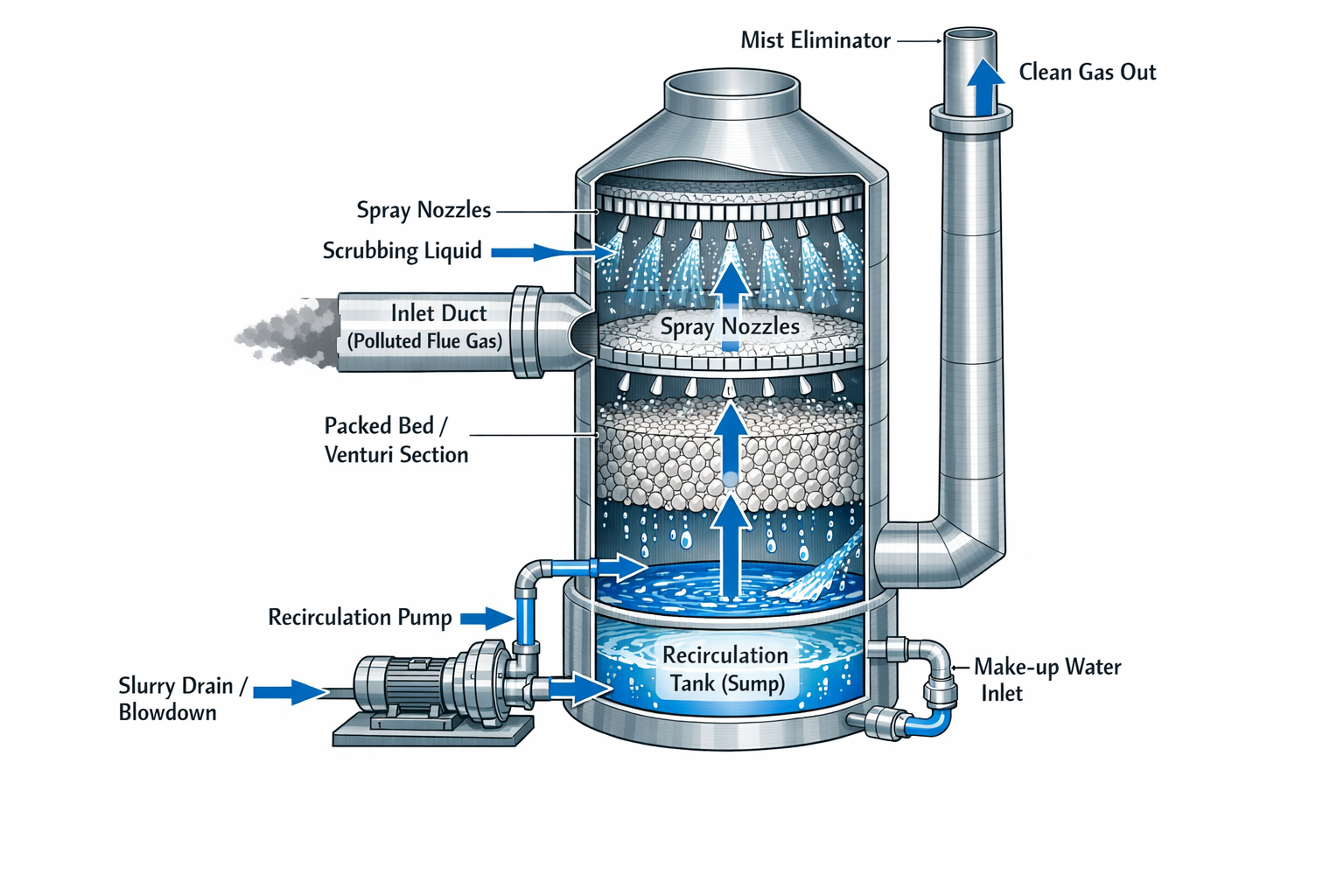
A robust wet scrubber air pollution control device consists of:
- Vessel/Body: Constructed from FRP, PP, or SS to withstand corrosion.
- Packing/Media: To increase surface area (in packed beds).
- Spray Nozzles: To atomize the liquid.
- Mist Eliminator: To prevent water droplets from leaving the stack.
- Recirculation System: Pumps and tanks to move the scrubbing liquid.
Integration with industrial exhaust systems
Integration is critical. We design the scrubber to handle the specific static pressure of the ducting network. An undersized fan or improperly sized duct can lead to “channeling,” where dirty gas bypasses the scrubbing liquid, rendering the device useless.
Continuous operation in heavy industries
Heavy industries like cement and steel rarely shut down. Therefore, we design and manufacture wet scrubbers for continuous duty cycles. This involves selecting heavy-duty bearings for pumps, using corrosion-resistant alloys for fans, and designing automation that allows the system to run 24/7 with minimal intervention.
Types of Scrubbers in Air Pollution Control
When discussing types of scrubbers in air pollution, we generally categorize them based on the phase of the scrubbing medium and the internal mechanism.
Wet Scrubbers
Wet scrubbers are classified into several distinct types, each suited for specific applications:
- Venturi Scrubbers: These use a constriction (throat) to accelerate gas to high velocities. They are highly effective for removing fine, sticky particulate matter. We use these extensively in mining and mineral processing.
- Packed Bed Scrubbers: Filled with packing media (plastic saddles or rings). These provide a large surface area for gas-liquid contact. They are the industry standard for acid gas removal in chemical and pharma industries.
- Spray Tower Scrubbers: Open vessels with spray headers. Used for gas quenching, cooling, and removing large particulates. They have a low pressure drop, making them energy-efficient.
- Plate / Tray Scrubbers: These use perforated plates to create bubbles of gas rising through a liquid layer. They are used when high efficiency is needed in a compact vertical height.
Dry Scrubber for Air Pollution Control
Working principle
A dry scrubber for air pollution control utilizes a dry sorbent, typically hydrated lime or activated carbon, injected into the gas stream. The pollutant reacts with the dry powder to form a solid compound, which is then collected in a bag filter or cyclone.
When dry scrubbers are preferred
Dry scrubbers are preferred when water usage is a constraint, or when the resulting product must be dry (e.g., in flue gas desulfurization where a dry byproduct is easier to handle than a wet sludge).
Comparison with wet scrubbers
While effective for acid gases, dry scrubbers generally cannot handle the cooling and quenching of hot gases as effectively as wet scrubbers. They also struggle with highly soluble gases or very high acid concentrations compared to a packed bed wet scrubber.
How Do Scrubbers Reduce Air Pollution?
Removal mechanisms for gases and particulates
Scrubbers reduce pollution by physically separating the contaminants from the air stream. By transferring pollutants into a liquid phase, we turn a diffuse problem (air pollution) into a concentrated one (wastewater/sludge), which is much easier to manage.
Typical removal efficiency ranges
With proper engineering, wet scrubbers achieve:
- Particulate Removal: 90% to 99.9% (for particles > 1 micron).
- Acid Gas Removal: 95% to 99.5% for soluble gases like HCl and HF.
Impact on stack emission quality
Post-installation, we consistently observe a drastic improvement in stack opacity and gas analysis. Visible plumes of smoke or fumes are replaced by a clean, transparent exhaust (or a harmless water vapor plume), ensuring the plant meets ambient air quality standards.
Applications – Where Wet Scrubber Is Used For Air Pollution Control
At Envigaurd, our diverse project portfolio demonstrates the versatility of these systems. Here is where a wet scrubber is used for specific industrial needs:
- Chemical and Petrochemical Industries: For scrubbing acid fumes (HCl, Cl2) from reactors, storage tanks, and process vents.
- Pharmaceutical Manufacturing: Critical for handling solvent vapors and acidic fumes during API synthesis, ensuring operator safety and containment.
- Cement Plants and Mining Operations: Controlling the massive dust loads from crushers, mills, and packing plants using high-energy Venturi scrubbers.
- Fertilizer and Ammonia-Based Processes: Removing ammonia slip and acid vapors from prilling towers and granulation plants.
- Food Processing and Odor Control: Treating malodorous emissions from rendering plants, cooking processes, and effluent treatment plants (ETP).
- Aerospace Surface Treatment Processes: Capturing toxic hexavalent chromium mists and chemical etching fumes from anodizing lines.
Performance Evaluation of Wet Scrubber System
For engineers and plant heads, understanding the performance evaluation of wet scrubber system for industrial air pollution control is vital for troubleshooting and compliance.
Key performance parameters
- Removal Efficiency: The percentage of pollutant removed.
- Penetration: The amount of pollutant escaping.
- Pressure Drop: The resistance to gas flow (measured in mmWC or inches of water).
Pressure drop and energy consumption
There is a direct correlation between pressure drop and energy cost. A scrubber with a high pressure drop requires a more powerful fan. During evaluation, we verify that the fan is operating at the correct amperage and that the pressure drop is within design limits.
Liquid-to-gas ratio
This is the volume of scrubbing liquid used per volume of gas. Too low a ratio results in poor efficiency; too high results in wasted pumping energy.
Collection efficiency measurement
We use stack testing methods (isokinetic sampling) to measure the inlet and outlet concentrations. The data is compared against the consent-to-operate (CTO) limits set by the pollution control board.
Compliance monitoring methods
Modern systems are equipped with online Continuous Emission Monitoring Systems (CEMS) that provide real-time data on SO2, NOx, and flow parameters to the regulatory servers, ensuring transparent compliance.
Wet Scrubber vs Dry Scrubber – Air Pollution Control Comparison
| Feature | Wet Scrubber | Dry Scrubber |
|---|---|---|
| Pollutant removal capability | Excellent for both fine particulates and soluble gases. | Excellent for acid gases; less effective on particulates without a filter. |
| Operating cost | Higher water and sewage costs; pumping costs. | High sorbent cost; lower water usage. |
| Waste generation | Generates wet sludge (requires dewatering). | Generates dry powder (easier to dispose). |
| Industry suitability | Best for chemical, pharma, food, and wet processes. | Best for combustion flue gases (boilers, incinerators). |
Operation and Maintenance of Wet Scrubber Systems
Knowing how to clean air scrubber components is essential for longevity.
Routine cleaning procedures
Routine checks involve inspecting the recirculation tank for sludge buildup. If sludge levels get too high, they can block the suction line, leading to pump failure—a common issue we see in the field.
Nozzle and packing maintenance
Spray nozzles are prone to clogging, especially in hard water areas. We recommend regular removal and cleaning. In packed bed scrubbers, the packing can scale up (accumulate salts). Periodic washing or acid cleaning is required to maintain airflow.
Mist eliminator cleaning
The mist eliminator is the most common point of failure. If dust passes the spray section and hits the dry mist eliminator, it forms a hard crust. We install wash headers above mist eliminators to spray them periodically, keeping them clean.
Sludge handling and disposal
The sludge collected in the scrubber tank must be drained periodically. We design systems with hydro-cyclones or filter presses to separate the water from the solids, reducing the volume of hazardous waste for disposal.
Common operational issues and solutions
- High Pressure Drop: Clogged packing or mist eliminator. Solution: Clean internals.
- Low pH in Recirculation Tank: Inadequate chemical dosing. Solution: Check dosing pumps and reagent supply.
- Water Carryover to Fan: Damaged mist eliminator. Solution: Replace pads.
Advantages of Wet Scrubbers in Air Pollution Control
Using scrubbers to control air pollution offers several distinct engineering advantages:
- High Efficiency for Fine Particles and Gases: Capable of capturing sub-micron particles and absorbing 99% of acid gases.
- Ability to Handle Hot and Corrosive Exhaust: The liquid acts as a coolant, allowing the scrubber to handle gases at temperatures that would melt bag filters.
- Simultaneous Gas and Dust Removal: A single unit can perform the function of a dust collector and a gas absorber, saving footprint.
Limitations of Wet Scrubbers
- Wastewater Generation: They produce a wet slurry that must be treated and disposed of, adding to the plant’s wastewater load.
- Corrosion and Material Selection Challenges: The wet environment is inherently corrosive. Poor material selection leads to rapid failure.
- Maintenance Requirements: They require constant attention to pump seals, nozzles, and chemical levels.
Selecting the Right Scrubber for Air Pollution Control
Selection is not a “one size fits all” process. We evaluate:
- Nature of Pollutants: Is it dust, gas, or both? Is it sticky?
- Exhaust Flow Rate and Temperature: High temperatures require quenching; high flows require large vessel diameters.
- Regulatory Requirements: What is the required outlet emission standard?
- Space and Utility Availability: Do you have space for a vertical scrubber? Is water and electricity available?
Conclusion – Role of Wet Scrubbers in Industrial Air Pollution Control
The necessity of industrial air pollution control is undeniable. As environmental regulations become stricter and the focus on sustainability grows, the role of the wet scrubber becomes more central.
At Envigaurd, we believe that a wet scrubber is not just a compliance tool but a commitment to environmental stewardship. By selecting the right type, be it a Venturi, packed bed, or spray tower, and maintaining it rigorously, industries can ensure long-term compliance, protect worker health, and contribute to cleaner air. For heavy and process industries, a well-engineered wet scrubber system remains the most reliable, versatile, and efficient solution available today.
Frequently Asked Questions (FAQ)
How effective are wet scrubbers in reducing air pollution?
Extremely effective. When correctly designed and operated, wet scrubbers can remove over 99% of acid gases and a very high percentage of particulate matter, bringing industries well within compliance limits.
Can wet scrubbers remove both dust and gases?
Yes, certain designs like Venturi scrubbers with a packed bed section are specifically engineered to remove dust in the first stage and gases in the second.
How often should a wet scrubber be cleaned?
While the system runs continuously, maintenance cleaning (nozzle checks, tank desludging) should be performed weekly to monthly, depending on the dust load.
Are wet scrubbers suitable for heavy industries?
Yes, they are the standard for heavy industries like cement, steel, and fertilizers because they are robust, fireproof, and handle the high loads associated with these processes.
What data is required to design a scrubber system?
We need the gas flow rate (m³/hr or CFM), temperature, exact chemical composition of the pollutants, and the desired outlet emission standards.