Skip to content
| An oversized HVAC system costs 20–30% more to run and consistently fails to dehumidify properly. An undersized one never achieves comfort, it simply runs non-stop without reaching target conditions. Both failures share a single root cause: skipping or mis-executing the heat load calculation in HVAC design. |
Every professional HVAC project, whether a pharmaceutical cleanroom in Hyderabad, a commercial office tower in Mumbai, or a food-processing plant in Pune, begins with one foundational step: determining exactly how much heating or cooling the space demands. Get this right, and everything else falls into place. Get it wrong, and no amount of expensive equipment will fix the problem.
What Is Heat Load Calculation in HVAC, and Why Does It Matter?
Heat load calculation in HVAC (also called HVAC load analysis or cooling load calculation) is the systematic process of quantifying all sources of heat gain and heat loss in a building or space, so that engineers can select and size equipment that meets, but does not exceed, those demands.
In practice, this means answering two fundamental questions for any space:
- How much heat must the system remove to maintain the desired indoor temperature and humidity during peak summer or process conditions? (Cooling load)
- How much heat must the system add during design winter conditions? (Heating load)
The answer, expressed in kilowatts (kW), British Thermal Units per hour (BTUh or Btuh), or Refrigeration Tonnes (RT), becomes the single most important number in any HVAC project. Every downstream decision, AHU capacity, chiller sizing, duct cross-sections, pump flow rates, traces directly back to this figure.
| Key formula context: 1 Tonne of Refrigeration (TR) = 12,000 BTU/hr = 3.517 kW. In India, RT is the dominant unit for commercial and industrial HVAC specification. |
Types of Heat Loads: A Complete Breakdown
A professional HVAC load analysis separates heat gains into categories. Understanding each one is essential to an accurate total.
Sensible Heat vs. Latent Heat
Every heat gain is either sensible or latent, and both must be calculated separately because they require different HVAC responses.
| Heat Type | What It Is | HVAC Response Required | Indian Context |
| Sensible Heat | Heat that changes air temperature (dry) | Cooling coil, reduces dry-bulb temperature | High sensible loads in May–June in northern India; up to 48°C outdoor dry-bulb in Delhi/Rajasthan |
| Latent Heat | Heat associated with moisture (humidity) | Dehumidification, removes moisture from air | Critical during monsoon season (June–September) across coastal and central India; RH can exceed 90% |
The ratio of sensible to total heat is called the Sensible Heat Ratio (SHR). In high-humidity Indian cities like Mumbai, Chennai, or Kolkata, a lower SHR means the system must do significant dehumidification work, a factor often missed in simple square-footage-based estimates.
External (Envelope) Heat Loads
These arise from heat transfer through the building’s skin, walls, roof, windows, and doors. Key factors include:
- Transmission load: Q = U × A × CLTD (Cooling Load Temperature Difference), as per ASHRAE methodology. U is the thermal transmittance of the building element; A is the surface area; CLTD accounts for time-lag effects in walls and roofs.
- Solar radiation: Sun-facing glass and walls can contribute disproportionately in tropical India. East-facing glass in the morning and west-facing glass in the afternoon are common hotspots in Indian commercial buildings.
- Infiltration: Uncontrolled air leakage through gaps, especially critical in older industrial buildings and cold-chain facilities.
Internal Heat Loads
Internal loads are often the dominant factor in commercial and industrial settings:
- Occupancy: Human body heat varies with activity. A sedentary office worker generates approximately 75W sensible + 55W latent heat. A factory worker performing heavy work generates 185W sensible + 315W latent. Accurate occupant schedules are therefore critical.
- Lighting: LED lighting generates less heat than older fluorescent systems, but in large commercial spaces the lighting load (typically 8–15 W/m²) remains significant.
- Equipment and process loads: Computers, servers, motors, reactors, autoclaves, all contribute heat. In pharmaceutical manufacturing, process equipment can be the single largest heat source, sometimes exceeding the envelope load entirely.
Process and Industrial Loads (Often Overlooked)
For Enviguard’s core sectors, pharma, chemical, food processing, and data centres, process loads are the most variable and often the most underestimated component. This includes:
- Heat from production equipment operating at rated load
- Heat from motors and drives (typically 10–15% of input power is dissipated as heat)
- Ventilation-driven loads: 100% outside air systems in GMP cleanrooms carry enormous fresh-air heat loads, especially at Indian summer design conditions
- Reheat loads for humidity control in monsoon conditions, a uniquely important factor in Indian pharma HVAC that many generic calculators ignore
Key Inputs Required for an Accurate HVAC System Load Calculation
A rigorous HVAC system load calculation depends on complete, site-specific data. Approximate or default inputs produce approximate, and often dangerous, results. The critical inputs are:
| Input Category | Key Parameters | Why It Matters |
| Building Envelope | Wall/roof/floor U-values, glazing type, window-to-wall ratio, orientation, shading devices | Determines conduction and solar gains |
| Location & Climate | Outdoor design dry-bulb and wet-bulb temperatures, solar radiation data (ISHRAE/ASHRAE) | Sets the external conditions the system must overcome |
| Occupancy Schedule | Number of occupants, activity level, hours of operation | Determines latent and sensible occupant loads |
| Lighting & Equipment | Installed wattage, diversity factors, operating schedules | Internal heat gain calculation |
| Ventilation Requirements | Fresh air CFM per ASHRAE 62.1 / NBC / GMP standards | Drives outside air load calculation |
| Process Loads | Equipment heat dissipation, operating cycles, diversity factors | Often the largest load in industrial projects |
| Indoor Design Conditions | Target dry-bulb temp, relative humidity, pressure differential | Defines the comfort or compliance target |
For Indian projects, the outdoor design conditions must be sourced from ISHRAE climatic data or ASHRAE’s Climatic Design Information (Chapter 14 of ASHRAE Fundamentals Handbook). Generic assumptions based on neighbouring states or cities can introduce significant errors, the conditions in coastal Chennai differ dramatically from those in Ahmedabad or Shimla.
Methods of Heat Load Calculation: Manual J, ASHRAE CLTD, and Software
Manual J (Residential & Small Commercial)
Manual J, developed by the Air Conditioning Contractors of America (ACCA), is the gold standard for residential heat load calculation. It performs a room-by-room analysis, accounting for construction materials, infiltration, internal gains, and local climate data. While widely mandated in the US, ISHRAE-aligned versions of this methodology are applied in Indian residential and small commercial projects.
ASHRAE Cooling Load Temperature Difference (CLTD) Method
For commercial and industrial projects, the ASHRAE CLTD/CLF (Cooling Load Factor) method is the professional standard in India. Key equations:
| Conduction through walls/roofs: Q = U × A × CLTD Solar gain through glass: Q = A × SC × SCL (where SC = shading coefficient, SCL = Solar Cooling Load factor) Internal sensible load: Q_sensible = 1.08 × CFM × ΔT (in imperial units) Total heat: Q_total = 4.5 × CFM × Δh (where Δh = enthalpy difference in BTU/lb) |
Software-Based Methods (HAP, eQUEST, IES-VE, Carrier E-20)
Modern HVAC engineering relies on simulation software for complex projects. These tools apply the ASHRAE Heat Balance Method or Radiant Time Series (RTS) method and are capable of modelling hour-by-hour performance across an annual weather file.
| Software | Best For | Standard Compliance | Used in India |
| Carrier HAP (Hourly Analysis Program) | Commercial buildings, hospitals, hotels | ASHRAE 183 | Widely used by HVAC consultants |
| eQUEST | Energy simulation, LEED compliance | DOE-2 engine | IGBC/LEED projects |
| IES-VE | Complex facades, healthcare, pharma | ASHRAE 140 | High-end commercial/pharma |
| Carrier E-20 / Excel-based | Pharma cleanrooms, industrial | ISHRAE/ASHRAE | Dominant in Indian pharma HVAC |
For pharma cleanrooms specifically, generic software often falls short. Critical factors like 100% outside-air AHUs, reheat coils for monsoon dehumidification, pressure cascade design, and ACH-driven airflow (which may dominate over heat-load-driven airflow) require customised calculation sheets or specialist software.
Heat Load Calculation in the Indian Context: Why Standard Approaches Fall Short
India presents HVAC engineers with one of the most challenging climatic envelopes in the world. A single project in India may need to handle:
- Summer peak cooling: Outdoor dry-bulb temperatures of 42–48°C in Delhi, Nagpur, and Ahmedabad with high solar radiation
- Monsoon latent loads: Near-saturated outdoor air (90%+ RH) in Mumbai, Chennai, Kochi, and Kolkata, driving heavy dehumidification demand
- Winter heating: Sub-zero design conditions in Chandigarh, Dehradun, and northern Indian pharmaceutical facilities
- Year-round humidity control: Pharma and food facilities must maintain 40–60% RH regardless of season, requiring both cooling-based dehumidification and monsoon reheat
The National Building Code of India (NBC) 2016 and the Bureau of Energy Efficiency’s Energy Conservation Building Code (ECBC) provide envelope performance requirements that directly feed into heat load calculations. Compliance with ECBC is now mandatory for commercial buildings above 500 m² in most Indian states, and the load calculation is the primary tool for demonstrating compliance.
| India-specific note: ISHRAE provides climatic data for over 60 Indian cities, including design dry-bulb temperatures, wet-bulb temperatures, and solar radiation values for both summer and monsoon conditions. Enviguard uses ISHRAE data as the primary reference for all India-based projects. |
What Happens When Heat Load Calculation Goes Wrong
The consequences of incorrect load estimation are severe, long-lasting, and often expensive to correct after installation.
Oversized HVAC Systems
- Short-cycling: The system reaches the thermostat setpoint quickly, shuts down, then restarts. Each start consumes peak power and creates mechanical wear.
- Poor dehumidification: The cooling coil never runs long enough to condense sufficient moisture. This is why many oversized systems in humid Indian cities feel ‘cold but sticky.’
- Energy penalty: Studies show oversized systems operate at 20–30% higher energy cost compared to right-sized equivalents.
- Cleanroom and GMP failures: In pharmaceutical facilities, an oversized AHU can destabilise pressure differentials and temperature uniformity, triggering regulatory non-compliance.
Undersized HVAC Systems
- Continuous operation at 100% load with no thermal buffer, accelerating equipment degradation
- Inability to maintain setpoints during peak conditions, critical failure in temperature-sensitive storage, manufacturing, or laboratory environments
- In pharma: Product loss, batch rejection, or regulatory action if temperature excursions occur during manufacturing or storage
Real-World Consequences in India
An FMCG cold-chain facility in Pune that was sized using a simple thumb-rule (square footage × cooling factor) experienced consistent temperature excursion alarms during the May–June period. Re-analysis revealed the original calculation had ignored solar gain on the west-facing metal roof, a commonly underestimated load source in Indian industrial buildings. The corrective addition of supplemental cooling capacity cost four times more than a proper load study at the design stage would have.
What Enviguard Includes in a Professional Heat Load Study
Enviguard’s certified HVAC engineering team delivers comprehensive heat load analysis as the first and most critical phase of any HVAC project. Our methodology is aligned with ASHRAE, ISHRAE, and, for pharmaceutical projects, CPCB/GMP standards.
A standard Enviguard heat load study includes:
- Site survey and data collection: Physical measurement of all building elements, orientation mapping, and thermal survey for existing structures
- Envelope analysis: U-value calculation for all walls, roofs, floors, and glazing using NBC/ECBC and ASHRAE Fundamentals data
- Outdoor design condition sourcing: ISHRAE-verified climatic data for the project city, covering summer, monsoon, and winter design scenarios
- Internal load survey: Occupancy schedules, lighting layouts, and full equipment heat dissipation inventory
- Process load quantification: For pharma, chemical, and industrial clients, detailed equipment heat load sheets with diversity factors
- CFM/airflow calculation: Room-by-room airflow demand based on both thermal loads and ventilation requirements (ASHRAE 62.1, GMP, or NBC)
- Psychrometric analysis: Full psychrometric chart for each supply air condition, including dehumidification, reheat (monsoon), and humidification (winter) scenarios
- Equipment selection brief: Recommended TR, kW, and airflow for all major plant items with efficiency parameters
- Energy estimation: Indicative annual energy consumption for client budgeting and ECBC compliance
| For pharmaceutical and GMP projects, Enviguard provides documentation-ready heat load calculation sheets that support DQ (Design Qualification) and system validation requirements. |
The CFM Formula in HVAC: Connecting Airflow to Load
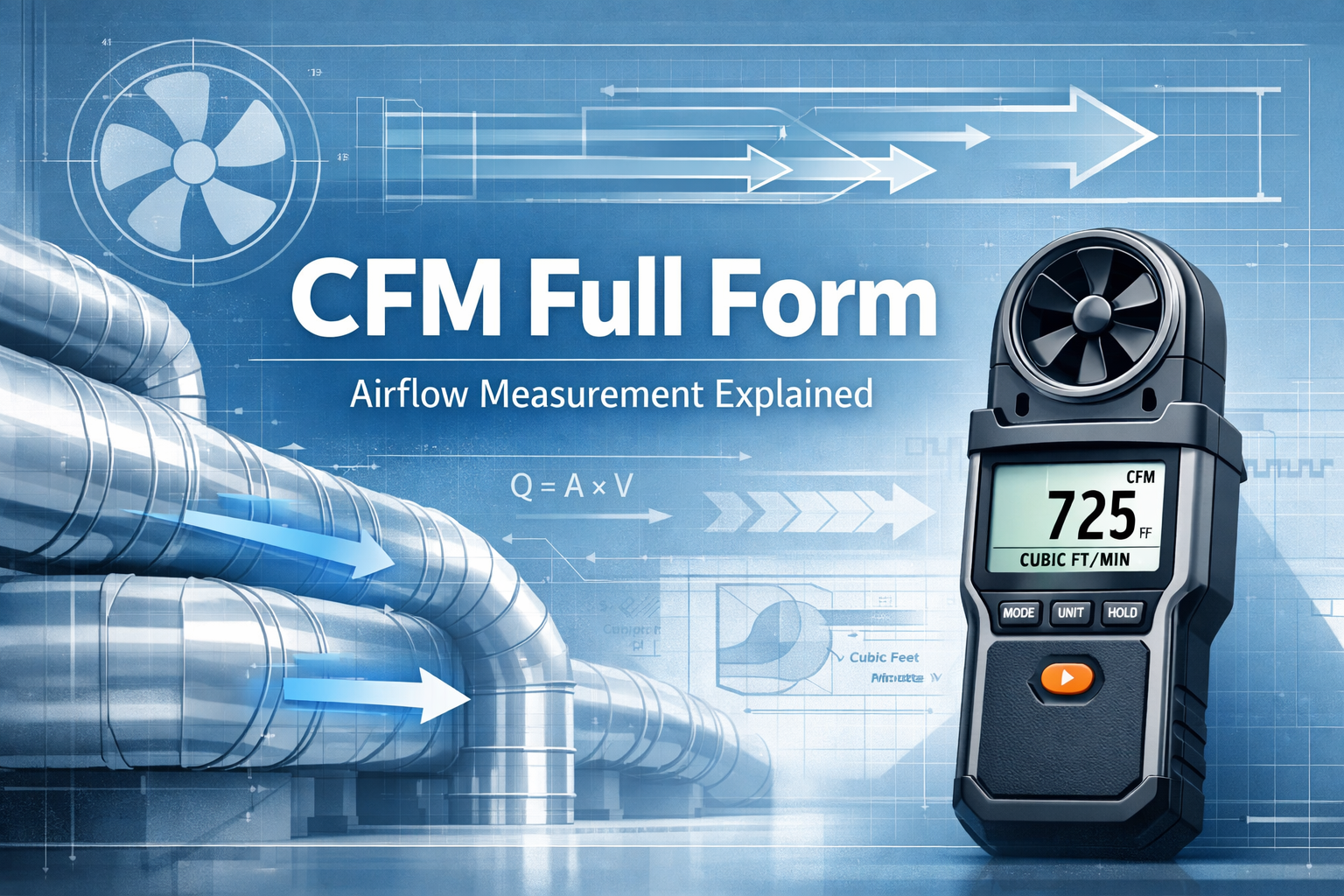
CFM (Cubic Feet per Minute) is the standard unit for measuring airflow in HVAC systems. Once the heat load is established, the CFM calculation formula in HVAC connects that load to the volume of air the system must deliver.
The primary CFM formula in HVAC for sensible cooling:
| CFM = Q_sensible (BTU/hr) ÷ (1.08 × ΔT) Where: Q_sensible = total sensible heat load in BTU/hr | ΔT = temperature difference between return air and supply air (°F) | 1.08 = constant derived from air density and specific heat at standard conditions |
As a general industry benchmark, HVAC systems are designed to deliver approximately 400 CFM per tonne of cooling for comfort applications. However, in the Indian context, this default requires adjustment:
| Application / Climate | CFM per TR | Reason for Adjustment |
| Comfort cooling, offices, retail (moderate climate) | 400 CFM/TR | Standard sensible heat ratio |
| High-humidity cities (Mumbai, Chennai, Kochi), monsoon | 350–380 CFM/TR | Lower CFM increases coil contact time for better dehumidification |
| Pharma cleanrooms (100% OA systems) | Per ACH requirement* | Air change rate (ACH) for contamination control governs, not heat load alone |
| Data centres, dry industrial spaces | 450 CFM/TR | High sensible load, minimal latent component |
*In pharma cleanrooms, the higher of the CFM required for contamination control (air changes per hour, or ACH) and the CFM required for heat removal governs AHU sizing. The heat load calculation is still performed, it determines which of the two criteria controls.
Frequently Asked Questions
How is HVAC heat load calculated?
HVAC heat load calculation involves summing all sources of heat gain (for cooling) or heat loss (for heating) in a space. The total load = envelope gains (through walls, roof, glass) + internal gains (occupants, lighting, equipment) + ventilation/fresh air load + process loads (if industrial). Professional calculations use ASHRAE’s CLTD method or Manual J, with software tools like HAP or Carrier E-20 for complex projects. The result is expressed in kW, BTU/hr, or Refrigeration Tonnes (RT). For Indian projects, ISHRAE climatic data must be used for accurate outdoor design conditions.
What is CFM in HVAC, and how is it calculated?
CFM stands for Cubic Feet per Minute, the standard unit for measuring airflow volume in HVAC systems. For cooling, the CFM formula in HVAC is: CFM = Sensible Heat Load (BTU/hr) ÷ (1.08 × ΔT), where ΔT is the difference between return and supply air temperature. As a rule of thumb, most comfort HVAC systems deliver 400 CFM per tonne of cooling. In humid Indian cities or pharmaceutical cleanrooms, this figure is adjusted based on dehumidification requirements or mandated air change rates. CFM determines the size of ducts, AHUs, and diffusers.
What is Manual J in HVAC?
Manual J is a residential heat load calculation methodology developed by the Air Conditioning Contractors of America (ACCA). It is the most detailed and widely accepted method for sizing HVAC systems in homes and small commercial buildings. Manual J performs a room-by-room analysis of heat gain and loss, accounting for insulation, window area and orientation, local climate data, occupancy, and infiltration. In India, ISHRAE-aligned adaptations of Manual J are used for residential projects, while commercial projects typically use ASHRAE’s CLTD method or simulation software.
What is the difference between sensible and latent heat load in HVAC?
Sensible heat load refers to heat that changes the dry-bulb temperature of air, it is what you feel as ‘hot.’ Latent heat load refers to heat associated with moisture in the air, it is what makes air feel humid and uncomfortable even at moderate temperatures. In HVAC design, both must be calculated separately because they require different equipment responses: sensible load is handled by cooling the air over a coil, while latent load is handled by condensing moisture on a cold coil (dehumidification). In Indian coastal cities during the monsoon season, the latent load can equal or exceed the sensible load.
Why is heat load calculation especially important for pharmaceutical facilities in India?
In GMP-regulated pharmaceutical facilities, HVAC systems must maintain precise temperature (typically 20–25°C) and humidity (40–60% RH) year-round, regardless of outdoor conditions. An incorrect heat load calculation leads to either undersized systems (which fail to maintain conditions under full production load) or oversized systems (which cause short-cycling, humidity instability, and pressure differential disruption). In India, the monsoon season adds a critical reheat requirement that generic calculators ignore. Regulatory authorities review HVAC design documentation during audits, and a poorly documented or incorrect load calculation is a red flag in DQ (Design Qualification) reviews.
How much does a professional HVAC heat load study cost in India?
The cost of a professional heat load analysis in India depends on project complexity, a small commercial space may require a few hours of engineering time, while a full pharmaceutical plant or industrial facility can involve several days of site survey, calculation, and documentation. The cost of getting it wrong, however, is invariably far higher: equipment replacement, energy penalties, production losses, or regulatory non-compliance. Enviguard provides heat load analysis as part of comprehensive HVAC engineering design services, contact us for a project-specific scope and fee.
Which Indian standard governs heat load calculation for HVAC?
There is no single Indian standard specifically governing the heat load calculation methodology. In practice, Indian HVAC engineers follow ASHRAE Fundamentals (CLTD method) and use ISHRAE’s climatic data for outdoor design conditions. The National Building Code (NBC) 2016 and the Bureau of Energy Efficiency’s Energy Conservation Building Code (ECBC) establish envelope performance requirements that directly influence load calculations. For pharmaceutical facilities, CPCB guidelines, WHO GMP, and Schedule M requirements govern indoor design conditions. ISHRAE publishes design weather data specific to Indian cities, which is the correct reference for any India-based project.
Ready to start your HVAC project the right way? Enviguard provides certified HVAC engineering design to installation services for industrial, pharmaceutical, commercial, and cleanroom applications across India, including comprehensive heat load analysis and HVAC system load calculation. Our deliverables are designed to meet ASHRAE, ISHRAE, ISO, and GMP documentation requirements. Contact Enviguard today to request a project scope and preliminary consultation. Site surveys available across India.