Skip to content

Most building owners think HVAC design is just selecting an air conditioner. Here’s why that thinking costs crores in energy bills and compliance failures.
Walk into any commercial building in India that was commissioned ten years ago and you will almost certainly find the same story: units running at full capacity even in mild weather, certain zones perpetually cold while others remain stifling, mould forming around poorly designed diffusers, and energy bills that make finance directors wince. The culprit, more often than not, is not the equipment, it is poor hvac design executed by under-qualified teams working without a structured engineering process.
In a country where HVAC systems account for up to 40% of a building’s total energy consumption, and where the market is forecast to grow by USD 3.5 billion between 2024 and 2029, the cost of getting hvac design wrong is enormous. This guide explains what rigorous HVAC design actually involves, the standards that govern it in India, the most common mistakes, and how Enviguard approaches every project.
What Does HVAC Design Actually Involve?
Professional hvac design is an engineering discipline, not a product selection exercise. A competent hvac design engineer integrates thermodynamics, fluid mechanics, controls logic, and building physics into a coherent system that performs reliably across every season, from a humid Mumbai monsoon to a dry Delhi summer. The five core pillars of the discipline are:
1. Thermal Load Calculation
Before a single piece of equipment is specified, the hvac design engineer must calculate the exact heating and cooling load for every zone in the building. This involves analysing the building envelope (walls, roof, glazing), orientation, internal heat gains from occupants, lighting and equipment, ventilation requirements, and local outdoor design conditions. In India, ISHRAE and ASHRAE provide outdoor design data for over 50 cities. Skipping or approximating this step is the single most common cause of oversized or undersized systems.
2. Airflow Design and Ventilation Strategy
Once loads are established, the engineer calculates the required airflow (CFM or litres per second) for each space. This determines how many air changes per hour the system must deliver, how outside air is introduced for occupant health, and how contaminants, whether CO2, particulates, or moisture, are controlled. In pharmaceutical and cleanroom environments, precise air-change rates and pressure differentials are critical for regulatory compliance.
3. Equipment Selection
Only after completing load calculations does equipment selection begin. The hvac design engineer evaluates chillers, AHUs, FCUs, VRF/VRV systems, cooling towers, and controls against the verified load, the available plant space, energy codes, and the client’s lifecycle cost targets. Selecting equipment by rule-of-thumb, a practice still common in India, routinely results in systems that are 20-40% oversized, consuming far more energy than necessary.
4. HVAC Duct Design and Piping Layout
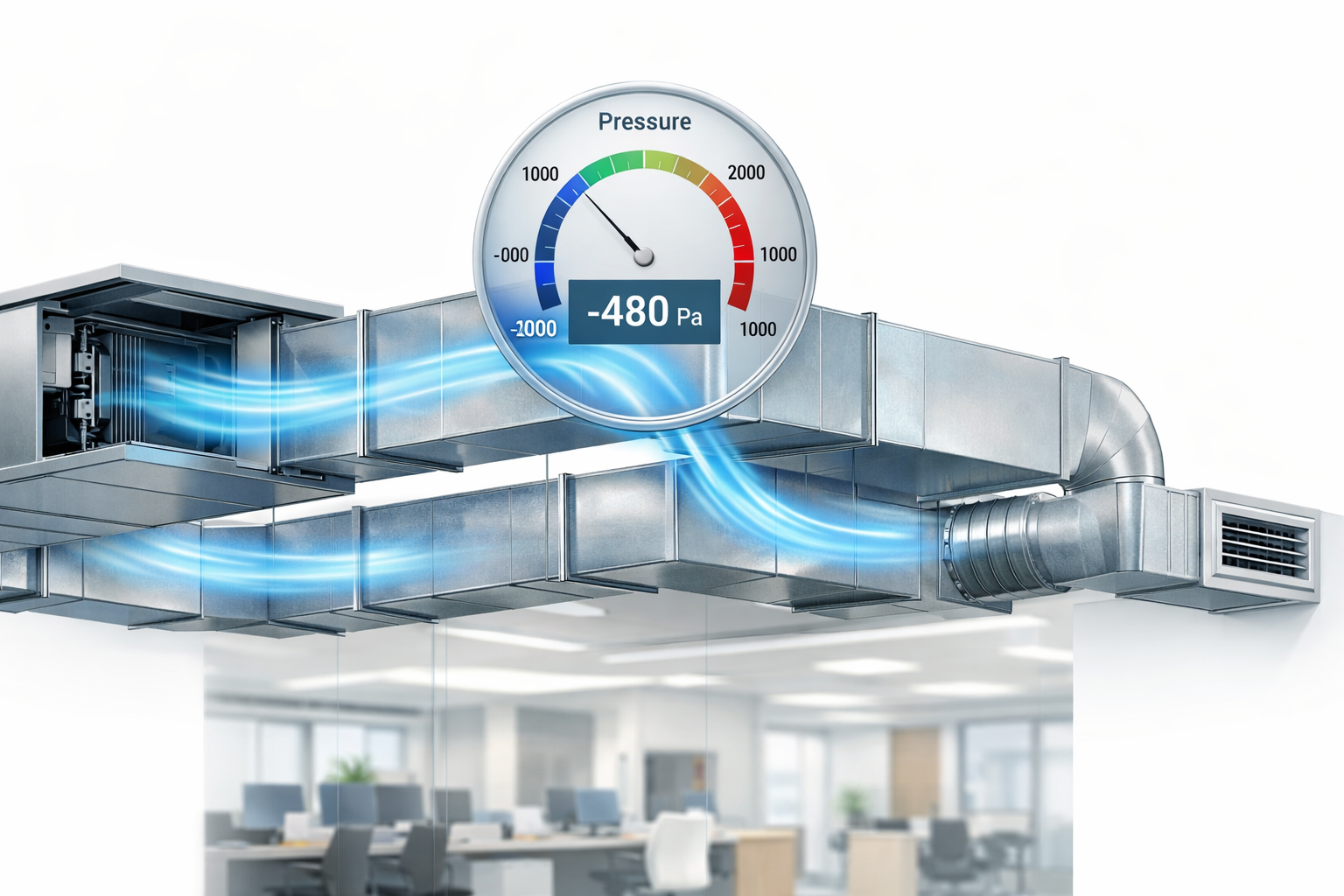
Hvac duct design determines how conditioned air is delivered from AHUs to each diffuser. Proper hvac layout design balances duct friction losses, manages air velocity to control noise, and ensures uniform distribution across all zones. Poor hvac drawing execution, undersized ducts, excessive bends, unbalanced branches, creates pressure imbalances that no amount of commissioning can fully correct.
5. Controls Philosophy and Building Automation
The controls layer determines how the system responds to varying occupancy, weather, and operational schedules. Modern HVAC design integrates BMS (Building Management System) logic, variable speed drives, demand-controlled ventilation via CO2 sensors, and predictive maintenance alerts. A system with sophisticated controls can reduce energy consumption by 25–35% compared to constant-volume, on/off designs.
The 6 Stages of Professional HVAC Design
World-class hvac design follows a structured, stage-gated engineering process. Skipping stages is how projects end up with expensive change orders, commissioning failures, and post-handover complaints.
| Stage | Name | Key Deliverables |
| 1 | Concept Design | System type selection, preliminary load estimates, plant room sizing, budget ROM |
| 2 | Basis of Design (BoD) | Design criteria, outdoor conditions, indoor temperature/humidity targets, applicable standards, redundancy philosophy |
| 3 | Schematic Design | System schematics, equipment schedules, single-line diagrams, zoning strategy |
| 4 | Detailed Engineering | Final load calculations, full equipment specifications, hvac duct design, piping design, controls architecture |
| 5 | Shop Drawings | Fabrication-ready hvac drawing sets, coordination with structural/electrical/plumbing, clash detection |
| 6 | As-Built Documentation | Verified drawings reflecting installed conditions, O&M manuals, commissioning reports, BMS integration records |
Each stage produces specific deliverables that are reviewed and approved before the next stage begins. This protects the client from scope creep, eliminates costly rework, and ensures the installed system matches design intent.
Key Standards That Govern HVAC Design in India
India has a layered regulatory framework for HVAC design. A credible hvac design consultant must be fluent in all of the following standards and know when each applies:
ASHRAE Standards: The American Society of Heating, Refrigerating and Air-Conditioning Engineers publishes the global technical benchmarks used by hvac design engineers worldwide. In India, ASHRAE 62.1 (ventilation for acceptable indoor air quality), ASHRAE 55 (thermal comfort), and the ASHRAE Fundamentals Handbook are the primary technical references for load calculations, duct design, and system performance.
National Building Code of India (NBC 2016): The NBC mandates minimum ventilation rates, fire damper requirements, smoke control provisions, and energy performance thresholds for all building types. Compliance is required for statutory approvals in most Indian states.
ISHRAE Standards and IAQ Guidelines: The Indian Society of Heating, Refrigerating and Air Conditioning Engineers has developed India-specific guidelines for IAQ, thermal comfort in Indian climatic zones, and energy efficiency. The ISHRAE IAQ Guidelines are increasingly cited in institutional and commercial project specifications.
Energy Conservation Building Code (ECBC): The Bureau of Energy Efficiency’s ECBC sets mandatory energy performance targets for commercial buildings above 500 sqm conditioned area. ECBC compliance directly affects hvac system design, glazing ratios, and building envelope performance.
WHO GMP Guidelines (for Pharmaceutical Facilities): Pharmaceutical manufacturing plants in India must comply with WHO Technical Report Series No. 1010 Annex 2 for HVAC GMP design, covering air change rates, HEPA filtration, pressure differentials, temperature and humidity control, and validation protocols. The CDSCO and FDA inspection teams audit HVAC systems against these benchmarks.
CPWD General Specifications for HVAC Works 2024: The Central Public Works Department’s 2024 HVAC specification is the mandatory reference for all government and public sector projects in India. The 2024 edition includes updated outdoor design conditions, system selection matrices, and acceptance testing procedures.
India’s Unique Climatic Challenge: Why Generic HVAC Design Fails
India spans five distinct climatic zones as defined by ECBC: hot-dry, warm-humid, composite, temperate, and cold. A hvac system design for India cannot apply a single solution across geographies. A chiller plant optimised for Delhi’s composite climate (dry summers, cold winters) will perform poorly in Chennai’s hot-humid coastal environment. A cooling-only design appropriate for Rajasthan will under-serve Shimla’s heating requirement.
The table below illustrates the range of outdoor design conditions that an hvac design engineer must account for across major Indian cities:
| City | Climate Zone | Summer DB (°C) | Summer WB (°C) | Winter DB (°C) |
| Delhi | Composite | 43.9 | 26.1 | 3.4 |
| Mumbai | Warm-Humid | 35.1 | 28.0 | 15.0 |
| Chennai | Warm-Humid | 38.3 | 28.0 | 19.2 |
| Bengaluru | Temperate | 33.0 | 22.0 | 12.5 |
| Ahmedabad | Hot-Dry | 44.0 | 25.2 | 8.0 |
| Kolkata | Warm-Humid | 37.8 | 28.5 | 12.4 |
Note: Design conditions sourced from ISHRAE/ASHRAE climatic data. DB = Dry Bulb temperature, WB = Wet Bulb temperature.
This climatic diversity means that hvac system design in India demands genuine local knowledge, not a copy-paste approach imported from international templates or adapted from projects in a different climatic zone.
Common Mistakes in Poor HVAC Design, And What They Cost
The following errors appear repeatedly in projects where hvac design was treated as an afterthought or delegated to under-qualified vendors:
Oversizing Equipment
The most prevalent mistake in Indian commercial projects. Oversized chillers and AHUs short-cycle, running in inefficient part-load conditions for most of the year. Oversizing by 30%, common when no formal load calculation is performed, increases capital cost, inflates energy consumption, and creates humidity control problems because the system cools air too quickly without adequately dehumidifying it.
Undersizing or Ignoring Ventilation
Many low-cost designs meet cooling loads but fail to provide adequate outside air ventilation. The result is elevated CO2 concentrations, poor odour control, and Sick Building Syndrome symptoms. ASHRAE 62.1 and ISHRAE IAQ Guidelines specify minimum outside air rates that are non-negotiable in occupied buildings, yet they are routinely ignored in budget projects.
Poor Air Distribution and Duct Layout Design
Inadequate hvac layout design creates hot and cold spots, pressure imbalances, and noise complaints. Common culprits include duct branches that are not properly sized, diffusers positioned too close to return air grilles, and absence of balancing dampers. These problems are nearly impossible to fix post-installation without significant rework.
No Redundancy Planning
A single point of failure in a mission-critical building, a data centre, hospital, or pharmaceutical plant, is a catastrophic design omission. Professional hvac design engineers establish a redundancy philosophy (N+1, 2N, or selective redundancy) at the Basis of Design stage and design standby capacity, automatic changeover, and maintenance bypass arrangements accordingly.
Disconnected Controls and No BMS Integration
Installing sophisticated HVAC equipment without a proper controls design is like fitting a Formula 1 engine with a bicycle gear lever. The absence of BMS integration, variable speed drives, and demand-based controls can add 20–30% to annual energy costs compared to a properly controlled system of equivalent capacity.
How Enviguard Approaches HVAC Design
Enviguard delivers complete HVAC design engineering services across industrial, commercial, pharmaceutical, and cleanroom projects. Our process is built on the six-stage framework described above, underpinned by a structured engineering management system that produces traceable, auditable deliverables at every stage.
Tools and Software
Our design team uses industry-standard hvac design software including Carrier HAP (Hourly Analysis Program) and Trane TRACE for detailed energy modelling and load calculations, AutoCAD MEP and Revit MEP for hvac drawing and 3D coordination, and ASHRAE-compliant duct sizing tools for hvac duct design validation. For pharmaceutical and cleanroom projects, we apply CFD analysis to validate air distribution patterns before construction begins.
Team Expertise
Enviguard’s hvac design engineers hold qualifications from ISHRAE and ASHRAE, with project experience spanning IT parks, manufacturing facilities, pharmaceutical plants, hospitals, cold chains, and data centres across India. Our team brings deep familiarity with NBC, ECBC, CPWD specifications, WHO GMP, and LEED/GRIHA certification requirements.
Deliverables
A complete Enviguard HVAC design package typically includes: Basis of Design document, certified load calculation reports, equipment specifications and selection reports, system schematics and single-line diagrams, full hvac layout design drawings and coordinated shop drawings, BMS control narratives and sequences of operation, commissioning and testing protocols, and as-built documentation.
| Ready to engineer a world-class HVAC system?Enviguard provides complete HVAC design engineering services, from load calculation to as-built documentation.Talk to our HVAC design engineers today.Request a Design Consultation | www.enviguard.in |
Professional HVAC Design vs. Rule-of-Thumb Approach: A Comparison
| Parameter | Professional HVAC Design | Rule-of-Thumb Approach |
| Load Calculation | Detailed room-by-room analysis using ASHRAE/ISHRAE data | Estimated from floor area or previous project |
| Equipment Sizing | Right-sized; validated against actual load and climate zone | Typically 20–40% oversized |
| Energy Efficiency | ECBC-compliant; BMS-controlled; lifecycle-costed | No energy modelling; fixed-speed systems |
| Code Compliance | NBC, ECBC, WHO GMP (where applicable) | Often non-compliant; fails audits |
| Duct Layout | Balanced system; pressure-tested; noise-controlled | Arbitrary routing; imbalanced airflow |
| Documentation | Full as-built drawings, O&M manuals, commissioning reports | Minimal or none |
| Typical Outcome | Reliable comfort, lower operating cost, audit-ready | High energy bills, callbacks, compliance risk |
Conclusion: Why HVAC Design Determines Long-Term Building Performance
In India’s rapidly expanding built environment, hvac design is not a line item to be minimised, it is the engineering foundation on which indoor comfort, energy performance, regulatory compliance, and occupant health all depend. As energy prices rise, as ECBC enforcement tightens, and as pharmaceutical and data centre clients demand higher levels of documentation and validation, the quality of your hvac design will directly determine how your building performs for decades.
The six-stage engineering process, adherence to ASHRAE, NBC, ISHRAE, and WHO standards, and the use of validated design tools are not optional refinements, they are the baseline for a system that reliably delivers what it promises. At Enviguard, this is the standard we hold ourselves to on every project.
| Start Your HVAC Design Project with EnviguardFrom concept design to as-built documentation, our HVAC design engineers deliver world-class systems engineered to India’s standards.Get in touch for a free design consultation.www.enviguard.in | HVAC Design Engineering Services |
Frequently Asked Questions About HVAC Design
1. What does an HVAC design engineer do?
An hvac design engineer is responsible for the complete technical design of a building’s heating, ventilation, and air conditioning systems. Their work covers thermal load calculations, equipment selection, hvac duct design and piping layout, controls architecture, energy modelling, preparation of construction-ready hvac drawing packages, and coordination with structural, electrical, and civil teams. A qualified hvac design engineer ensures the system meets comfort, energy efficiency, and regulatory requirements throughout its lifecycle, not just on commissioning day.
2. How long does HVAC design take?
The duration depends on project scale and complexity. A schematic design for a mid-sized commercial building of 5,000 to 15,000 sqm typically takes 4 to 8 weeks. Full detailed engineering and shop drawing production for a large pharmaceutical facility or IT park can take 12 to 20 weeks. Projects that require cleanroom CFD analysis, GMP validation documentation, or multi-building campus design will sit at the upper end of this range. Front-loading design time almost always saves money by reducing costly changes during construction.
3. What does HVAC design cost in India?
HVAC design consultant fees in India typically range from 1.5% to 4% of the estimated HVAC installation cost, depending on project complexity, deliverable scope, and the consultant’s experience. For a standard commercial office project, design fees might range from INR 8 to 25 lakhs. For a pharmaceutical or cleanroom facility with GMP documentation requirements, the fee will be higher given the additional validation deliverables required. Investing in rigorous hvac design routinely returns 5 to 15 times the design fee in energy savings and avoided rework costs over the system’s life.
4. What is the difference between HVAC design and HVAC installation?
HVAC design is the engineering process that determines what systems are needed, how they are configured, and how they must perform, it produces drawings, specifications, and calculations. HVAC installation is the physical implementation of those designs by contractors. In India, these roles are often confused or combined, particularly in smaller projects, which is a primary source of design errors. Best practice separates the design function (independent engineer or consultant) from the installation function (contractor) to maintain technical oversight and accountability.
5. Which HVAC standards apply to pharmaceutical facilities in India?
Pharmaceutical HVAC design in India must comply with WHO GMP guidelines (TRS 1010, Annex 2 for non-sterile; Annex 1 for sterile products), CDSCO Schedule M requirements, and increasingly EU GMP Annex 1 for export-oriented manufacturers. These standards govern air change rates, HEPA filtration, pressure differentials, temperature and humidity tolerances, and HVAC validation protocols (IQ, OQ, PQ). ASHRAE 62.1 and ISO 14644 cleanroom standards are also referenced in pharmaceutical hvac system design in India.
6. What HVAC design software is used by professionals in India?
The most widely used hvac design software in India includes Carrier HAP and Trane TRACE 700 for cooling and energy load calculations; AutoCAD MEP and Autodesk Revit for 2D and 3D hvac drawing and coordination; and Wrightsoft or Elite Software for residential load calculations. CFD tools such as SimScale or ANSYS Fluent are used for critical applications like cleanrooms, data centres, and atria. Many senior hvac design engineers also use HAP or EnergyPlus for ECBC and LEED energy compliance submissions.
7. Can I take an HVAC design course in India?
Yes. The Indian Society of Heating, Refrigerating and Air Conditioning Engineers (ISHRAE) offers the most recognised hvac design course programmes in India, including certificate courses in HVAC system design, energy management, and refrigeration. ASHRAE also offers online and in-person training through its India chapters. For working professionals, programmes from institutions affiliated with ACREX and specialised MEP training providers offer practical, software-based hvac design course content aligned with Indian standards and climate conditions.