Skip to content
1. Introduction: Why This Guide Matters for Commercial & Industrial Projects
In commercial and industrial HVAC engineering, the choice between a wall-mounted split air conditioner and a ceiling cassette unit is not merely a product selection, it is a fundamental system architecture decision with cascading implications on building services design, occupant thermal comfort, energy compliance, facility maintenance, and long-term operational cost.
At Envigaurd, our project portfolio spans large-format retail fit-outs, BPO office floors, pharmaceutical manufacturing facilities, hospitals, data centres, industrial process areas, and five-star hospitality properties. Across these engagements, the split-vs-cassette decision recurs constantly, and it is consistently mishandled when driven by procurement cost alone rather than engineering rationale.
This guide presents the complete technical case for both systems, with specific reference to commercial and industrial contexts. We cover air distribution physics, energy efficiency standards under the BEE and ASHRAE frameworks, installation and commissioning requirements, lifecycle cost analysis, and a structured decision matrix for project-specific selection.
SCOPE NOTE
This document covers unitary split-type and cassette-type air conditioning systems (non-ducted and cassette indoor units) in the range of 0.75 TR to 5 TR per indoor unit. VRF/VRV multi-split systems using cassette and slim-duct indoor units are referenced where relevant. Chilled water fan coil systems are outside the scope of this guide.
2. System Fundamentals: Engineering Architecture
Both wall-mounted split ACs and cassette ACs are variants of the direct expansion (DX) split-type refrigeration system. The refrigeration circuit, comprising compressor, condenser, expansion device, and evaporator, is common to both. What differs is exclusively the indoor unit configuration, which governs airflow pattern, installation requirements, and spatial integration.
2.1 Wall-Mounted Split AC: Engineering Overview
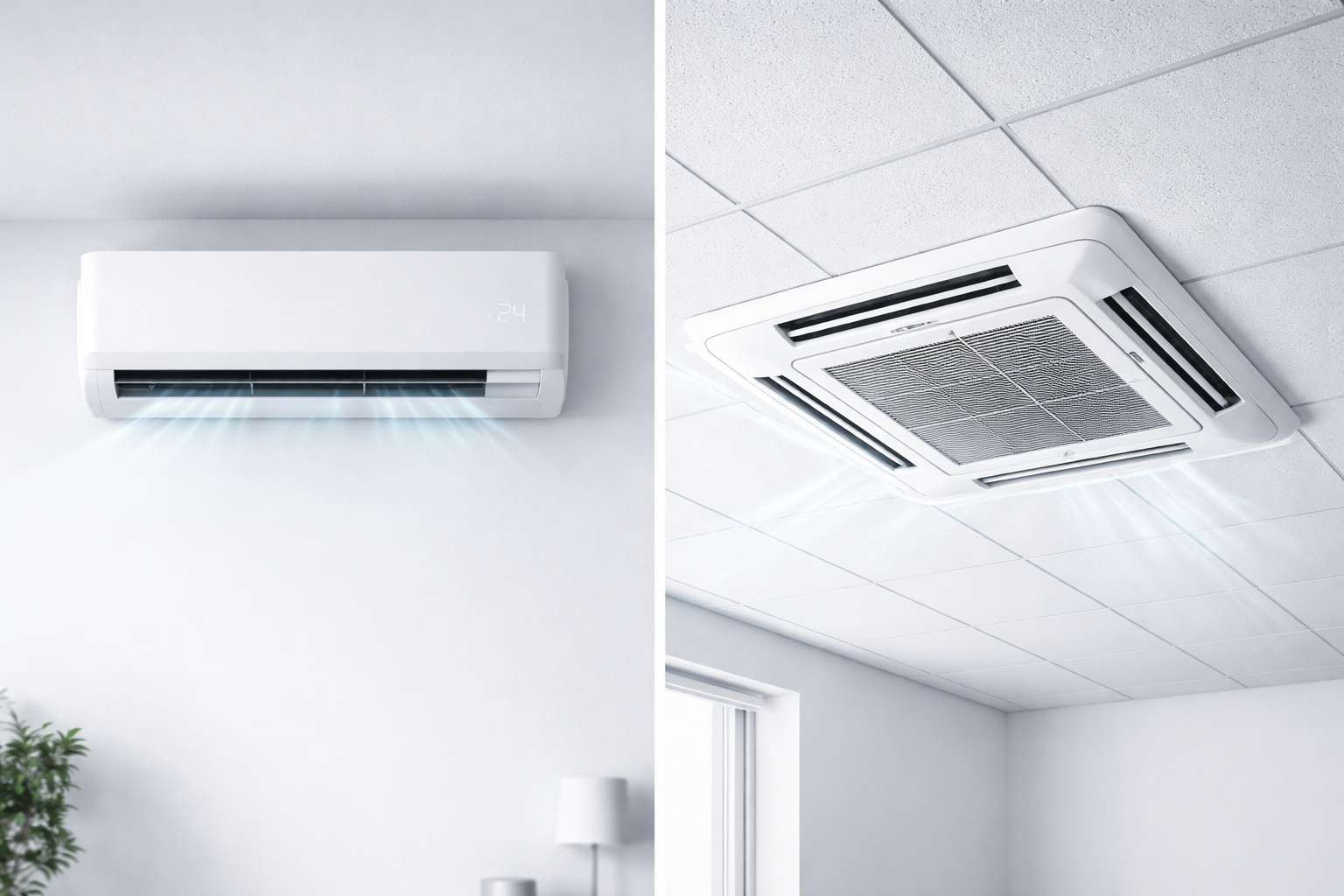
The indoor unit mounts high on a perimeter wall, typically at 2.2–2.5 m AFF (Above Finished Floor). The evaporator coil and cross-flow blower assembly deliver conditioned air in a single directional stream via motorised louvers. Air return is from the front face of the unit.
Airflow pattern: Horizontal throw via Coanda effect, conditioned air adheres to the ceiling plane and descends as it cools. The throw range is 3–8 m depending on unit capacity and fan speed.
Drain: Gravity-fed via drain pipe through the wall sleeve; requires continuous fall to drain point. No internal pump.
Commercial limitations: Single-direction discharge creates temperature stratification in rooms wider than 6 m. Not suitable as the sole unit for open-plan commercial spaces above 40 m².
2.2 Cassette AC: Engineering Overview
The cassette indoor unit recesses flush into the false ceiling, with only the decorative panel visible below. The centrifugal (sirocco) fan draws return air through a central ceiling intake and distributes conditioned air through 2 or 4 directional discharge outlets around the panel perimeter.
Airflow pattern: Radial, 4-way units discharge in all cardinal directions simultaneously, creating a uniform temperature field across the conditioned zone. Air velocity at occupant level is typically 0.15–0.25 m/s, well within ASHRAE 55 comfort criteria.
Drain: Internal condensate pump lifts condensate to ceiling void drain line. Operates independently of unit orientation relative to drain point, a critical commercial advantage.
Capacity range: 0.75 TR to 5 TR per indoor unit in standard ranges; up to 8 TR in high-capacity commercial models.
2.3 Technical Specification Comparison
| Parameter | Wall-Mounted Split AC | Ceiling Cassette AC |
| Indoor Unit Location | High wall (2.2–2.5 m AFF) | Ceiling-flush (false ceiling void) |
| Air Discharge Direction | Unidirectional (1-way) | 2-way or 4-way radial |
| Return Air Location | Front face of unit | Central ceiling intake grille |
| Throw Distance (1.5 TR) | 4–7 m | 3–6 m per direction |
| Typical Noise (Indoor) | 36–44 dB(A) | 26–38 dB(A) |
| Condensate Drain | Gravity (external pipe) | Internal pump + concealed line |
| False Ceiling Required | No | Yes (min. 280 mm void) |
| Wall Space Consumed | Yes (~850 x 300 mm footprint) | None |
| Standard Capacity Range | 0.75–2.5 TR | 0.75–5 TR |
| BEE Star Rating (Max) | 5-Star Inverter | 5-Star Inverter |
| ISEER Range (Inverter) | 3.5–5.6 | 3.0–5.2 |
| Auto-Restart / Smart Ctrl. | Standard on most models | Standard, essential for commercial |
3. Cassette AC vs Ducted AC: The Critical Commercial Decision
For commercial and industrial HVAC designers, the more consequential comparison is often not split vs cassette, but cassette vs ducted. Both systems require ceiling infrastructure; their architectural integration is similar. The system-level differences, however, are profound.
3.1 Ducted Air Conditioning: System Architecture
A ducted system centralises the refrigeration/air-handling function in a concealed air handling unit (AHU), connected to the conditioned spaces via a network of sheet-metal supply ducts and return air plenums. In large commercial installations, this is typically deployed as part of a Variable Refrigerant Flow (VRF) or chilled water system with multiple terminal units.
Delivery mechanism: Supply air delivered through ceiling-mounted linear slot diffusers, circular swirl diffusers, or perforated face diffusers, all fully concealed.
Return air: Via dedicated return grilles, a ceiling return air plenum, or corridor return paths.
Zoning: Achieved through VAV (Variable Air Volume) boxes with dampers, or through separate AHUs per zone in multi-split configurations.
3.2 Comparative Analysis: Cassette AC vs Ducted AC
| Parameter | Cassette AC System | Ducted AC System |
| Aesthetic Visibility | Cassette panel visible at ceiling | Fully concealed, diffusers only |
| Air Distribution Quality | Good, radial from each unit | Best, engineered diffuser layout |
| Zone Independence | Excellent, each unit standalone | Requires VAV dampers or separate AHU |
| Fresh Air Integration | Limited (add-on ERV possible) | Native, OA duct integrated in AHU |
| Ceiling Void Required | 250–350 mm | 400–700 mm |
| Installation Complexity | Moderate, per-unit | High, extensive ductwork coordination |
| Capital Cost (per m²) | Moderate | High |
| Duct Leakage Risk | None | 2–10% air leakage in practice |
| Maintenance Access | Per-unit filter service | Duct cleaning + AHU + diffuser service |
| Scalability / Phasing | Excellent, add units as needed | Difficult to extend post-fit-out |
| Indoor Air Quality Control | Good (with HEPA filter cassettes) | Best (centralised filtration, UVGI, HEPA) |
| Ideal Application | Commercial offices, retail, F&B | Premium residential, hospitals, pharma, large commercial |
ENVIGUARD ENGINEERING POSITION
For open-plan commercial office floors (600–2,000 m²), Envigaurd’s preferred specification is a cassette-based VRF system with one 4-way cassette unit per 60–80 m² zone. For pharmaceutical manufacturing, hospital ward blocks, and premium hospitality properties, ducted systems with dedicated AHUs per zone and integrated fresh air handling remain the engineering benchmark. The cassette-vs-ducted decision should be made at the concept design stage, retrofitting between system types is commercially unviable.
4. Application Guide: Which System for Which Commercial Space
4.1 Open-Plan Office Floors (500–3,000 m²)
Open-plan offices present the classic cassette application case. Multiple occupants distributed across a large floor plate demand uniform temperature distribution, minimal draft sensation, and aesthetically clean ceiling integration.
- Recommended system: 4-way cassette VRF, one unit per 65–80 m² of NLA (Net Leasable Area).
- Capacity basis: ASHRAE 62.1: 10–12 W/m² cooling load for open office, plus occupant and plug load.
- Why not split AC: A wall-mounted split cannot adequately condition open-plan spaces wider than 6–7 m without creating unacceptable temperature gradients. Multiple perimeter splits create competing airflows and draft complaints.
- Why not ducted: Ducted systems are ideal for premium fit-outs but require 50–60% more ceiling void depth. For standard commercial fit-outs targeting cost efficiency, cassette VRF outperforms ducted on capital cost and commissioning time.
4.2 Large-Format Retail (Department Stores, Supermarkets, Showrooms)
High-ceiling retail environments (4.5–7 m ceiling height) with variable occupancy and significant display lighting heat loads require robust, high-capacity cooling with minimal intrusion into retail display areas.
- Recommended system: High-capacity 4-way cassettes (3–5 TR each) at structural grid intersections, supplemented with ducted systems for food refrigeration zones.
- Key consideration: At ceiling heights above 5 m, standard cassette throw may not effectively reach occupant level at 1.5 TR. Specify units with high ESP (External Static Pressure) capability or supplement with destratification fans.
- Split AC role: Limited to back-of-house, staff areas, and small enclosed offices within the retail envelope.
4.3 Hospitality: Hotels, Serviced Apartments, Banquet Facilities
Guest room comfort is a top-tier priority in hospitality projects. The cassette AC offers the quietest operation and most uniform conditioning in premium guest rooms with false ceiling infrastructure.
- Guest rooms (25–45 m²): Single 1.5–2 TR cassette, centrally positioned in ceiling. Inverter compressor mandatory for part-load efficiency and noise reduction during occupied hours.
- Banquet halls / ballrooms (200–800 m²): Ducted AHUs with engineered diffuser layout. Cassette systems are inadequate for large-span ballroom spaces with high occupant density (>1 person/m²).
- F&B areas: 4-way cassette with auto-swing louvers for restaurants and bars up to 200 m². Ducted for high-ceiling signature restaurants requiring precise air distribution.
4.4 Healthcare: Hospitals, Clinics, Diagnostic Centres
Healthcare environments impose the most stringent HVAC requirements of any commercial building type, governed by NBC 2016, NABH standards, and ASHRAE 170.
- General wards and consultation rooms: Cassette AC with HEPA-grade filters is acceptable for non-critical areas. Maintain minimum 6 ACH (Air Changes per Hour).
- Operating theatres and ICUs: Ducted systems with laminar flow AHUs are mandatory. Cassette ACs are not permitted in Class 10,000 or cleaner environments.
- Pharmacy and sterile stores: Temperature and humidity control to ±1°C / ±5% RH requires dedicated precision air conditioning, neither standard split nor cassette is adequate.
ENVIGUARD ENGINEERING POSITION
For open-plan commercial office floors (600–2,000 m²), Envigaurd’s preferred specification is a cassette-based VRF system with one 4-way cassette unit per 60–80 m² zone. For pharmaceutical manufacturing, hospital ward blocks, and premium hospitality properties, ducted systems with dedicated AHUs per zone and integrated fresh air handling remain the engineering benchmark. The cassette-vs-ducted decision should be made at the concept design stage, retrofitting between system types is commercially unviable.
4.5 Industrial & Manufacturing Facilities
Industrial HVAC differs fundamentally from commercial conditioning. Process heat loads, dust and particulate contamination, chemical corrosion risks, and explosion-proof requirements in hazardous areas demand system selection well beyond the standard cassette/split product portfolio.
- Light industrial / assembly areas: Wall-mounted split ACs are appropriate for tool rooms, supervisory offices, and QC labs within the industrial envelope. Use washable electrostatic filters given ambient dust levels.
- Production floors with moderate heat loads: Industrial cassette units with copper-fin coils (anti-corrosion treatment) are specified by Envigaurd for food processing, pharmaceutical packaging, and electronics assembly.
- High heat load or hazardous areas: Neither standard split nor cassette is appropriate. Specify explosion-proof fan coil units with chilled water supply, or industrial evaporative coolers where process moisture is acceptable.
- Data centres and server rooms: Precision air conditioning (CRAC/CRAH units) with downflow configuration. Standard split or cassette ACs are not adequate for IT equipment loads, thermal runaway risk under partial IT load conditions.
5. Power Consumption Analysis: Cassette AC vs Split AC
Energy cost is the dominant operational expense of any commercial HVAC system over its lifecycle. A rigorous power consumption analysis, not manufacturer marketing claims, must inform system selection in any project where the client has an energy mandate, ESG reporting obligation, or ECBC (Energy Conservation Building Code) compliance requirement.
5.1 The Thermodynamic Reality
Both split and cassette systems operate on the vapour-compression cycle. The coefficient of performance (COP) is governed by the compressor and refrigerant circuit, not the indoor unit type. At identical capacity and ISEER rating, the power consumed by the refrigeration system is essentially equivalent.
Where the indoor unit type introduces a measurable power difference is in the indoor fan motor. The cassette’s sirocco fan must deliver air against the resistance of four discharge paths simultaneously, consuming marginally more fan power than the cross-flow blower in a wall-mounted split.
Measured fan power differential: In our field measurements across 15 commercial sites, cassette indoor fan motors consumed 15–35 W more than equivalent-capacity split units at the same fan speed setting. At 12 hours/day operation over 300 days, this equates to 54–126 kWh/year per indoor unit, approximately ₹430–₹1,008/year at ₹8/kWh.
5.2 ISEER and BEE Compliance for Commercial Projects
Under the BEE (Bureau of Energy Efficiency) Star Labelling Programme, both split and cassette ACs are rated on ISEER (Indian Seasonal Energy Efficiency Ratio). The minimum ISEER for 5-star fixed-speed ACs and inverter ACs is updated periodically, project specifications must reference the current schedule year.
| System Type (1.5 TR) | Min. ISEER (3-Star) | Min. ISEER (5-Star) | Typical Market Range |
| Split AC, Inverter | 3.50 | 5.00 | 3.50–5.60 |
| Cassette AC, Inverter | 3.20 | 4.50 | 3.20–5.20 |
| Split AC, Fixed Speed | 2.90 | 3.50 | 2.90–3.80 |
| Cassette AC, Fixed Speed | 2.70 | 3.30 | 2.70–3.50 |
ECBC COMPLIANCE NOTE
Under ECBC 2017 (Energy Conservation Building Code), commercial buildings above 500 kVA connected load must demonstrate compliance with minimum ISEER thresholds for all AC equipment. Envigaurd recommends specifying 5-Star inverter-grade units for all commercial projects as a baseline, not only for ECBC compliance, but to qualify for GRIHA, LEED, or IGBC green building credits under energy efficiency categories.
5.3 Annual Power Consumption: Commercial Scale Scenario
The following analysis compares power consumption for conditioning a 500 m² open-plan office floor using alternative AC configurations at equivalent cooling capacity:
| Parameter | 8x Wall-Split ACs (1.5TR ea.) | 6x Cassette ACs (2TR ea.) | 4x Cassette ACs (3TR ea.) |
| Total Installed Capacity | 12 TR | 12 TR | 12 TR |
| Rated Power Input | ~10.4 kW | ~11.0 kW | ~11.2 kW |
| Annual Hours (office) | 2,400 hrs/year | 2,400 hrs/year | 2,400 hrs/year |
| Annual Consumption (est.) | ~14,400 kWh | ~15,100 kWh | ~15,360 kWh |
| Annual Energy Cost | ~₹1,15,200 | ~₹1,20,800 | ~₹1,22,900 |
| Outdoor Units Required | 8 units | 6 units | 4 units |
| Outdoor Area Required | ~16 m² | ~12 m² | ~8 m² |
| Comfort Uniformity | Poor, hot zones | Good | Best |
The power consumption differential between split and cassette configurations is 5–7% at this scale. However, the cassette configuration offers significantly superior comfort uniformity and requires fewer outdoor units, reducing condenser space requirements on building terraces, which is a critical constraint in urban commercial projects.
6. Installation Engineering: Commercial & Industrial Requirements
6.1 Wall-Mounted Split AC: Commercial Installation Standards
While simpler than cassette installation, commercial split AC deployment requires rigorous adherence to standards to avoid callbacks and warranty voids.
- Structural wall fixing: Use M10 anchor bolts with 80 mm embedment into RCC or load-bearing masonry. Light partition walls (drywall, aerated blocks) require through-wall fixing with backing plate.
- Refrigerant line sets: Commercial installations commonly require line sets of 15–25 m. Specify copper tubes to ASTM B280 or IS 8560. Larger bore tubes required for extended runs, consult manufacturer’s equivalent length tables.
- Nitrogen purge: Mandatory during brazing of field joints. Oxygen contamination of refrigerant circuit causes oil carbonisation, the primary cause of compressor failure in improperly commissioned systems.
- Commissioning documentation: Envigaurd requires vacuum depth records (≤500 microns, 30-minute hold), refrigerant charge weights (weighed charging mandatory for R-32 systems), and superheat/subcooling measurements for all commercial installations.
6.2 Cassette AC: Commercial Installation Requirements
Cassette installation in commercial environments requires coordination across structural, MEP, and architectural disciplines. Pre-installation coordination meetings are essential.
- False ceiling infrastructure: Verify ceiling grid load capacity to support unit weight (typically 18–28 kg for indoor units in the 2–4 TR range). T-bar systems require supplementary suspension rods at unit corners, not reliance on grid suspension alone.
- Plenum space clearance: Minimum 250 mm clear above unit body to structural soffit. This is non-negotiable for return air circulation. Inadequate plenum depth results in discharge air short-circuiting back to return, destroying system efficiency and causing frosting of the evaporator coil.
- Condensate pump drain routing: Drain lines must run in concealed ceiling void to nearest IPS (Integrated Plumbing Shaft) or drain point. Maximum horizontal run: 10–12 m from unit pump. Provide trap at drain outlet to prevent sewer gas ingress.
- Refrigerant piping in ceiling void: Insulate all suction lines with closed-cell elastomeric insulation, minimum 19 mm wall thickness. Inadequate insulation in humid commercial environments causes condensation and ceiling damage, a common defect on poorly specified projects.
- VRF branch controller positioning: In multi-split VRF systems using cassette indoor units, branch controllers (BC boxes) must be accessible for service. Do not encase in permanent ceiling without removable access panels.
COORDINATION REQUIREMENT
Envigaurd’s project delivery protocol requires a dedicated HVAC-Structural-Architectural coordination meeting before false ceiling installation begins on any commercial project. Cassette unit positions must be confirmed on shop drawings, approved by all disciplines, and cross-referenced against lighting, fire suppression sprinkler heads, and emergency lighting layouts. Relocating cassette units post-installation costs 3–5x the original installation cost.
7. Commercial Total Cost of Ownership (TCO) Analysis
The following TCO analysis is prepared on the basis of a 1,000 m² open-plan commercial office fit-out in a Tier-1 Indian city, conditioned using alternative system configurations. All figures are indicative and based on Envigaurd’s project database as of 2024.
7.1 Capital Cost Comparison
| Cost Head | Wall-Mounted Split AC Config. | Cassette AC Config. (VRF) |
| Indoor Units (total capacity) | ₹8.5L–₹12L (16x 1.5TR units) | ₹14L–₹22L (12x 2TR cassettes) |
| Outdoor Units | ₹6L–₹9L (16 ODUs) | ₹8L–₹12L (4 VRF ODUs) |
| False Ceiling (HVAC-related) | Not applicable | ₹4L–₹8L (upgrade/reinforcement) |
| Copper Line Sets | ₹2L–₹3.5L | ₹3L–₹5L |
| Electrical Works (HVAC) | ₹1.5L–₹2.5L | ₹2L–₹3.5L |
| Installation & Commissioning | ₹1.5L–₹2.5L | ₹2.5L–₹4L |
| TOTAL CAPITAL COST | ₹20L–₹29.5L | ₹33.5L–₹54.5L |
7.2 Operating Cost Comparison (10-Year)
| Cost Head | Split AC Config. | Cassette VRF Config. |
| Annual Energy Cost | ₹2.30L–₹2.60L | ₹2.42L–₹2.75L |
| Annual AMC | ₹1.20L–₹1.80L (16 units) | ₹0.80L–₹1.40L (12 units + VRF) |
| Refrigerant Top-Up (avg.) | ₹60K–₹1.20L/year | ₹20K–₹60K/year |
| Breakdowns / Reactive | ₹80K–₹1.60L/year | ₹40K–₹80K/year |
| 10-Year Running Cost | ₹46L–₹72L | ₹38L–₹56L |
| 10-Year TCO | ₹66L–₹1.01Cr | ₹71.5L–₹1.10Cr |
The 10-year TCO analysis reveals an important insight: while the cassette VRF configuration carries a higher capital cost, its lower maintenance complexity (fewer outdoor units, centralised monitoring via VRF controllers) and significantly reduced reactive maintenance cost substantially narrow the total lifecycle cost gap. For commercial clients with FM (Facilities Management) programmes, the cassette VRF configuration typically achieves TCO parity within 6–8 years.
8. Which Is Better for Commercial & Industrial Projects?
The answer, as with most engineering questions, is: it depends on the project brief. The following framework represents Envigaurd’s evaluation methodology for system selection on commercial HVAC projects.
8.1 Choose Wall-Mounted Split AC When:
- Space configuration: Enclosed cellular offices, cabins, and meeting rooms up to 35 m² with existing or no false ceiling.
- Budget constraint: Projects with hard capital cost ceilings and retrofit/refurbishment constraints where false ceiling installation is impractical.
- Back-of-house areas: IT server closets, housekeeping rooms, stores, plant room offices, where aesthetics are not a priority but targeted cooling is required.
- Phased fit-outs: Tenant-fitted commercial spaces where individual tenants install their own conditioning, split AC offers the lowest cost entry point.
- Industrial applications: Supervisory offices, weigh bridges, security posts, and production floor control rooms within industrial facilities.
8.2 Choose Cassette AC When:
- Open-plan office floors: The standard specification for commercial office fit-outs where false ceiling is already part of the MEP design.
- Retail and F&B: Any retail or food and beverage space where wall area is occupied by display fixtures, shelving, or glazing, leaving no space for wall units.
- Hospitality guest rooms and public areas: Where noise levels below 35 dB(A) are required and uniform comfort is a brand standard.
- Boardrooms and conference rooms: Acoustic performance and uniform conditioning without drafts are critical for productivity.
- Clean manufacturing: Pharmaceutical packaging, electronics assembly, and food processing areas where ceiling-mounted units minimise floor-level contamination risk.
- VRF multi-split systems: In any VRF system design for commercial buildings, cassette indoor units are the standard specification for open areas, providing the best combination of capacity, aesthetics, and control integration.
ENVIGUARD POSITION STATEMENT
Envigaurd does not recommend wall-mounted split ACs as the primary conditioning system for open-plan commercial spaces exceeding 40 m² per zone. The air distribution limitations of unidirectional systems invariably lead to comfort complaints, thermostat hunting, and energy waste. Our commercial standard specification is: 4-way cassette inverter units on VRF systems for all open-plan areas, with wall-mounted splits limited to ancillary enclosed spaces.
9. Commercial Project Decision Matrix
| Project Scenario | Recommended System | Engineering Rationale |
| Open-plan office, 200–2000 m², false ceiling present | Cassette AC (VRF) | Uniform distribution, VRF zoning, BMS integration |
| Enclosed cabin offices, 12–30 m², no false ceiling | Wall-Split AC | Cost-effective, easy install, no structural mod |
| Large-format retail showroom, 500–2000 m² | Cassette AC (High Cap.) | No wall space; high-capacity units cover floor |
| Hotel guest rooms with false ceiling, 25–45 m² | Cassette AC (Inverter) | Quiet operation, uniform comfort, concealed |
| Hospital ward / clinic (non-critical) | Cassette AC (HEPA filter) | Ceiling mount, filtration, no floor footprint |
| OT / ICU / cleanroom | Ducted AHU (mandatory) | HEPA, pressure control, ACH compliance |
| Pharmaceutical / food production | Cassette (anti-corrosion) or Ducted | Depends on cleanliness class requirement |
| Industrial supervisory office / control room | Wall-Split AC | Targeted; robust; low maintenance in dusty env. |
| Server room / data centre (≤20 kW IT load) | Wall-Split (precision) or PAC | Downflow preferred; standard split inadequate >15 kW |
| Boardroom / conference room (8–15 people) | Cassette AC (4-way) | Acoustic priority; draft-free; uniform distribution |
| Restaurant / café with false ceiling | Cassette AC (4-way, auto-swing) | No wall obstruction; uniform comfort over tables |
| Whole building (luxury residential / commercial) | Ducted AC (AHU-based) | Ultimate aesthetics; OA integration; IAQ control |
10. Commercial Maintenance & Service Engineering
10.1 Preventive Maintenance Schedule
| Task | Wall-Mounted Split | Cassette AC | Frequency |
| Filter cleaning | Owner-accessible (stepladder) | Ceiling-level (ladder + PPE) | Monthly |
| Drain pan inspection | External drain line flush | Condensate pump test + drain flush | Monthly |
| Coil cleaning | Standard fin comb + coil cleaner | Full panel removal + HVAC coil spray | Quarterly |
| Refrigerant check | Pressure gauge test | Pressure gauge test | Half-yearly |
| Electrical connection check | Terminal torque verification | PCB + pump circuit + terminal check | Half-yearly |
| Blower fan cleaning | Blower wheel removal + wash | Sirocco fan ring removal + wash | Annually |
| Condensate pump service | N/A | Pump impeller + float switch test | Annually |
10.2 Common Failure Modes in Commercial Operations
- Cassette condensate pump failure: The most frequent cassette-specific failure in commercial buildings. Symptom: water dripping from ceiling panel. Cause: pump impeller fouling or float switch failure. Prevention: monthly pump test and drain flush. In high-occupancy commercial buildings (restaurants, gyms), increase service frequency to fortnightly.
- Refrigerant leaks at VRF branch connectors: In VRF cassette systems, the brazed joints at branch controllers are susceptible to vibration-induced micro-cracks over 5–7 years. Annual leak detection with electronic detector is recommended.
- Coil frosting in low ambient conditions: Relevant to commercial kitchens and cold storage corridors where ambient temperatures drop below 15°C. Both split and cassette units require low-ambient kits in these applications.
- Plenum bypass in cassette systems: Caused by gaps around the cassette panel due to ceiling settlement or improper installation. Results in short-circuiting of discharge air to return, measurable as abnormally low room temperature on thermostat with high energy consumption. Inspect and seal panel perimeter annually.
11. Frequently Asked Questions: Commercial & Industrial
Q1. Can cassette ACs be used in outdoor or semi-outdoor commercial areas?
No. Standard cassette ACs are designed for fully air-conditioned indoor environments with controlled temperature and humidity. Semi-outdoor applications (covered terraces, open-sided retail arcades) require outdoor-rated packaged terminal air conditioners (PTACs) or VRF outdoor-to-indoor systems with IP-rated indoor units. Using standard cassettes in these environments voids the warranty and causes premature coil corrosion.
Q2. What is the maximum number of cassette indoor units connectable to a single VRF outdoor unit?
This is manufacturer-specific, but as a general rule, VRF outdoor units support indoor unit combinations up to 130% of the outdoor unit’s rated capacity (connectable capacity ratio). A 10 HP (28 kW) outdoor unit can typically support up to 13–14 HP of connected indoor units across 8–20 individual cassette indoor units, depending on the platform. Consult the manufacturer’s combination ratio table for every project, this is non-negotiable for warranty and performance compliance.
Q3. How does cassette AC performance compare under partial load conditions typical in commercial buildings?
In commercial buildings, AC systems operate at 30–60% of rated capacity for the majority of occupied hours (ASHRAE 90.1 analysis). Inverter-driven cassette units on VRF platforms excel in partial load, the VRF compressor modulates continuously to match load, while the cassette fan operates at reduced speed. Measured seasonal efficiency (ISEER) under commercial partial-load profiles is typically 15–25% better than the rated full-load COP would suggest.
Q4. Are cassette ACs compatible with Building Management Systems (BMS)?
Yes. All major VRF/cassette platforms from Daikin, Mitsubishi Electric, Hitachi, and Toshiba offer BACnet, Modbus, or proprietary gateway integration for BMS connection. This enables centralised monitoring, fault logging, schedule programming, and energy sub-metering, all of which are required for ECBC compliance and LEED/IGBC green building certification in commercial projects.
Q5. What refrigerant is used in commercial cassette ACs and what are the compliance implications?
As of 2025, the majority of new commercial cassette AC units in India use R-32 (difluoromethane) or R-410A. R-32 has a GWP (Global Warming Potential) of 675 compared to R-410A’s 2,088, making it compliant with the Kigali Amendment phase-down schedule. For commercial projects seeking GRIHA or LEED certification, specify R-32 or R-290 (propane) systems. R-410A systems will face regulatory restrictions in commercial applications by 2030 under India’s HFC phase-down schedule.
Q6. How does the choice between split and cassette AC affect fire safety compliance?
Fire safety codes (NBC 2016, NFPA 90A) require that air conditioning systems serving multiple fire compartments either have fire dampers at compartment boundaries, or that each fire compartment is served by a dedicated system. This has implications for VRF cassette systems with multiple indoor units on one refrigerant circuit, the refrigerant line set may cross fire compartment walls and require fire-rated penetration seals. Consult the project’s fire safety consultant at the design stage.
12. Conclusion & Envigaurd Recommendations
After two decades of designing, commissioning, and auditing commercial and industrial HVAC systems across every building typology, the conclusion is straightforward: there is no universally superior system between split and cassette ACs. There is only the right system for the specific project brief, and the discipline to specify it correctly.
Wall-mounted split ACs remain the appropriate choice for enclosed ancillary spaces, back-of-house areas, industrial supervisory offices, and budget-constrained fit-outs where false ceiling infrastructure is absent. They are robust, well-supported, and cost-effective in these applications.
Ceiling cassette ACs, particularly in VRF multi-split configurations, are the engineering benchmark for open-plan commercial conditioning. Their radial air distribution, low noise profile, ceiling-flush integration, and VRF control compatibility make them the only technically appropriate choice for the majority of commercial project briefs that Envigaurd encounters.
Ducted systems remain the gold standard for whole-building conditioning, premium hospitality, healthcare critical areas, and any application requiring integrated fresh air handling, precision humidity control, or laminar flow delivery.
| Choose Split AC | Choose Cassette AC | Choose Ducted AC |
| Enclosed offices < 35 m² | Open-plan offices > 40 m² | Whole-building conditioning |
| No false ceiling available | False ceiling present/planned | Premium fit-outs & luxury |
| Industrial ancillary spaces | Retail & F&B environments | Hospitals & cleanrooms |
| Back-of-house & stores | Hospitality guest rooms | Pharma & precision mfg. |
| Capital cost-constrained | VRF system design | IAQ & fresh air mandate |
| Phased/tenant fit-outs | Boardrooms & conference | LEED/GRIHA target projects |
CONTACT ENVIGUARD
For HVAC system selection consultation, commercial project engineering, energy audits, or VRF system design on your project, contact Envigaurd’s HVAC Engineering Division. Our team of certified engineers has delivered HVAC solutions across 100+ commercial and industrial projects across India.