Skip to content
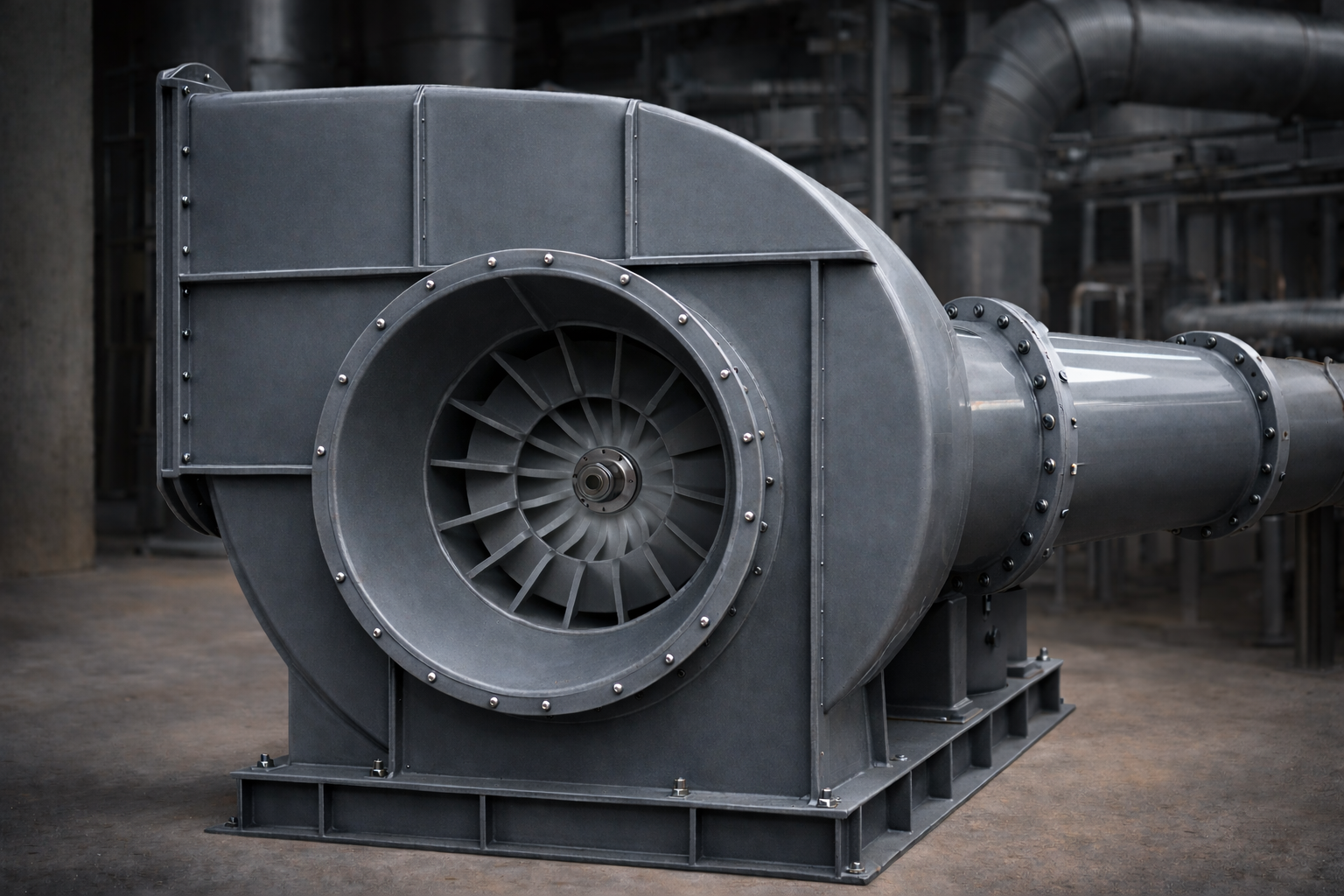
Key Highlights of Centrifugal Blower
- Centrifugal blowers convert rotational kinetic energy into airflow through centrifugal force acting on the impeller, generating higher static pressure than axial fans of comparable size.
- They move air perpendicular to the inlet axis, which makes them fundamentally different from axial fans and suited to applications demanding pressure rise against system resistance.
- Industrial applications span chemical processing, power generation, HVAC, wastewater treatment, and pneumatic material handling, where sustained high-pressure airflow is non-negotiable.
- Modern centrifugal blowers in 2026 increasingly integrate Variable Frequency Drive (VFD) controls and IoT-enabled predictive maintenance platforms to reduce energy consumption and unplanned downtime.
- Selection depends on flow rate, static pressure requirements, gas properties, blade geometry, and compliance with AMCA performance standards.
Definition and Core Working Principle
A centrifugal blower is a mechanical device that uses a rotating impeller to add velocity to a gas stream and then converts that velocity into static pressure energy through controlled deceleration in a volute or diffuser casing. Unlike simple fans, which are optimized for high volume at low pressure, centrifugal blowers are engineered to deliver meaningful pressure rise, typically ranging from 0.5 to 15 psi depending on configuration, making them the workhorse of demanding industrial air handling systems.
The governing physics are rooted in Euler’s turbomachinery equation, which relates the work done on the fluid to the change in angular momentum between the impeller inlet and outlet. In practical terms, when the impeller rotates, it imparts kinetic energy to the air or gas passing through it. That kinetic energy, once the gas exits the impeller at high velocity, is then converted into pressure energy as the gas decelerates through the expanding cross-section of the volute casing. This two-stage energy conversion, first to velocity then to pressure, is what distinguishes centrifugal machines from positive-displacement alternatives such as Roots blowers or reciprocating compressors.
As an centrifugal blower manufacturer with global delivery capability, Envigaurd designs every machine around verified fan curve data rather than catalog approximations, because real-world system resistance curves almost never match textbook assumptions straight out of the box.
The 2026 operating environment is placing new demands on these machines. Regulatory pressure toward decarbonization, rising energy costs, and the proliferation of smart manufacturing frameworks mean that plant engineers can no longer treat blowers as passive infrastructure. Efficiency at part-load conditions, remote diagnostics, and lifecycle cost are now primary selection criteria alongside the traditional metrics of flow and pressure.
Key Components of a Centrifugal Blower
Understanding how a centrifugal blower works requires a clear picture of each component and the specific engineering function it serves. The interaction between these components determines the overall performance envelope of the machine.
Impeller
The impeller is the heart of the machine. It consists of a hub, a series of blades arranged radially or at a defined angle, and a shroud plate that guides the gas from inlet to tip. As the impeller rotates, centrifugal force accelerates the gas outward from the eye (center) to the blade tips, increasing velocity from near-zero at the inlet to the tip speed dictated by rotational frequency and impeller diameter. Tip speeds in industrial centrifugal blowers typically range from 50 to 250 meters per second. Material selection for the impeller depends on the handled medium: stainless steel for corrosive gases, high-strength aluminum alloys for clean air applications, and wear-resistant overlays or engineered plastics for abrasive-laden streams.
Volute Casing
The volute casing is a spiral-shaped housing that surrounds the impeller. Its cross-sectional area increases progressively from the cutoff point around the circumference to the discharge nozzle. This expanding geometry decelerates the high-velocity gas exiting the impeller, converting kinetic energy into static pressure in accordance with Bernoulli’s principle. The design of the volute, specifically the rate of area expansion and the tongue geometry at the cutoff, has a large influence on efficiency and noise generation. Poorly designed volutes create recirculation zones that dissipate energy as heat and turbulence rather than useful pressure.
Inlet and Outlet Connections
The inlet is typically axial, drawing gas directly into the eye of the impeller in a direction parallel to the shaft axis. Inlet conditions matter considerably: a distorted velocity profile caused by an elbow immediately upstream will reduce performance and increase mechanical loading on the shaft and bearings. AMCA standards provide specific installation recommendations around inlet ductwork length and geometry to minimize these effects. The outlet is typically a flanged rectangular or circular nozzle positioned tangentially off the volute. Discharge velocity at the outlet must be managed to avoid excessive pressure loss in downstream ductwork.
Drive Arrangement
Centrifugal blowers are driven either directly by a motor coupled to the shaft or indirectly through belt-and-sheave or gear transmission systems. Direct drive eliminates slip losses and reduces maintenance intervals, but locks the machine to motor speed. Indirect drive allows speed adjustment through sheave diameter changes, though this is a coarse and manual form of control. In 2026, the most capable installations combine direct coupling with a Variable Frequency Drive on the motor, enabling precise, continuous speed modulation to match system demand in real time.
Motor
The motor converts electrical energy into the shaft rotation that powers the impeller. In modern industrial installations, high-efficiency induction motors meeting IE3 or IE4 efficiency classifications are standard, and IE5 ultra-premium motors are gaining traction as energy costs and carbon accounting requirements tighten. Motor selection must account for starting torque characteristics, ambient temperature, ingress protection rating, and compatibility with VFD operation if variable speed is planned. A centrifugal blower’s power consumption scales with the cube of impeller speed, so even modest reductions in operating speed through VFD control can produce dramatic energy savings at part-load conditions.
Types of Centrifugal Blowers by Blade Design
Blade geometry is the primary design variable that determines the performance character of a centrifugal blower. Three blade configurations dominate industrial practice, each representing a different balance between efficiency, pressure capability, and self-limiting power behavior.
| Blade Type | Efficiency | Pressure Capability | Power Behavior | Typical Application |
|---|---|---|---|---|
| Backward-Curved (BCF) | High (up to 85%) | Moderate to High | Non-overloading | HVAC, clean air systems, general industrial |
| Forward-Curved (FCF) | Moderate | Moderate | Overloading (rises with flow) | Low-pressure HVAC, room ventilation |
| Radial (Paddle) | Lower | High | Stable, non-overloading | Material handling, dusty/abrasive environments |
| Airfoil (AF) | Highest (up to 87%) | Moderate to High | Non-overloading | Large HVAC, clean room, data centers |
Backward-curved blades are the configuration of choice for most industrial applications where efficiency is a priority and the gas stream is relatively clean. The blade angle at the impeller outlet is less than 90 degrees relative to the direction of rotation, which results in a non-overloading power curve. This means that even if the system resistance drops unexpectedly, the motor will not be driven into overload, a critical protection characteristic for unmanned or remotely monitored installations.
Radial blades, sometimes called paddle wheels, sacrifice efficiency for robustness. Their geometry is self-cleaning: material that enters with the gas stream tends to be flung off the blade surface rather than accumulating. This makes radial blade centrifugal blowers the standard choice for pneumatic conveying, cement handling, and any application where the gas carries significant particulate matter.
Airfoil blades apply aerodynamic profile theory to achieve the lowest drag and highest efficiency, typically reserved for large, clean-air installations where the capital premium for precision-manufactured blades is justified by long-term energy savings.
How Centrifugal Blowers Differ from Axial Fans
The distinction between centrifugal and axial machines is not merely a matter of size or application category. It reflects a fundamentally different approach to fluid mechanics and system integration.
In an axial fan, air enters and exits the machine in the same axial direction, parallel to the shaft. The blades generate lift in the aerodynamic sense, accelerating the gas in the direction of flow. Axial machines are highly efficient at moving large volumes of air against low system resistance, which is why they dominate applications such as cooling towers, mine ventilation, and large building supply air systems where duct pressure losses are modest.
In a centrifugal blower fan configuration, gas enters axially but exits radially, perpendicular to the inlet flow direction. This 90-degree turn in flow path is what enables the much higher static pressure capability of centrifugal machines. When system resistance is high, as it is in long duct runs, filter banks, process vessels, and scrubbers, centrifugal machines maintain flow far more effectively than axial alternatives. They are also inherently more tolerant of upstream flow disturbances and can handle denser gas streams, elevated temperatures, and corrosive or moisture-laden atmospheres that would destroy axial fan blades.
The practical crossover point is generally around 500 Pa of system static pressure. Below that, axial fans are often the more economical and efficient choice. Above it, centrifugal blowers are almost always specified.
Key Performance Parameters
Selecting and operating a centrifugal blower correctly requires fluency with the performance parameters that define machine behavior. These are the quantities that govern both specification and ongoing operational assessment.
Air Volume (Flow Rate): Expressed in cubic meters per hour (m3/h) or cubic feet per minute (CFM), this is the volumetric quantity of gas moved by the blower per unit time. Note that volume is not the same as mass: a blower moving hot or humid gas at a stated volume is moving less mass than the same blower handling dense cold air, which has direct implications for process performance.
Static Pressure: The pressure rise generated by the blower, measured in Pascals, inches water gauge (inWG), or millimeters water column (mmWC). This must exceed the total system resistance, including losses in ductwork, filters, heat exchangers, and any downstream process equipment, for the system to deliver the required flow.
Fan Curves: The graphical relationship between flow rate and static pressure for a given impeller diameter and rotational speed. Fan curves are the primary engineering tool for matching a blower to a system. The intersection of the fan curve with the system resistance curve is the operating point. If the system curve is steeper than expected, flow will be lower than designed. VFD control effectively shifts the fan curve up or down by changing speed, providing the flexibility to maintain the correct operating point across varying process conditions.
Efficiency: The ratio of useful aerodynamic power delivered to the gas versus the shaft power input. Peak efficiency is a single point on the fan curve, and operation far from this point in either direction results in wasted energy and accelerated wear. AMCA 210 certification provides a standardized and independently verified efficiency rating that allows meaningful comparison between competing products.
Specific Speed: A dimensionless index that classifies impeller geometry based on the combined requirements of flow and pressure. Low specific speed corresponds to high-pressure, low-flow machines with narrow impellers, while high specific speed corresponds to high-flow, lower-pressure designs with wider blade passages. Selecting an impeller with the appropriate specific speed for the application is one of the most consequential early design decisions.
AMCA Standards: The Air Movement and Control Association International (AMCA) publishes the authoritative performance test standards for industrial blowers. AMCA 210 governs laboratory methods for measuring fan performance, and AMCA 300 covers sound measurement. Specifying AMCA-certified equipment ensures that nameplate ratings reflect actual performance rather than theoretical calculations.
Industrial Applications in 2026
The range of industries relying on industrial centrifugal blower technology continues to expand as process engineers recognize the breadth of applications where controlled high-pressure airflow is a critical process variable rather than a utility afterthought.
Chemical Processing: Centrifugal blowers move process gases through reactors, supply combustion air to burners, and provide stripping air in distillation and absorption columns. In this sector, material compatibility is paramount, and blowers are frequently specified in exotic alloys or with fluoropolymer coatings to resist corrosive gases.
Power Generation: Forced draft (FD) and induced draft (ID) fans in thermal power stations are large centrifugal machines. As the power sector transitions toward cleaner fuels and flexible operation to complement intermittent renewables, blowers must increasingly operate efficiently across a wider load range, a requirement that VFD integration addresses directly.
Wastewater Treatment: Aeration blowers supplying dissolved oxygen to biological treatment tanks represent one of the most energy-intensive loads in a wastewater plant, often accounting for 50 to 60 percent of total facility energy consumption. The shift from older lobe blowers to high-efficiency centrifugal blowers with VFD and dissolved oxygen feedback control is delivering documented energy reductions of 20 to 40 percent at operating plants worldwide.
HVAC and Commercial Buildings: Large-scale air handling units in data centers, hospitals, and industrial facilities rely on centrifugal fans and blowers for supply and return air at static pressures that axial fans cannot economically meet. In 2026, building automation integration means these blowers operate as responsive elements within demand-controlled ventilation systems rather than fixed-speed assets.
Pneumatic Material Handling: Cement, grain, plastic pellets, pharmaceutical powders, and a wide range of bulk solids are conveyed through pipelines by the pressure differential generated by centrifugal blowers in dilute-phase or dense-phase pneumatic conveying systems. The radial blade configuration dominates here due to its robustness and resistance to clogging.
Mining and Mineral Processing: Mine ventilation, kiln combustion air, and process gas recirculation in smelting operations all place heavy demands on centrifugal blowers, often in high-temperature, dusty, and remote environments where reliability and maintainability are as important as initial efficiency.
The 2026 Shift: Smart Blowers and Energy Efficiency
The industrial landscape is undergoing a measurable transformation driven by three converging forces: tightening energy regulations, corporate decarbonization commitments, and the maturation of affordable IoT sensing and edge computing hardware. Centrifugal blowers are at the center of this shift.
Variable Frequency Drives, once considered premium additions for large installations, are now standard specification items even on mid-size blower packages. The payback period for VFD integration has shortened to one to three years in many applications as electricity costs have risen, making the capital case straightforward. Beyond energy savings, VFDs enable soft starting, which dramatically reduces mechanical stress on couplings, bearings, and impellers during startup cycles, extending equipment life.
IoT-enabled predictive maintenance is moving from pilot projects to operational reality. Vibration sensors mounted on bearing housings, current signature analysis on motor windings, and differential pressure monitoring across filters all feed into cloud analytics platforms that detect developing faults weeks or months before they produce unplanned downtime. For centrifugal blowers in critical continuous-process applications, this capability shift is transforming maintenance strategy from time-based replacement cycles to condition-based interventions.
Digital twin technology, in which a computational model of the blower is updated in real time with operational sensor data, is enabling plant engineers to evaluate the impact of process changes on blower performance without physical testing. This is particularly valuable in chemical and refining applications where feed compositions and throughput requirements change frequently.
Envigaurd incorporates these capabilities into its high-pressure blower packages, delivering machines that are not only sized correctly for the application but are instrumented and software-ready for integration with plant-wide energy management and asset performance platforms.
Selection Criteria for Centrifugal Blowers
Selecting the wrong blower for an application is one of the more costly engineering errors in industrial plant design. The consequences manifest as chronic underperformance, elevated energy consumption, premature bearing and seal failure, or, in the worst cases, impeller failures that endanger personnel and damage adjacent equipment.
A rigorous selection process addresses the following parameters in sequence:
Flow Rate and Static Pressure: The process or system engineer must provide a verified flow requirement and a complete system resistance calculation, accounting for all duct sections, fittings, heat exchangers, filters, and process equipment in the gas path. Both the design point and the expected range of operating conditions must be defined, as a blower that performs well at design conditions may be unstable or inefficient at the actual part-load operating hours that dominate its real service life.
Gas Properties: Density, temperature, molecular weight, moisture content, dust loading, and chemical composition all affect blower sizing and material selection. A blower sized on standard air density (1.2 kg/m3 at 20 degrees Celsius, sea level) will underperform if the actual gas is hot, humid, or at elevation. Gas composition determines material compatibility requirements, which in turn affect casing material, impeller alloy, seal type, and surface treatment specifications.
Blade Geometry: As discussed above, the choice between backward-curved, radial, and airfoil configurations must reflect the cleanliness of the gas stream, the required pressure capability, and the efficiency targets for the installation.
Drive and Speed Control: The decision between direct coupling and indirect drive, and between fixed-speed and variable-speed operation, must be made based on the expected load profile and the economic value of energy savings over the equipment lifecycle rather than on initial capital cost alone.
Installation and Maintenance Access: Blower orientation (horizontal or vertical shaft), casing split configuration (vertically or horizontally split), and bearing access must be assessed against the physical constraints of the installation and the maintenance capabilities of the operating team.
Compliance and Certification: AMCA certification for performance and sound, applicable pressure vessel codes, local electrical and machinery safety standards, and any customer-specific engineering standards should be confirmed during the specification phase, not during final inspection.
Need a Custom Centrifugal Blower Built to Your Specifications?
Envigaurd engineers design and supply high-pressure centrifugal blowers globally, from initial assessment to final delivery. Request a Free Engineering Consultation
Frequently Asked Questions
What is the difference between a centrifugal blower and a fan?
Both centrifugal blowers and fans use rotating impellers to move air, but they operate at different pressure and flow regimes. Fans typically operate at static pressures below 500 Pa and prioritize high volume flow with low energy input. Centrifugal blowers are designed for substantially higher static pressure rise, often from 500 Pa up to several thousand Pascals or higher, enabling them to overcome significant system resistance in ductwork, process vessels, and filtration equipment. The term “centrifugal fan” is often used interchangeably in industrial practice, but when engineers specify a blower, they are referencing a machine engineered for elevated pressure duty. A centrifugal blower fan is therefore a subset of the broader fan family, distinguished by its pressure capability and the engineering standards applied in its design and testing.
What is a centrifugal blower used for?
Centrifugal blowers serve a wide range of industrial and commercial applications wherever sustained high-pressure airflow is required. Major application categories include aeration in wastewater treatment plants, combustion and draft control in power stations and industrial furnaces, process gas circulation in chemical and petrochemical plants, pneumatic conveying of bulk solids in food, pharmaceutical, cement, and plastics industries, ventilation of large industrial facilities and mines, and supply air in high-resistance HVAC systems. The global centrifugal fans and blowers market reflects this breadth, with growth driven by expanding industrialization, tightening environmental compliance requirements, and the ongoing transition toward energy-efficient air handling systems across all sectors.
How does a centrifugal blower work step by step?
The operating sequence of a centrifugal blower proceeds as follows. First, the drive motor applies torque to the shaft, rotating the impeller at the design speed. Second, the rotating blades create a low-pressure region at the impeller eye, drawing gas axially into the center of the impeller from the inlet duct. Third, as the gas passes through the blade passages, centrifugal force accelerates it radially outward, increasing its velocity from near-zero at the eye to maximum at the blade tips. Fourth, the high-velocity gas exits the impeller tip and enters the volute casing, where the expanding cross-sectional area causes the gas to decelerate, converting kinetic energy into static pressure in accordance with Bernoulli’s principle. Fifth, the pressurized gas exits through the discharge nozzle into the connected process or ductwork system.
What are the parts of a centrifugal blower?
The primary components of a centrifugal blower are the impeller, which accelerates the gas through rotation; the volute casing, which converts velocity to pressure and contains the impeller; the inlet connection and inlet cone, which guide gas into the impeller eye; the discharge nozzle, which delivers pressurized gas to the connected system; the shaft, which transmits torque from the motor to the impeller; the bearings, which support the shaft under radial and axial loads; the seals, which prevent gas leakage between the rotating shaft and stationary casing; the coupling, which connects the shaft to the motor or gearbox; and the motor, which provides the driving power. In modern installations, the component list also includes VFD panels, vibration sensors, temperature transmitters, and differential pressure instrumentation as integral elements of the blower system rather than ancillary accessories.
Conclusion
The centrifugal blower remains one of the most versatile and mechanically reliable machines in industrial engineering. Its fundamental operating principle, converting shaft rotation into pressurized airflow through centrifugal force and controlled deceleration, has remained essentially unchanged for more than a century. What has changed dramatically, particularly entering 2026 and looking toward 2027, is the intelligence and adaptability that surrounds this core mechanism.
Variable speed drives have transformed blowers from fixed-point machines into adaptive systems that track process demand. IoT instrumentation has shifted maintenance from reactive repair to predictive intervention. Advanced materials and precision manufacturing have pushed efficiency boundaries that engineers of a previous generation would have considered theoretical limits rather than commercially available specifications.
For plant engineers, procurement specialists, and project managers specifying industrial air handling equipment in this environment, the centrifugal blower selection process must integrate performance, energy economics, smart system compatibility, and lifecycle cost into a single coherent evaluation. Getting that evaluation right from the first engineering consultation is the difference between a blower that performs for 25 years with minimal intervention and one that becomes a chronic maintenance problem within the first operating cycle.
Envigaurd’s engineering team brings deep expertise in high-pressure centrifugal blower design, from initial application assessment through mechanical design, material specification, manufacturing, and global supply. If your process requires a custom centrifugal blower solution, contact Envigaurd to begin the engineering conversation.