Skip to content
1. CFM Full Form and Fundamental Definition
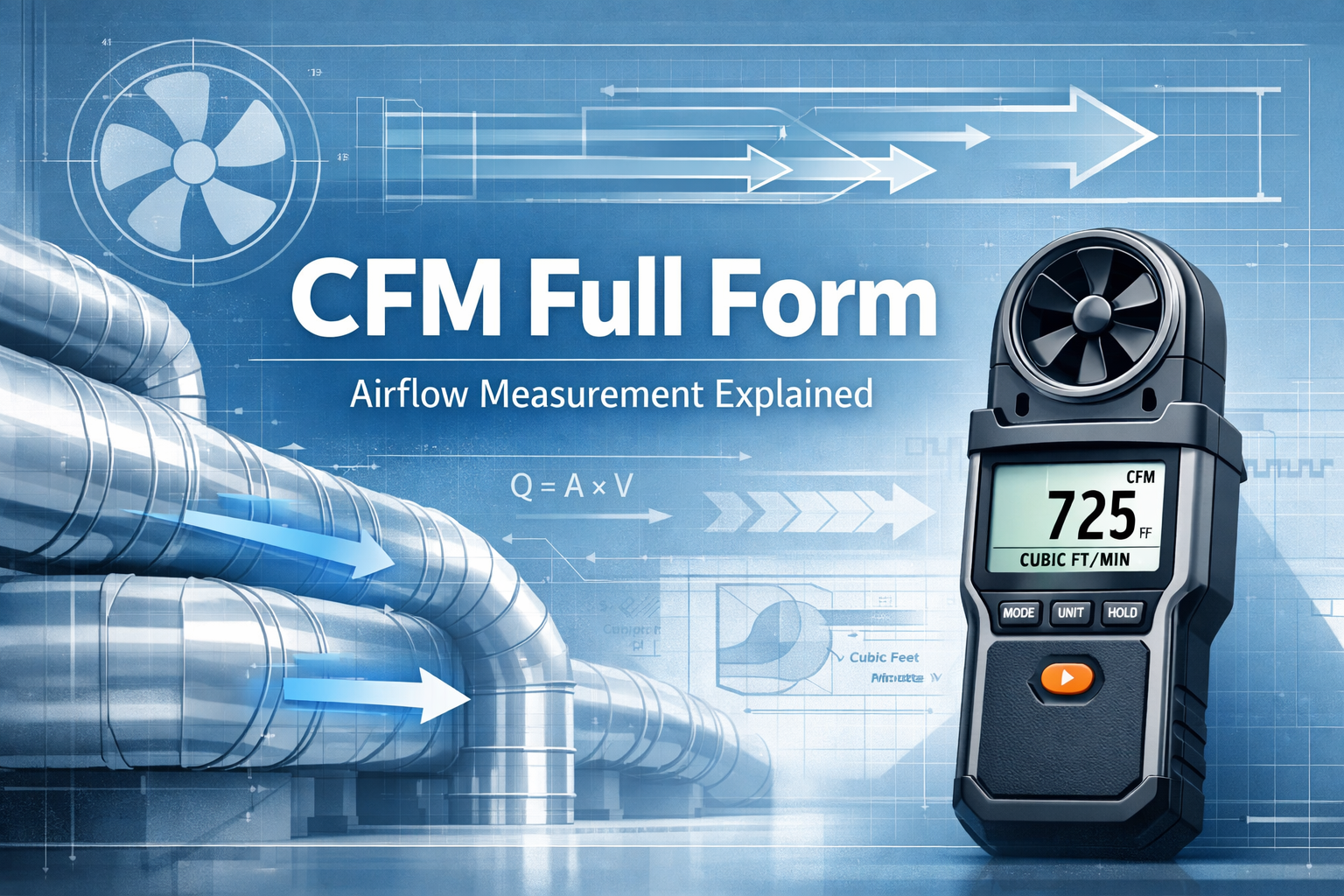
CFM stands for Cubic Feet per Minute. It is the standard imperial unit of volumetric airflow rate used extensively across the HVAC (Heating, Ventilation, and Air Conditioning) industry in the United States and several other countries that follow the imperial system of measurement.
| Engineering Definition CFM is defined as the volume of air (in cubic feet) that moves past a given point in one minute. It quantifies how much air is being supplied, exhausted, or circulated by a mechanical system within a unit of time. |
Mathematically: 1 CFM = 1 cubic foot of air per minute = approximately 0.000471947 m³/s (cubic meters per second) in SI units, or 1.699 m³/hour.
1.1 Unit Equivalents and Conversions
| Unit | Equivalent Value | Common Usage Region |
| 1 CFM | 0.4719 L/s (Litres/second) | US, Canada |
| 1 CFM | 28.317 L/min | US Imperial |
| 1 CFM | 1.699 m³/hr | Europe (SI) |
| 1 CFM | 0.000472 m³/s | Global Scientific |
| 1 L/s | 2.119 CFM | Reverse conversion |
| 1 m³/hr | 0.5886 CFM | Reverse conversion |
2. Why CFM Matters in HVAC Engineering
As an HVAC engineer with EnviGaurd, CFM is arguably the single most important metric in ventilation system design, commissioning, and performance verification. It directly determines:
- Whether a space receives adequate fresh outdoor air to maintain occupant health and cognitive function
- Whether contaminants, odors, heat, and humidity are effectively diluted and removed
- The capacity and sizing of air handling units (AHUs), fans, ductwork, and terminal devices
- Compliance with ASHRAE, NBC, OSHA, NFPA, and local building codes
- Energy consumption, oversized systems waste electricity; undersized systems fail to perform
- Pressurization relationships between spaces (positive/negative pressure control)
CFM is not just a design parameter, it is a measurable, verifiable, and enforceable standard. TAB (Testing, Adjusting, and Balancing) technicians physically measure CFM at every terminal device to confirm that the design intent has been achieved in the field.
3. The Fundamental CFM Formula
The core relationship governing airflow is derived from basic fluid mechanics:
| CFM = Area (ft²) × Velocity (FPM) Where FPM = Feet Per Minute (air velocity), and Area = cross-sectional duct or opening area in square feet |
Example: A 24″ × 12″ duct (2 ft × 1 ft = 2 ft²) with an air velocity of 800 FPM carries: CFM = 2 × 800 = 1,600 CFM
3.1 Heat Transfer CFM Formula (Sensible)
| CFM = Q ÷ (1.08 × ΔT) Q = Sensible heat load (BTU/hr), ΔT = Temperature difference (°F), 1.08 = constant derived from air density and specific heat |
3.2 Latent Load CFM Formula
| CFM = Q_latent ÷ (0.68 × ΔW) Q_latent = Latent heat load (BTU/hr), ΔW = Humidity ratio difference (grains/lb), 0.68 = psychrometric constant |
4. Where CFM Calculation is Required, Complete Application Guide
As EnviGaurd HVAC engineers, CFM calculations are mandatory across every phase and every system type. Below is a comprehensive breakdown:
4.1 Outdoor Air Ventilation (ASHRAE 62.1)
ASHRAE Standard 62.1 mandates minimum ventilation rates for acceptable indoor air quality. CFM is calculated per person (occupant-based) and per unit floor area (area-based):
| Space Type | People Component (CFM/person) | Area Component (CFM/ft²) | Typical Occupancy |
| Office – Open Plan | 5 | 0.06 | 5 people/1000 ft² |
| Conference Room | 5 | 0.06 | 50 people/1000 ft² |
| Classroom | 10 | 0.12 | 35 people/1000 ft² |
| Hospital Patient Room | 25 | 0.06 | 10 people/1000 ft² |
| Restaurant Dining | 7.5 | 0.18 | 70 people/1000 ft² |
| Retail Store | 7.5 | 0.12 | 15 people/1000 ft² |
| Gym / Fitness | 10 | 0.18 | 10 people/1000 ft² |
| Clean Room (ISO 7) | N/A | Site-specific | Controlled |
| Vbz = (Rp × Pz) + (Ra × Az) Vbz = Breathing zone outdoor airflow | Rp = People rate (CFM/person) | Pz = Number of occupants | Ra = Area rate (CFM/ft²) | Az = Zone floor area |
4.2 Cooling Load CFM, Sensible Heat Removal
When HVAC equipment is sized for cooling, the supply air CFM required to remove the sensible heat load of a space is calculated as:
| CFM = Q_sensible ÷ (1.08 × (T_room − T_supply)) Typical supply air temperature: 55°F (13°C). Room setpoint: 75°F (24°C). ΔT = 20°F |
Example: A server room with 24,000 BTU/hr sensible load needs: CFM = 24,000 ÷ (1.08 × 20) = 1,111 CFM of supply air
4.3 Heating Load CFM
For heating systems, the supply air must be warm enough to offset heat losses. CFM is calculated similarly:
| CFM = Q_heating ÷ (1.08 × (T_supply − T_room)) Supply air for heating is typically 100–120°F. Room setpoint: 70°F. ΔT ≈ 30–50°F |
4.4 Duct Sizing and Airflow Distribution
Every segment of a duct network is designed around CFM. The total system CFM is distributed to each branch and terminal unit. Key relationships:
- Main trunk ducts carry total system CFM (sum of all zones)
- Branch ducts carry zone-level CFM
- Diffusers/grilles carry room-level CFM
- Duct velocity is verified against ASHRAE recommended limits (typically 600–2,000 FPM for low-velocity systems)
| Duct Type | Recommended Velocity (FPM) | Resulting Duct Size for 1,000 CFM |
| Main Supply Trunk | 800 – 1,200 | ~10″ × 12″ rectangular or 12″ round |
| Branch Supply | 600 – 900 | ~8″ × 10″ or 10″ round |
| Return Air Trunk | 600 – 900 | ~12″ × 14″ |
| Final Branch to Diffuser | 400 – 600 | ~6″ – 8″ round flex duct |
4.5 Exhaust Systems, Kitchen, Toilet, Parking
Local exhaust ventilation requires CFM calculations based on contaminant generation rate or code-mandated air changes per hour (ACH):
| CFM = (Room Volume ft³ × ACH) ÷ 60 ACH = Air Changes per Hour required by code or engineering judgment |
| Application | Required ACH | CFM per 1,000 ft³ Room |
| Commercial Kitchen Hood | 30–60 ACH (makeup air) | 500 – 1,000 CFM |
| Toilet / Restroom | 6–10 ACH | 100 – 167 CFM |
| Underground Parking Garage | 4–6 ACH (CO control) | 67 – 100 CFM |
| Paint Booth | 60–100 ACH | 1,000 – 1,667 CFM |
| Laboratory Fume Hood | 60–100 ACH face velocity based | Custom per hood size |
| Hospital Isolation Room | 12 ACH (ASHRAE 170) | 200 CFM |
| Operating Theater | 20 ACH minimum | 333 CFM |
4.6 Clean Rooms and Critical Environments
Clean rooms are classified by particle count per ISO 14644. CFM requirements are extraordinarily high to achieve the required dilution and filtration:
| ISO Class | Cleanliness Level | Typical ACH | Typical Ceiling Coverage |
| ISO 1 (Class 1) | Highest, Semiconductor Fabs | 500 – 600 ACH | 80 – 100% ULPA |
| ISO 5 (Class 100) | Pharmaceutical Fill/Finish | 240 – 360 ACH | 30 – 50% HEPA |
| ISO 7 (Class 10,000) | Surgical Instruments | 30 – 60 ACH | 15 – 25% HEPA |
| ISO 8 (Class 100,000) | General Manufacturing | 10 – 25 ACH | 5 – 10% HEPA |
4.7 Pressurization Control
Controlling air pressure between spaces requires precise CFM calculations. EnviGaurd routinely designs pressurization for infection control (hospitals), odor containment (labs), and product protection (pharma):
| Net Pressurization CFM = Supply CFM − Exhaust CFM Positive pressure: Supply > Exhaust | Negative pressure: Exhaust > Supply | Neutral: Supply = Exhaust |
| Space Type | Pressure Relationship | Typical Net CFM Offset |
| Hospital Isolation Room | Negative (−8 Pa) | −25 to −50 CFM net exhaust |
| Operating Theater | Positive (+8 Pa) | +25 to +50 CFM net supply |
| Pharmacy Compounding | Positive (+12.5 Pa) | +50 CFM net supply |
| Janitor / Soiled Utility | Negative (−8 Pa) | −25 CFM net exhaust |
| Hazardous Chemical Lab | Negative (−12.5 Pa) | −50 CFM net exhaust |
4.8 Makeup Air Units (MAU)
When exhaust removes air from a building, an equal volume of outdoor air must be mechanically introduced to maintain pressure balance. This makeup air CFM equals the total exhaust CFM:
| Makeup Air CFM = Total Exhaust CFM (minus infiltration allowance) Infiltration credit is typically 10–15% in well-sealed modern buildings |
4.9 Fan Selection and Matching
Fans are selected on a CFM vs. static pressure curve basis. The system curve (resistance) and fan curve intersect at the operating point. Key parameters:
- System CFM requirement is determined by load calculations
- External Static Pressure (ESP) is calculated from duct friction losses (inches WC / 100 ft) and fitting losses
- Fan laws: CFM varies with RPM; pressure varies with RPM²; power varies with RPM³
| New CFM = Old CFM × (New RPM ÷ Old RPM) Fan Affinity Law, used for VFD (Variable Frequency Drive) speed control calculations |
4.10 VAV (Variable Air Volume) Systems
In VAV systems, CFM is modulated between a minimum (typically 30% of design) and maximum based on zone demand. EnviGaurd designs VAV systems with:
- Cooling maximum CFM: Based on sensible cooling load (see Section 4.2)
- Heating minimum CFM: Based on ASHRAE 62.1 ventilation requirement
- Minimum position: Must not go below ventilation requirement even when zone is satisfied
- System diversity factor: Total installed CFM × 0.70–0.85 for central plant sizing
4.11 Return Air CFM Calculations
Return air must balance supply air (less any pressurization offset). EnviGaurd calculates:
| Return CFM = Supply CFM − Transfer CFM − Exhaust CFM − Pressurization Offset Transfer air flows from one zone to adjacent through transfer grilles or undercut doors |
4.12 Industrial Ventilation and Dilution
In manufacturing environments, CFM is calculated to dilute contaminants below TLV (Threshold Limit Value) or PEL (Permissible Exposure Limit):
| CFM = (Generation Rate × K) ÷ (C_limit − C_inlet) K = Safety factor (3–10), C_limit = Allowable concentration (PPM), C_inlet = Incoming air concentration |
4.13 TAB (Testing, Adjusting and Balancing)
TAB technicians verify installed CFM against design using:
- Pitot tube traversal in ducts, measures velocity pressure, converts to FPM × Area = CFM
- Flow hood (capture hood) placed over diffusers and grilles, direct CFM reading
- Vane anemometer at face of registers, velocity × area = CFM
- Differential pressure across fan, used with fan curve to verify operating point
| 📌 EnviGaurd Field Note All TAB measurements must be within ±10% of design CFM per ASHRAE 111 and SMACNA standards. Deviations exceeding this require re-balancing or engineering evaluation before project acceptance. |
5. CFM in HVAC Equipment Selection
| Equipment Type | CFM Role | Typical Range |
| Split AC / Packaged Unit | Defines cooling/heating capacity & coil face velocity | 400 – 600 CFM per ton cooling |
| Air Handling Unit (AHU) | Total supply air, OA, return air, exhaust CFM | 500 – 50,000+ CFM |
| Fan Coil Unit (FCU) | Zone-level supply CFM for terminal cooling/heating | 100 – 2,000 CFM |
| Energy Recovery Ventilator (ERV) | OA and exhaust CFM must match for max efficiency | 50 – 10,000 CFM |
| DOAS (Dedicated OA System) | 100% outdoor air CFM to meet ventilation code | 500 – 20,000 CFM |
| Kitchen Hood Exhaust Fan | Hood capture velocity (75–100 FPM) × hood area | 500 – 8,000 CFM |
| Bathroom Exhaust Fan | CFM rating must meet code (50 CFM min or 1 ACH) | 50 – 110 CFM |
6. Codes and Standards Governing CFM Requirements
| Standard / Code | Authority | CFM Application |
| ASHRAE 62.1-2022 | ASHRAE | Minimum ventilation CFM for commercial occupancies |
| ASHRAE 62.2-2022 | ASHRAE | Minimum ventilation CFM for residential |
| ASHRAE 90.1-2022 | ASHRAE | Maximum CFM limits for energy efficiency |
| ASHRAE 170-2021 | ASHRAE | Healthcare facility ventilation CFM and ACH |
| SMACNA Duct Design | SMACNA | Duct sizing, velocity, CFM distribution |
| NFPA 96 | NFPA | Kitchen exhaust hood CFM requirements |
| OSHA 29 CFR 1910 | OSHA | Industrial ventilation CFM for worker safety |
| ISO 14644 | ISO | Clean room CFM and air change requirements |
| NBC / NPC (India) | BIS | Ventilation CFM for Indian building codes |
7. Common CFM Mistakes to Avoid
- Neglecting diversity factor: Sizing the central plant at 100% of all peak zone CFMs simultaneously leads to massive oversizing. Apply 70–80% diversity.
- Ignoring duct leakage: Actual delivered CFM at terminals can be 15–30% less than fan CFM due to duct leakage. Seal ducts to SMACNA Class A or B.
- Wrong density assumption: Standard air = 0.075 lb/ft³ at sea level, 70°F. At high altitudes or high temperatures, density drops and CFM must be corrected.
- Confusing CFM with FPM: CFM is volumetric flow; FPM is velocity. Using FPM values in CFM formulas is a critical error that causes sizing failures.
- Forgetting supply/return balance: Every CFM of supply must return somewhere. Unaccounted return paths cause pressurization problems and noise.
- Not accounting for duct static pressure: High CFM through undersized ducts creates excessive noise (high velocity), energy waste, and pressure imbalance.
8. CFM vs. SI Unit (L/s), EnviGaurd Dual-Standard Practice
EnviGaurd serves both US-market and international clients. Our engineers are fluent in both systems:
| Parameter | Imperial (CFM) | SI Equivalent |
| Ventilation Rate | 0.15 CFM/ft² | 0.76 L/s·m² |
| Supply Air Constant | 1.08 (BTU·min/hr·ft³·°F) | 1.2 (W·s/L·°C) |
| Duct Friction | in WC/100 ft | Pa/m |
| Fan Pressure | inches WC | Pascals (Pa) |
| Air Velocity | FPM (ft/min) | m/s |
9. EnviGaurd CFM Calculation Workflow Summary
Our standard design process follows this systematic CFM calculation sequence:
- STEP 1, Establish occupancy and space use: Determine occupant count, schedule, and activity level
- STEP 2, Calculate ventilation CFM: Apply ASHRAE 62.1 Vbz formula per zone
- STEP 3, Calculate cooling CFM: Q_sensible ÷ (1.08 × ΔT)
- STEP 4, Determine controlling CFM: Max of ventilation CFM and cooling/heating CFM
- STEP 5, Calculate exhaust and makeup air CFM: Match to local exhaust requirements
- STEP 6, Perform duct sizing: Size all ducts for velocity within ASHRAE limits
- STEP 7, Verify system balance: Supply = Return + Exhaust ± pressurization offset
- STEP 8, Select equipment: Match fan and AHU to system CFM and static pressure
- STEP 9, Commission and TAB: Verify installed CFM meets design within ±10%
| EnviGaurd Engineering Principle CFM is not just a number, it is the breath of a building. Every CFM delivered to an occupant is a commitment to health, comfort, and code compliance. As HVAC engineers, our foremost responsibility is to ensure that every cubic foot of air, every minute, reaches where it was designed to go, at the right temperature, humidity, and cleanliness. |
Document Information
Prepared by: EnviGaurd HVAC Engineering Division
Standards Referenced: ASHRAE 62.1-2022, ASHRAE 90.1-2022, ASHRAE 170-2021, SMACNA, NFPA 96, OSHA 29 CFR 1910, ISO 14644
This document is intended as a technical reference for qualified HVAC engineers and does not replace project-specific engineering calculations, local code compliance review, or professional judgment.