Skip to content
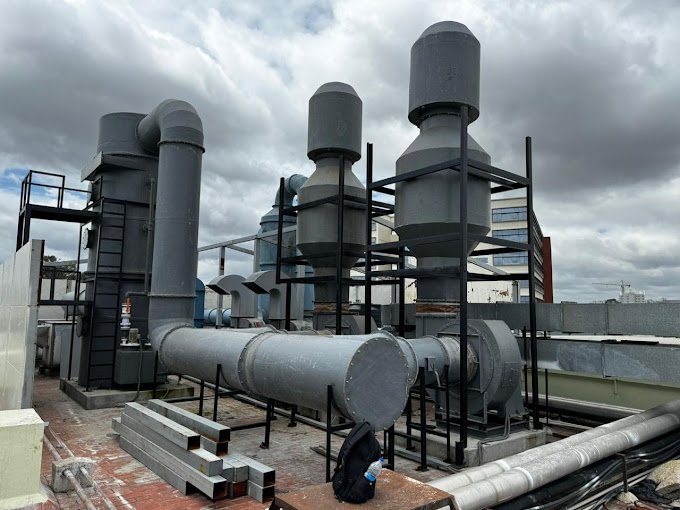
In the complex landscape of industrial manufacturing, environmental compliance is not merely a legal checkbox, it is a critical operational parameter. Having spent over a decade designing and executing industrial air pollution control systems across India, I have observed that the difference between a plant that runs smoothly and one that faces constant shutdowns often lies in the robustness of its pollution control infrastructure.
At Envigaurd, we do not view a wet scrubber as an off-the-shelf commodity. We view it as a complex process engineering system that must integrate seamlessly with your production line. Whether you are managing a corrosive acid fume stream in a chemical plant or handling massive dust loads in a cement unit, the right wet scrubber system is the cornerstone of your environmental strategy.
Overview of Wet Scrubber Systems in Industrial Pollution Control
What a wet scrubber system is in real industrial operations
In practical terms, a wet scrubber system is a dedicated assembly of vessels, pumps, fans, and piping designed to remove contaminants from an exhaust stream by washing them with a liquid slurry. Unlike simple filtration, which traps particles, a wet scrubber system actively treats the gas stream. It changes the state of the pollutant, transforming toxic gases into soluble salts or capturing dust in a liquid slurry, thereby neutralizing the hazard before it is released into the atmosphere.
Why integrated scrubber systems are critical for compliance-driven industries
For industries governed by strict CPCB (Central Pollution Control Board) and state pollution control board norms, piecemeal solutions often fail to deliver consistent data. An integrated wet scrubber system ensures that every variable, from inlet temperature to recirculation tank pH, is controlled. In sectors like pharmaceuticals and fertilizers, where even a minor leak can halt production, a system-wide approach ensures that safety and compliance are built-in, not bolted-on.
Envigaurd’s approach to engineered wet scrubber solutions
At Envigaurd, our engineering philosophy is rooted in “Application Specificity.” We do not force a standard design onto a unique process. We analyze the gas stream composition, flow rates, and particulate loading to design wet scrubber systems for light, medium, and heavy industries. Our solutions range from compact, skid-mounted units for solvent fumes to massive, concrete-lined structures for cement kiln exhaust.
Wet Scrubber System Working Principle (Engineer’s Perspective)
Gas–liquid contact mechanisms used in Envigaurd systems
The efficiency of any wet scrubber system working principle relies on maximizing the surface area of contact between the dirty gas and the scrubbing liquid.
- Impaction: Used primarily for dust removal. We force the gas through a constricted throat or around packing media, causing particles to collide with liquid droplets due to inertia.
- Absorption: Used for gases. This is a mass transfer operation where the gaseous pollutant dissolves into the liquid. We enhance this by selecting packing media that creates a thin, turbulent film of liquid.
Absorption, impaction, and dust capture logic
The physics is straightforward but the execution is nuanced. In our designs, we calculate the “cut-point”—the particle size at which 50% efficiency is achieved. By adjusting the gas velocity and liquid droplet size, we shift this curve to capture even sub-micron particles. For gases like HCl or Cl2, we rely on chemical reaction kinetics, ensuring the reagent in the liquid (usually NaOH or Ca(OH)2) is available in stoichiometric excess to drive the reaction to completion.
How system design impacts efficiency, pressure drop, and operating cost
There is always a trade-off between efficiency and energy. A Venturi scrubber designed for 99.9% dust removal will have a high pressure drop (measured in mmWC), requiring a powerful, energy-hungry Induced Draft (ID) fan. Our engineering team optimizes this curve. By using Computational Fluid Dynamics (CFD) simulations where necessary, we design the internal geometry to maximize efficiency while minimizing the pressure drop, thereby reducing your long-term operating costs.
Typical performance ranges achieved in industrial applications
For our standard wet scrubber system installations, we typically target and achieve:
- Particulate Removal: 95% to 99.9% for particles > 1 micron.
- Acid Gas Removal: 95% to 99.5% removal efficiency for HCl, HF, and SO2.
- Pressure Drop: Maintained between 50mmWC to 400mmWC depending on the type, ensuring optimal fan energy consumption.
Wet Scrubber System Diagram & Process Flow Explanation
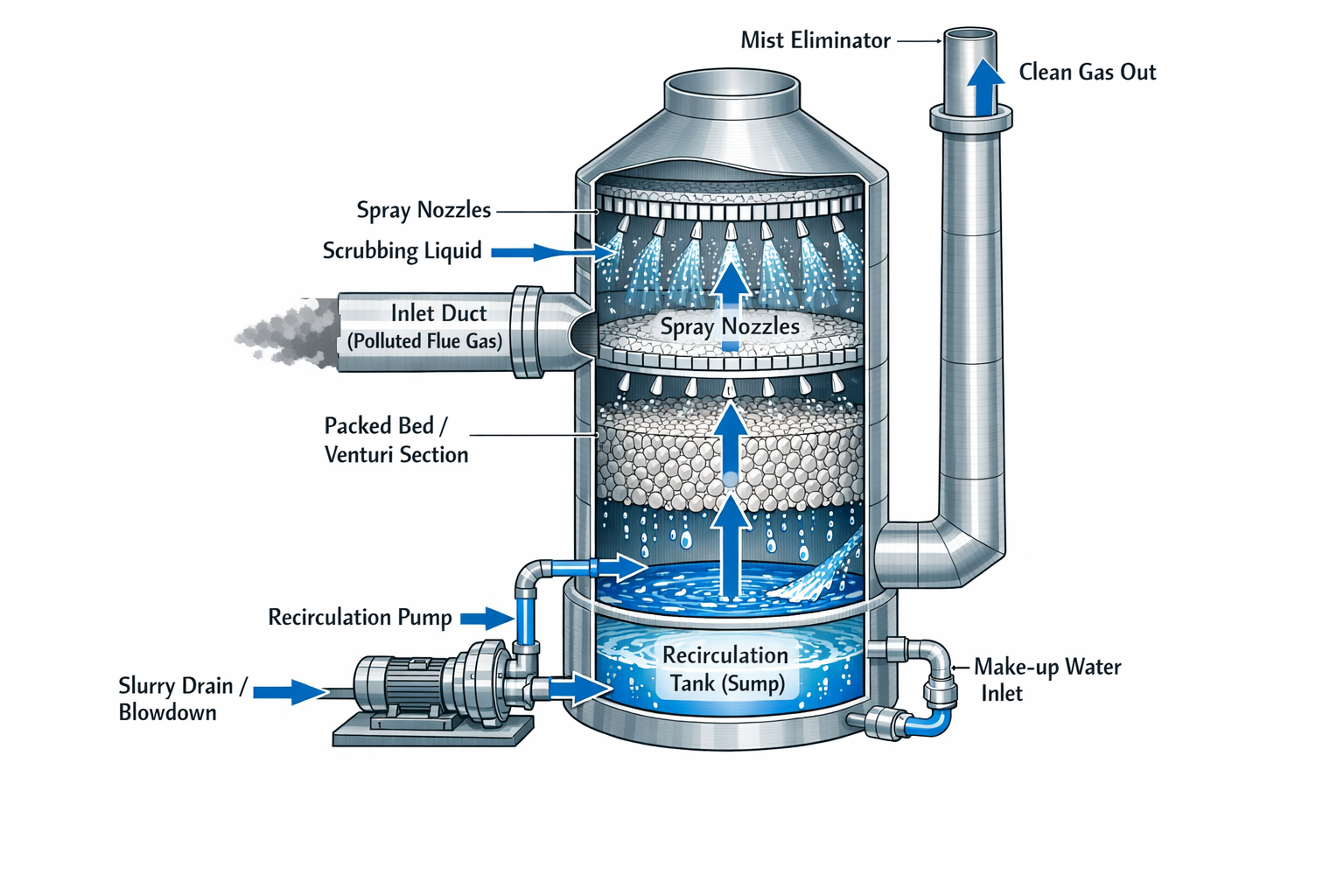
Visualizing the process flow is crucial for understanding the integration. While every wet scrubber system diagram varies based on application, the core flow remains consistent in our designs.
- Inlet Ducting and Flow Distribution: The contaminated gas enters the system. We design the inlet with turning vanes or distribution plates to ensure uniform velocity across the scrubber cross-section. Poor distribution here leads to channeling and reduced efficiency.
- Scrubber Chamber (Contact Zone): This is where the action happens.
- In a Packed Bed, gas flows upward through packing media while liquid flows downward.
- In a Venturi, gas accelerates through a throat where liquid is injected.
- In a Spray Tower, nozzles atomize liquid into the open chamber.
- Mist Eliminator (Demister): The “clean” gas is still wet. It passes through a chevron or mesh pad mist eliminator. This stage captures entrained droplets, preventing liquid carryover into the fan and stack.
- Recirculation Tank: The scrubbing liquid, now loaded with pollutants, collects at the bottom. We maintain the chemistry here via pH/ORP sensors.
- Pumps, Chemical Dosing, and Blowdown: Recirculation pumps send the liquid back to the top. A chemical dosing system adds reagent (like caustic) to maintain neutralization potential. A blowdown line removes accumulated sludge/solids to prevent scaling.
- Stack and Exhaust Fan Integration: Finally, the ID fan pulls the gas through the entire system and discharges it via a stack of sufficient height for dispersion.
Types of Wet Scrubber Systems Manufactured by Envigaurd
Venturi Wet Scrubber System
- High-efficiency dust and fume removal: The Venturi wet scrubber system uses the kinetic energy of the gas to atomize the liquid. It is the gold standard for removing fine, sticky particulates.
- Heavy-duty use in cement, mining, and metallurgical processes: We deploy these in environments with high dust loading and temperatures where dry filters would cake or burn.
- EPC considerations for high-pressure-drop systems: Because of the high pressure drop, our EPC team focuses heavily on fan selection and structural reinforcement to handle the vibration and suction forces.
Wet Packed Bed Scrubber System
- Gas absorption for acidic and alkaline vapors: The wet packed bed scrubber system offers the maximum surface area for gas-liquid contact. It is ideal for removing acid gases like HCl, HF, and SO2.
- Pharma, chemical, and fertilizer industry use cases: In these sectors, where solubility and chemical reaction are key, we specify packing materials (PP Pall Rings or Saddles) that offer high void ratios to prevent clogging.
Vertical Wet Packed Bed Scrubber System
- Compact footprint for space-constrained plants: The wet packed bed scrubber system vertical design is preferred when floor space is at a premium. The vertical orientation utilizes height rather than width.
- Skid-mounted and rooftop installations: We frequently pre-assemble these units on skids for rapid deployment. Their vertical profile makes them ideal for rooftop installation, minimizing interference with ground-level process machinery.
Wet Spray Scrubber System
- Odor control and coarse particulate applications: A wet spray scrubber system relies on spray nozzles without packing media. It is less efficient for fine sub-micron mists but excellent for large particles and soluble gases.
- Cost-effective solutions for moderate emission loads: For applications like boiler flue gas desulfurization (FGD) with moderate SO2 levels, or composting odor control, this is a cost-effective, low-maintenance option.
Wet Scrubber Dust Collection System
- Dust-laden exhaust handling in abrasive environments: In a wet scrubber dust collection system, the objective is to capture abrasive materials like silica, fly ash, or metal dust that would destroy bag filters.
- Integration with material handling and process equipment: We design these to sit directly downstream of crushers, mixers, or mills. The system handles the slurry generated, often integrating with dewatering presses for waste management.
Material Selection for Wet Scrubber Systems
The longevity of the system is defined by the materials used. As a manufacturer, we rigorously analyze the chemical compatibility of the exhaust stream.
FRP wet scrubber systems for corrosive and acidic gases
Fiber Reinforced Plastic (FRP) is the workhorse of the industry. Our FRP wet scrubber systems are manufactured using premium vinyl ester resins, offering exceptional resistance to chlorides, fluorides, and strong acids up to specific temperatures. They are lightweight, strong, and inherently corrosion-proof.
PP wet scrubber systems for specific chemical compatibility
Polypropylene (PP) offers superior chemical resistance to a wider range of alkalis and acids compared to standard FRP. A PP wet scrubber system is often fully welded (homogeneous construction) to eliminate the risk of delamination in highly aggressive environments, particularly in high-purity pharma applications.
Comparison of PP vs FRP vs SS from an EPC lifecycle perspective
- FRP: Best balance of strength and corrosion resistance. Cost-effective for large diameters. Temperature limit usually ~80-90°C.
- PP: Superior chemical resistance for aggressive alkalis/solvents. Lower strength. Temperature limit ~60-70°C.
- SS (Stainless Steel): Used for structural integrity or when chlorides are absent (to avoid pitting). High capital cost but necessary for high-temperature, high-velocity applications where plastic would erode.
Envigaurd’s fabrication and quality control standards
Whether we are fabricating an FRP vessel or a PP tank, our process involves NDT (Non-Destructive Testing) of welds, hydro-testing of vessels, and spark testing of linings. We ensure that every wet scrubber system that leaves our shop floor is leak-proof and structurally sound.
Wet Scrubber System for Odor Control Applications
Odor is often a more complex compliance issue than particulate emissions because it affects the community immediately.
Odor-causing compounds and scrubbing chemistry
A wet scrubber odor control system targets compounds like Hydrogen Sulfide (H2S), Ammonia (NH3), and Volatile Organic Compounds (VOCs). The scrubbing chemistry is critical, for H2S, we use NaOH (caustic) and often an oxidant like Sodium Hypochlorite (NaOCl) to convert the odorant into odorless sulfates.
Applications in food processing, pharma, wastewater, and chemical plants
From fish rendering plants to pharmaceutical fermentation units, we design multi-stage scrubbers. A common configuration is a water wash stage followed by a chemical scrubbing stage to handle complex odor profiles.
Chemical dosing, pH control, and odor removal efficiency
We automate the chemical dosing based on pH and ORP (Oxidation-Reduction Potential) readings. If the pH drifts, the scrubbing efficiency drops, and odor escapes. Our integrated control logic ensures consistent removal efficiencies of 95-99%.
TRS Wet Scrubber System for Sulfur-Based Emissions
Understanding Total Reduced Sulfur (TRS) emissions
TRS includes hydrogen sulfide, methyl mercaptan, dimethyl sulfide, etc. These are extremely odorous and toxic, commonly found in refineries, pulp & paper mills, and tanneries.
Industries requiring TRS scrubber systems
Any industry processing organic matter or sulfur compounds is a candidate. A TRS wet scrubber system is specifically engineered to handle these gases, which require careful oxidation chemistry.
Design considerations for sulfur recovery and odor mitigation
Designing for TRS requires careful management of the reaction products. If not fully oxidized, elemental sulfur can precipitate and plug the packing or nozzles. Envigaurd designs these systems with optimal residence time and reagent control to ensure complete oxidation and prevent plugging.
Industry-Wise Wet Scrubber System Applications
Our experience as an EPC partner spans the breadth of Indian industry:
- Pharmaceutical Manufacturing: We handle solvent fumes (acidic and alkaline) and process exhaust. Our systems are designed for GMP compliance, often using clean-in-place (CIP) compatible designs.
- Cement Plants: We design heavy-duty wet scrubber dust collection systems for crushers, mills, and packing units, handling high dust loads and abrasive conditions.
- Mining and Mineral Processing: We address silica dust, crushing house fumes, and combustion gases. Robustness and easy maintenance access are our primary design drivers here.
- Fertilizer Plants: Managing ammonia slip and acid vapors during prilling and granulation. We use both water wash and acid scrubbing systems depending on the stream.
- Chemical & Specialty Chemicals: Handling highly corrosive acid chlorides and mists. We utilize Dual Laminate (FRP + PVC/PP) or high-alloy steel systems.
- Food Processing & Industrial Kitchens: Managing grease-laden steam and odors. Our wet spray scrubber systems are ideal here to prevent grease fires and odor nuisance.
- Aerospace Surface Treatment: Scrubbing toxic hexavalent chromium mists and etching fumes. We use high-efficiency mist eliminators to ensure zero visible emissions.
Wet Marine Scrubber System Market – Engineering Perspective
SOx emission control requirements in marine applications
With IMO 2020 regulations capping sulfur content in fuel oil, the wet marine scrubber system market has seen significant growth. Ships must either switch to low-sulfur fuel or install a scrubber to clean the exhaust from high-sulfur fuel.
Open-loop vs closed-loop marine scrubber concepts
- Open Loop: Seawater is used as the scrubbing medium. The alkalinity of seawater neutralizes the SOx, and the water is treated before discharge.
- Closed Loop: Freshwater is recirculated with a caustic additive. This is used in areas where discharge of washwater is prohibited (e.g., ports).
Engineering challenges and system customization
Marine scrubbers face unique challenges: space constraints on a ship, rolling/pitching motions affecting fluid dynamics, and the corrosive nature of seawater. While Envigaurd primarily focuses on land-based industrial systems, our engineering principles—compact footprint, corrosion-resistant materials, and automated controls—align closely with the rigors required in marine applications.
Wet Scrubber System Servicing, Maintenance & AMC Support
A scrubber system is a mechanical asset; its performance degrades without maintenance.
Preventive and breakdown maintenance scope
Our Annual Maintenance Contracts (AMCs) cover periodic inspection of pumps, fans, and chemical dosing systems. We look for signs of wear, erosion in the Venturi throat, cracks in FRP nozzles, or vibration in the fan bearings.
Packing, nozzle, mist eliminator inspection
The internals, packing and mist eliminators, are prone to plugging (scaling). During servicing, we inspect these for pressure drop buildup. If not cleaned or replaced, a clogged scrubber can choke the plant’s production line.
Pump, fan, and instrumentation servicing
We ensure that the pH/ORP sensors are calibrated and the recirculation pumps are delivering the rated flow. A dry-running pump or a mis-calibrated pH probe can lead to compliance failure in minutes.
Importance of AMC for consistent compliance
Regular maintenance is cheaper than a shutdown. With Envigaurd’s support, we ensure your system operates at peak efficiency, avoiding regulatory penalties and ensuring continuous production.
Wet Scrubber System Performance & Design Factors
Capacity sizing and gas flow variation
We design for the maximum flow rate, but we also consider turndown ratios. If your plant operates at 50% capacity at night, the scrubber must still function without flooding or channeling.
Liquid-to-gas ratio optimization
This is the heart of the design. Too little liquid, and efficiency drops. Too much, and you waste water and pumping power. We calculate the optimal L/G ratio for your specific pollutant.
Pressure drop vs energy consumption
We present clients with a clear trade-off analysis. A higher pressure drop system cleans better but costs more to run. We find the “sweet spot” where capital cost (CAPEX) and operating cost (OPEX) are balanced.
Impact of poor maintenance on performance
Scaling on the mist eliminator or worn nozzles can increase pressure drop by 30-50%. This directly impacts your plant’s exhaust flow and production rate. We design systems that are easy to access and clean to mitigate this risk.
Wet Scrubber System vs Alternative Pollution Control Technologies
Wet scrubber vs dry scrubber
- Wet Scrubber: Excellent for acid gases and sticky particulates. Produces wet sludge. Low gas temperature at outlet.
- Dry Scrubber: Good for acid gases (using dry lime). Produces dry waste. Better for waste handling but less efficient on very sticky particles.
Wet scrubber vs bag filter
- Wet Scrubber: Handles wet streams and high temperatures (with quenching). No risk of fire in the collector.
- Bag Filter: Higher efficiency on fine dry dust. Dry waste collection. Fire hazard risk with combustible dust.
Technology selection guidance for heavy industries
For heavy industries like cement and metal processing, wet scrubbers are often preferred for their ability to handle “sticky” dust and cool hot gases simultaneously. For chemical industries, wet scrubbers are indispensable for acid gas absorption.
Wet Scrubber System for Sale – EPC Buyer Evaluation Checklist
If you are evaluating a wet scrubber system for sale, consider these factors beyond just the price:
- Process data validation and design responsibility: Does the vendor verify your flow rates and temperature? Or are they guessing? At Envigaurd, we insist on accurate data before quoting.
- Custom-built vs standard scrubber systems: Your process is unique. A “one-size-fits-all” scrubber is rarely efficient. Look for custom-designed solutions.
- Installation, commissioning, and integration scope: Who provides the ducting? Who connects the electricity? We offer turnkey EPC solutions, so you don’t have to manage multiple contractors.
- Long-term operating cost and serviceability: Ask about spare parts availability (nozzles, packing) and the cost of chemical consumption.
Wet Scrubber System Manufacturers – Why EPC Capability Matters
In-house engineering and design validation
Many suppliers are just fabricators, they build what you tell them. Envigaurd is an engineering-led manufacturer. We validate the design, run calculations, and ensure the physics works before we cut metal.
Fabrication, testing, and quality assurance
Our manufacturing facility includes specialized equipment for FRP winding, PP welding, and nozzle testing. We pressure-test every vessel before dispatch.
Single-point responsibility under EPC execution
When you hire Envigaurd, we take responsibility for the entire performance of the system. From the inlet flange to the stack outlet, we own the result. This simplifies project management and accountability for the plant head.
Proven execution across Indian industrial sectors
Our portfolio is diverse. We have installed systems for the smallest pharma labs and the largest cement kilns. This cross-sector experience means we bring “best practices” from one industry to solve problems in another.
Advantages and Limitations of Wet Scrubber Systems in Industrial Use
Key advantages for corrosive and high-temperature exhaust
- Versatility: Handles gases + particulates simultaneously.
- Cooling: Inherently cools hot gases.
- Safety: Eliminates fire risk in dust collectors.
- Corrosion Control: FRP/PP construction handles aggressive acids better than steel.
Operational and environmental limitations
- Water Usage: Requires a continuous water source and wastewater treatment (blowdown) capacity.
- Visibility: Can produce a visible steam plume (water vapor) on cold days, which is environmentally harmless but visually concerning.
- Sludge: Handling wet sludge can be messier than dry dust.
Mitigation strategies through proper engineering
We mitigate water usage by optimizing the recirculation rate. We handle sludge by providing clarifiers or filter presses. We address plumes with reheat coils or proper stack height if visual impact is a concern.
Conclusion – Engineering the Right Wet Scrubber System
Investing in a wet scrubber system is a decision that impacts your plant’s compliance, safety, and operational continuity for the next decade. It requires a partner who understands the fluid mechanics, the chemistry, and the practical realities of your industry.
At Envigaurd, we bring over 10 years of experience in designing, manufacturing, and commissioning these systems. We do not just sell equipment; we engineer solutions. By focusing on application-specific design, robust material selection, and comprehensive EPC execution, we ensure that your wet scrubber system performs reliably, keeping your operations compliant and your environment safe.
Frequently Asked Questions (FAQ)
Which wet scrubber system is suitable for heavy dust loads?
For heavy dust loads (e.g., cement dust, fly ash), a Venturi wet scrubber system is the most suitable. It is designed to handle high inlet dust concentrations without clogging.
Is FRP safe for high-temperature exhaust?
FRP is generally safe for temperatures up to 80-90°C with standard vinyl ester resins. For higher temperatures (up to 120°C+), we use specialized resins or a dual laminate structure (PP/FRP) or shift to metallic construction.
How often should wet scrubber systems be serviced?
Preventive maintenance should be conducted at least monthly. A full inspection of nozzles, packing, and pumps is recommended quarterly to ensure consistent compliance.
Can one system handle dust and odor together?
Yes, we design hybrid systems. Typically, the first stage is a Venturi or spray tower to remove dust, and the second stage is a packed bed scrubber to remove odor/gases.
What data is required to design a wet scrubber system?
We require the Gas Flow Rate (CMH/CFM), Temperature, Composition of pollutants (dust/grm3, gas concentration in ppm), and the desired outlet efficiency/emission standards.