Skip to content
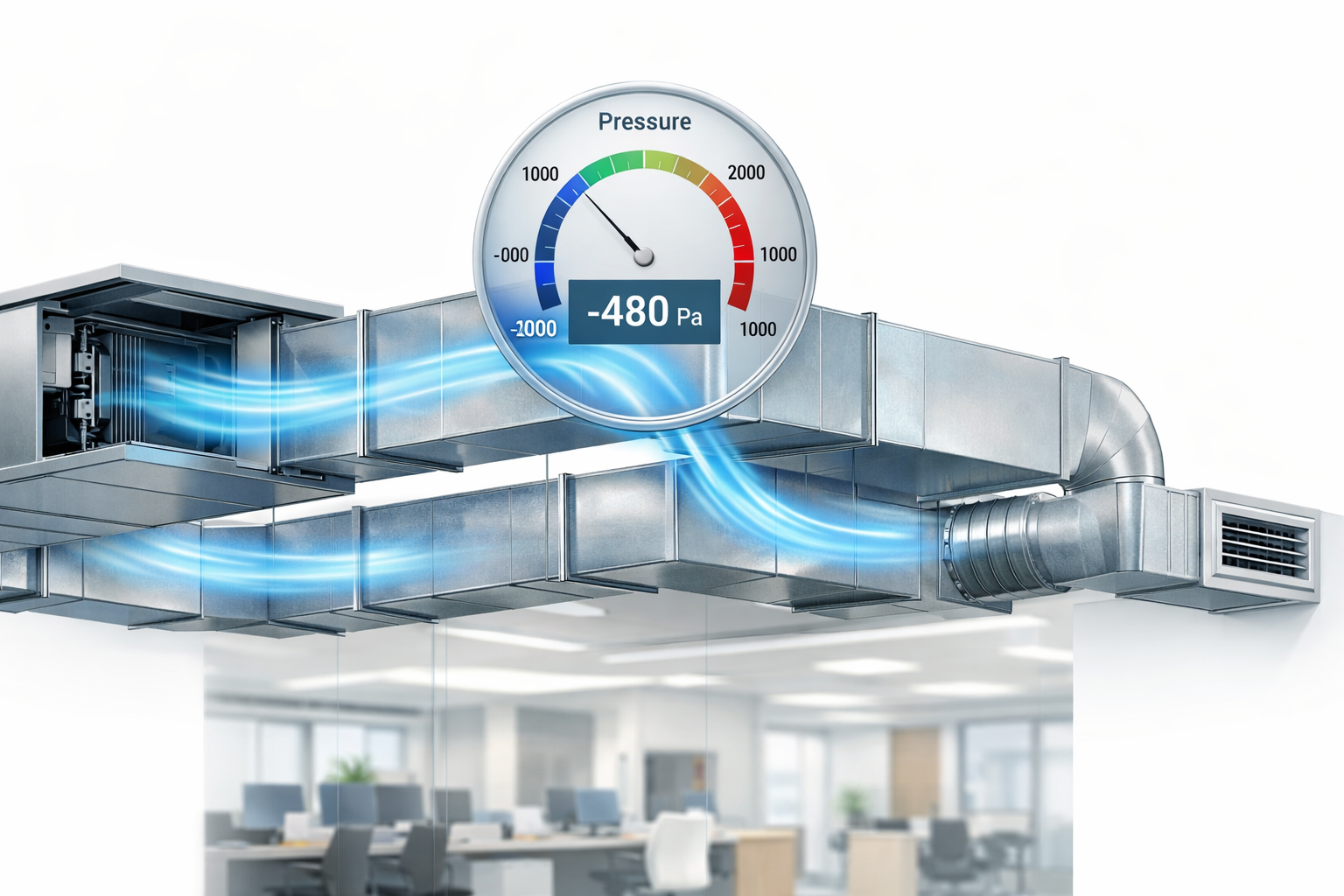
If your air-conditioning system runs constantly but some rooms stay stuffy, or your electricity bills are climbing without explanation, the culprit is often something building owners rarely hear about: static pressure in HVAC. Get it right and your system delivers comfortable air quietly and efficiently. Get it wrong and you face noisy fans, uneven temperatures, inflated energy bills, and equipment that fails years ahead of schedule.
This guide explains what static pressure is in plain English, how it is calculated and verified, and, critically, what it means for building owners and facility managers operating in India’s demanding climate conditions.
What Is Static Pressure in HVAC? (Plain-English Definition)
Think of your duct system like a network of roads. The blower fan in your air-handling unit (AHU) or fan coil unit (FCU) is the engine pushing air along those roads. Static pressure is every speed bump, pothole, and narrow lane the air must fight through on its journey: the combined resistance offered by duct walls, bends, fittings, filters, cooling coils, and dampers.

Formally, static pressure is the force that air exerts perpendicularly against duct walls due to resistance in the system. It is measured in Pascals (Pa), the SI unit used in India, or in inches of water column (in. WC) in older datasheets. A well-designed low-pressure system typically operates below 250 Pa (approximately 1 in. WC). High-pressure systems can reach 1,500 Pa or more, which is common in large commercial or industrial builds.
The key rule: the fan must always generate enough pressure to overcome total system resistance and still deliver the design airflow (measured in cubic metres per hour, m³/hr, or litres per second, l/s) to every zone. When that balance is wrong in either direction, problems will follow.
The static pressure in HVAC systems represents the resistance to airflow within the duct system. It is typically measured in Pascals (Pa) or inches of water column (in. w.c.) using a manometer or differential pressure gauge.
Static Pressure Formula
SP = TP – VP
Where:
- SP = Static Pressure
- TP = Total Pressure
- VP = Velocity Pressure
Explanation
- Total Pressure (TP) is the sum of static pressure and velocity pressure in the duct.
- Velocity Pressure (VP) represents the pressure created by the airflow velocity moving through the duct.
- Static Pressure (SP) is the pressure exerted by the air perpendicular to the duct walls, indicating resistance from filters, dampers, coils, and duct friction.
Velocity Pressure Formula
VP = \frac{\rho V^2}{2}
Where:
- ρ (rho) = Air density (kg/m³)
- V = Air velocity (m/s)
Practical HVAC Context
In commercial HVAC duct systems:
- High static pressure → indicates restricted airflow (dirty filters, undersized ducts, closed dampers).
- Low static pressure → may indicate duct leakage or oversized ducts.
- Typical supply static pressure in many commercial systems ranges 250–750 Pa, depending on system design.
Example
If:
- Total Pressure = 900 Pa
- Velocity Pressure = 300 Pa
Then:
Static Pressure = 900 − 300 = 600 Pa
This value helps HVAC engineers evaluate fan performance, duct sizing, and airflow efficiency during system commissioning and testing.
The Three Types of Static Pressure You Need to Know
Engineers and equipment datasheets use three related but distinct terms. Understanding the difference is essential when comparing fan specifications or reviewing an HVAC design proposal.
| Term | What It Measures | Why It Matters |
| Total Static Pressure (TSP) | Full resistance across the entire system, including AHU internal components (coil, filter, drain pan) plus all ductwork and fittings. | Governs overall fan power selection and energy consumption. |
| External Static Pressure (ESP) | Resistance outside the AHU cabinet: ducts, grilles, diffusers, and external accessories only. Stated on equipment datasheets. | Used to match the AHU to a specific duct system. Selecting too low an ESP rating means the fan will be overwhelmed by real-world duct losses. |
| Available Static Pressure (ASP) | What remains for distributing air to zones after subtracting all known accessory losses (filters, dampers, coils) from the ESP. | The true design budget for duct sizing. Using ASP ensures the duct system is sized realistically, not optimistically. |
| Key Formula Available Static Pressure = External Static Pressure − (Pressure drop across filter) − (Pressure drop across coil) − (Pressure drop across other accessories). This remainder is what your duct designer actually has to work with when sizing ducts. |
How Static Pressure Affects Fan Selection and Duct Design
Every fan manufacturer publishes a fan curve, a graph showing the relationship between airflow (m³/hr) and static pressure (Pa). A fan can deliver high airflow at low resistance, or push air against high resistance at reduced flow. It cannot do both simultaneously. The design operating point, where the fan curve intersects the system resistance curve, determines actual airflow delivered to occupants.
When duct pressure calculation is performed correctly, the designer identifies the index circuit (the longest duct run with the greatest resistance), calculates cumulative HVAC duct friction loss along that path, adds accessory losses, and selects a fan whose curve comfortably crosses the operating point with some margin. An undersized fan will run at full speed, fail to reach design airflow, and strain its motor.
HVAC fan static pressure and airflow are inversely related: as you add bends, diffusers, and accessories, available airflow drops. This is why every resistance item in the system must be accounted for before a fan is specified; not estimated, not assumed.
Duct sizing also depends directly on this calculation. The equal-friction method, widely used in Indian commercial projects, sets a target friction rate (typically 0.8–1.0 Pa/m for low-pressure systems) and sizes each duct section accordingly. A correct duct pressure calculation produces ducts that are neither oversized (wasting material and ceiling space) nor undersized (creating excessive resistance and noise).
What Happens When Static Pressure Is Underestimated
Underestimating total static pressure is one of the most common and costly errors in HVAC design. The consequences are not minor inconveniences; they are system-level failures that compound over time.
- Undersupply of air: The fan cannot overcome actual resistance, so airflow to distant zones falls short. Occupants complain of stuffiness, uneven cooling, and hot spots, particularly on upper floors of multi-storey buildings.
- Noisy operation: When a fan works against a higher-than-designed load, blower speed increases, turbulence grows, and the system becomes loud. Tenants in commercial buildings in cities like Bengaluru, Mumbai, and Hyderabad often attribute this to poor equipment quality. In most cases it is a static pressure mismatch.
- Excessive energy use: A blower fighting high resistance draws significantly more power. Studies on commercial buildings in India indicate that oversized or mismatched HVAC systems can consume 20–40% more electricity than correctly designed systems. Over the life of a building, this adds crores of rupees to operating costs.
- Premature component failure: Sustained operation at elevated resistance accelerates wear on blower motors, bearings, and drive belts. Cooling coils run wetter than designed, increasing the risk of biological growth in condensate trays. In worst cases, heat exchanger cracks and compressor failures follow.
- ECBC non-compliance: India’s Energy Conservation Building Code (ECBC 2017), enforced by the Bureau of Energy Efficiency (BEE), requires that HVAC systems meet minimum fan efficiency thresholds and submit system balancing reports. A system operating with wrong static pressure may fail compliance checks, creating legal and financial exposure for building owners.
How Duct Elements Contribute to HVAC Pressure Drop
Every component in an air distribution system adds to the HVAC pressure drop. Understanding which items carry the greatest penalty helps designers and owners make informed decisions about layout and specifications.
Duct Shape and Size
Round ducts are the most aerodynamically efficient, producing the least HVAC duct friction loss for a given airflow. Rectangular ducts are popular where ceiling heights are limited, but aspect ratios above 3:1 significantly increase friction. As a rule, keep aspect ratios as close to 1:1 as possible, and never exceed 4:1 per ASHRAE guidance adopted in Indian practice.
Bends and Fittings
A sharp 90° elbow can add the equivalent resistance of 5–10 metres of straight duct. Gradual-radius bends and turning vanes reduce this by 60% or more. Every reducer, tee, and transition fitting carries a loss coefficient that must be included in duct pressure calculation; overlooking fittings is a frequent source of underestimation.
Filters
A clean G4 pre-filter typically adds 30–50 Pa. A loaded, dirty filter of the same type can reach 150 Pa or more, tripling its contribution to total static pressure. High-efficiency HEPA or F7/F9 bag filters used in cleanroom or hospital applications can add 250–500 Pa even when clean. Filter pressure drop must be calculated at its dirty (end-of-life) value to ensure the fan can still deliver design airflow when the filter needs replacement.
Cooling and Heating Coils
A wet cooling coil (operating with condensate on its fins, which is standard in India’s warm-humid cities like Chennai, Kochi, and Mumbai) adds significantly more resistance than a dry coil. Wet coil pressure drops of 75–150 Pa are common. This is a critical point often missed in preliminary designs that use dry-coil data.
Dampers and Diffusers
Volume control dampers, fire dampers, and variable air volume (VAV) boxes each carry a pressure penalty. Diffusers and grilles, especially at high face velocities, can add 10–40 Pa per terminal. These are often last-minute site selections; specifying them up front and including their loss in the design budget is best practice.
Static Pressure Testing During Commissioning: The Enviguard Approach
Design calculations are only as good as what is built and commissioned. Enviguard’s HVAC design engineers carry out static pressure verification as a mandatory commissioning step, not an optional add-on.
The process involves drilling calibrated test ports at the supply and return connections of each AHU and FCU, then using a digital micromanometer to measure static pressure under operating conditions. The measured external static pressure is compared against the design value. A significant deviation, particularly a measured value higher than designed, triggers a root-cause investigation: undersized ducts, an unaccounted fitting, a blocked filter, or a partially closed damper are common culprits.
Enviguard also conducts airflow traverses at key points in the system using pitot tubes or electronic flow hoods to verify that every zone receives its design CFM (or m³/hr). This two-step verification (pressure and airflow) gives building owners documentary proof that their system performs to specification, which is increasingly required for ECBC 2017 compliance and LEED/IGBC certification in India.
For larger commercial projects, Enviguard issues a formal HVAC system balancing report, a document that records measured vs. design values for every AHU, duct branch, and terminal device. This report is the building owner’s assurance against future disputes and the auditor’s reference during BEE inspections.
Why Static Pressure Demands Extra Attention in Indian Buildings
India’s five climatic zones are Hot Dry (Rajasthan, parts of Gujarat), Warm Humid (coastal Maharashtra, Kerala, Tamil Nadu), Composite (Delhi, Bengaluru, Pune), Temperate (parts of the northeast), and Cold (Himachal Pradesh, J&K). Each zone creates distinct HVAC static pressure challenges.
- Warm-humid cities such as Chennai, Kochi, and Mumbai: Latent heat loads are high, so AHU coils operate wet for most of the year, adding up to 150 Pa of extra resistance compared to dry-coil assumptions. Under-designed systems in these cities are chronically short on airflow.
- Composite-climate cities such as Bengaluru, Delhi, and Hyderabad: Wide seasonal swing in humidity means coil behaviour varies. Static pressure budgets must be validated for the peak-wet-coil scenario (June–September monsoon) rather than the drier winter months.
- High-rise commercial towers: Long duct runs in multi-storey offices mean cumulative HVAC duct friction loss is significant. Poor static pressure design in these projects results in the topmost floors being chronically under-conditioned, a common complaint in IT parks and Grade A offices across Indian metros.
- ECBC 2017 compliance: Sections 5.1.5 (System Balancing) and associated fan efficiency requirements under ECBC mandate that systems are designed and verified for correct static pressure. Karnataka, Telangana, Andhra Pradesh, and several other states have mandated ECBC compliance for new commercial construction. Building owners who skip static pressure verification risk failing inspections and losing energy performance certificates.
Enviguard’s engineers are trained against both ASHRAE standards and Indian NBC 2016 guidelines, and work within the ECBC 2017 framework, giving clients compliant, optimised systems from day one.
Frequently Asked Questions About Static Pressure in HVAC
Q: What is a good static pressure for an HVAC system?
A: For small commercial and institutional systems using FCUs or packaged units, a typical external static pressure range is 50–200 Pa (0.2–0.8 in. WC). Large central AHU systems serving multi-floor buildings may operate at 250–600 Pa or higher. The ‘correct’ value is whatever was calculated for your specific duct layout and airflow requirements; there is no universal target. Systems operating well above their design pressure are wasting energy; systems below it may have air leaks.
Q: What causes high static pressure in an HVAC duct system?
A: High static pressure is most commonly caused by undersized ductwork, clogged or high-MERV filters, dirty cooling coils, too many sharp bends without turning vanes, or partially closed dampers. In Indian buildings, dust accumulation on coils and filters during the pre-monsoon dry season is a frequent culprit. A rise in measured static pressure above the design value is always a signal to investigate. Ignoring it accelerates motor wear and increases electricity consumption.
Q: What is the difference between external static pressure and total static pressure?
A: Total static pressure (TSP) is the full resistance across the entire HVAC system, including losses inside the AHU cabinet (coil, filter, heat exchanger). External static pressure (ESP) is the resistance outside the cabinet, meaning only the ductwork, fittings, and terminal devices. Equipment datasheets rate fans against ESP; the design engineer must ensure the rated ESP covers the actual duct system losses with margin to spare.
Q: How is HVAC static pressure measured on site?
A: A digital micromanometer (pressure gauge) is connected via flexible tubing to test ports drilled into the supply and return duct sections immediately adjacent to the AHU. The return-side reading (negative pressure) and supply-side reading (positive pressure) are added together to give the total external static pressure. Readings are taken with the system at full design airflow. For accurate results, test ports must be located at least 1.5 duct diameters from any bend or fitting.
Q: Can dirty air filters alone cause static pressure problems?
A: Yes, and it is one of the most overlooked issues in Indian commercial buildings, where dust levels are high. A clean G4 filter adds roughly 30–50 Pa of resistance. The same filter at end-of-life can add 150 Pa or more, nearly tripling that component’s contribution to static pressure. This is why Enviguard’s designs are calculated using dirty-filter pressure drops, not clean, and why filter replacement schedules are an integral part of every preventive maintenance plan we recommend.
Q: Does ECBC 2017 regulate HVAC static pressure or duct design in India?
A: ECBC 2017 does not prescribe specific static pressure values, but it does require system balancing reports, minimum fan motor efficiencies, and proper duct insulation for ECBC-compliant commercial buildings. Poor static pressure design leads to oversized fan motors and high fan power consumption, both of which can cause a building to fail its Energy Performance Index (EPI) target. The National Building Code of India (NBC) 2016 provides reference standards for HVAC design, including duct velocity limits that indirectly constrain static pressure.
Q: What does static pressure testing cost in India, and is it worth it?
A: Static pressure commissioning for a typical commercial HVAC system in India costs a small fraction of the annual energy bill, usually Rs. 15,000–50,000 for a medium-sized installation, depending on scope. Against the backdrop of energy waste from a poorly balanced system (which can add 20–30% to annual electricity costs), the payback is measured in months. For ECBC-mandated projects, the balancing report is also a compliance deliverable, so the cost is unavoidable.
Q: My office in Bengaluru feels warm in some zones even though the AC is running. Could static pressure be the reason?
A: It is one of the most likely reasons. Bengaluru’s composite climate means AHU coils operate wet during the monsoon and in transitional months, increasing static pressure above dry-season values. If the original design used dry-coil assumptions, the system may be undersupplying air to distant zones by 20–30% during peak load periods. Enviguard recommends a static pressure test during the July–August period to capture worst-case conditions and diagnose whether duct resizing, fan upgrade, or a VFD-controlled fan is the right fix.
| Is Your HVAC System Sized for the Right Static Pressure? Enviguard’s HVAC design engineers ensure your system is sized for correct static pressure, from the first duct pressure calculation to final commissioning verification. Whether you are designing a new building, diagnosing a problem with an existing system, or preparing for ECBC 2017 compliance, our team delivers systems that perform exactly as designed. Get a Free Design Consultation Today → contact@enviguard.in |