Skip to content
As a senior air flow calculation engineer at Enviguard with over a decade of operational experience across the commercial, industrial, pharmaceutical, and healthcare sectors, I have established that the theoretical foundation of HVAC and process engineering rests entirely on the precision of fluid dynamics analysis. The movement of air is not a simple matter of moving volumes, it is a complex thermodynamic interaction involving pressure gradients, resistance, density variations, and thermal loads. In high-stakes environments such as pharmaceutical containment rooms or semiconductor manufacturing fabs, an error in air flow calculation can compromise product integrity or endanger human life.
This article dissects the technical intricacies of air flow calculation methodologies. We will explore the governing equations, the nuances of varying system components, and the specific requirements of distinct industrial applications, moving beyond basic concepts into advanced engineering execution.

Key Airflow Calculation Methods & Formulas
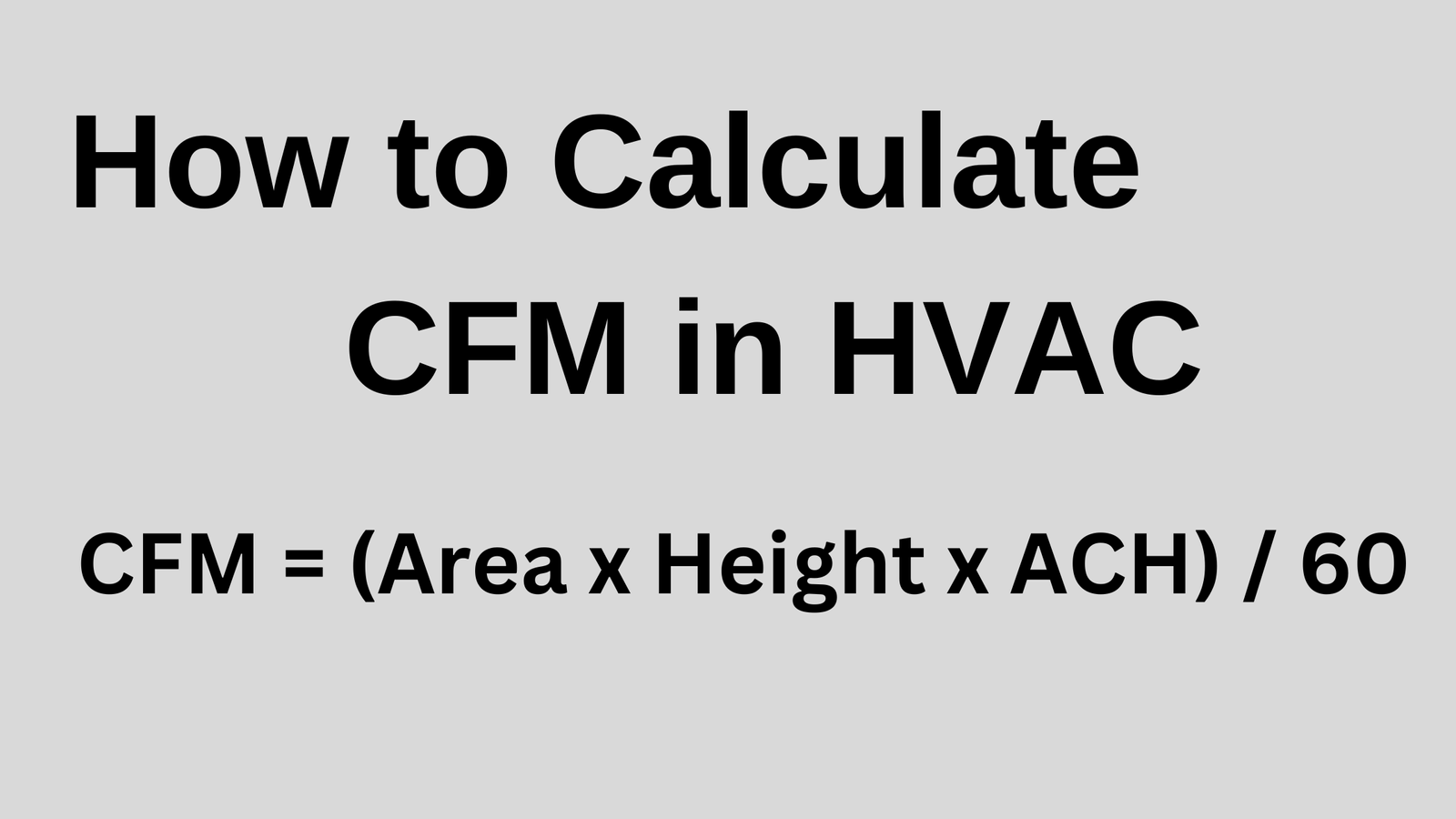
- Air Changes per Hour (ACH): To determine required supply/exhaust rates based on volume:
ACH=Volume of Airflow per Hour (CFM×60)Room Volume (ft3).
- Differential Pressure Flow: To ensure negative pressure, the exhaust fan must remove more air than is supplied, typically requiring an air volume difference of
150–200 CFM.
- Velocity Calculation (Anemometer): To measure velocity (
𝑉) for volume flow (
𝑄) through a known area (
𝐴):
𝑄=𝐴×𝑉.
- Pressure to Flow Conversion: To estimate necessary flow based on desired pressure (
Δ𝑃):
𝑄=𝐶×𝐴×2×Δ𝑃𝜌.
Key Parameters for Negative Pressure Isolators
- Pressure Differential: Target a minimum of
−2.5 Pa to
−8 Pa.
- Airflow Direction: Air must always flow from clean areas (corridor) to the contaminated area (isolator).
- Exhaust Rate: Minimum of 12 air changes per hour (ACH) is standard for infection control.
- Inward Velocity: A minimum cross-sectional velocity of
0.45 m/s±20% (
90 FPM) is often required under the HEPA filter.
- Volume Calculation: Measure air velocity 6 inches below the HEPA filter grid to determine CFM.
Steps for Calculation and Testing
- Measure Velocity: Use an anemometer to measure HEPA filter airflow velocity (
𝑉) in FPM.
- Calculate Flow: Multiply average velocity by the filter area (
𝐴) to find CFM.
- Calculate Total Exhaust: Sum the airflow (CFM) of all exhaust filters.
- Verify Pressure: Use a magnehelic gauge to confirm a minimum
−2.5 Pa differential.
Fundamental Equations and Theoretical Frameworks
The core of our discipline relies on the relationship between velocity, area, and pressure. However, the practical application requires rigorous adherence to specific formulas that account for real-world variables.
Below is a technical reference table detailing the primary equations utilized in our daily engineering calculations at Enviguard.
Table 1: Core Air Flow Calculation Formulas
| Formula Name | Equation | Variable Definitions | Application Context |
|---|---|---|---|
| Volumetric Flow Rate (Velocity Area Method) | Q=A×v | Q = Flow Rate (m³/s or ft³/min) A = Cross-sectional Area (m² or ft²) v = Air Velocity (m/s or fpm) | Basic duct air flow calculation and pipe sizing. |
| Mass Flow Rate | m˙=ρ×Q | m˙ = Mass Flow Rate (kg/s) ρ = Air Density (kg/m³) Q = Volumetric Flow Rate (m³/s) | Engine mass air flow calculation, compressed air systems, and HVAC psychrometrics. |
| Standard vs. Actual Flow | Qact=Qstd×PactPstd×TstdTact | P = Absolute Pressure (Pa or psi) T = Absolute Temperature (K or R) | Compressor air flow calculation and altitude corrections. |
| Pitot Tube / Differential Pressure | v=ρ2×ΔP | ΔP = Velocity Pressure (Pa) ρ = Density (kg/m³) | Air flow calculation from differential pressure and traverse readings. |
| Fan Law 1 (Affinity Law) | Q2Q1=N2N1 | Q = Flow Rate N = Fan Speed (RPM) | Fan air flow calculation for speed modulation. |
| Pressure Drop (Darcy-Weisbach Simplified) | ΔP=f×DL×2ρv2 | f = Friction factor L = Length (m) D = Diameter (m) | Air flow calculation through duct and pipe systems. |
System Design and Ductwork Dynamics
Accurate air flow calculation in duct systems is a multi-variable problem. In the pharmaceutical industry, for instance, we do not merely move air, we control turbulence to prevent particle contamination. When performing a duct air flow calculation formula application, one must determine the friction rate per unit length. This requires analyzing the duct material roughness and the aspect ratio of rectangular ducts.
Furthermore, air flow calculation through duct necessitates a careful balance of static pressure and dynamic pressure. As air velocity increases, the static pressure drops. A high-velocity system saves space but incurs significant noise and energy penalties, whereas a low-velocity system is quieter but requires larger ducts. This trade-off is critical in commercial HVAC air flow calculation where building architectural constraints often conflict with acoustical requirements.
Similarly, air flow calculation in pipe for compressed air systems involves dealing with high pressures (often exceeding 7 bar). Here, the ideal gas law deviations become significant, and we must account for the compressibility factor. A precise compressed air flow calculation formula is essential to determine the pressure drop between the compressor and the point of use, ensuring that pneumatic tools receive the necessary pressure for optimal operation.
Advanced Measurement and Pressure Based Calculations
In the field, direct measurement of velocity is not always feasible. Consequently, Enviguard engineers frequently rely on air flow rate calculation using pressure. By using a differential pressure sensor across an orifice plate, venturi meter, or even the coil of an AHU, we can derive the flow rate.
The air flow calculation based on pressure is derived from Bernoulli’s principle. When the flow area constricts, the velocity increases and the pressure decreases. By measuring this pressure differential (
ΔP), we can calculate the flow. This method is standard for air flow measurement calculation in existing building retrofits where installing hot-wire anemometers in every duct is impractical.
For critical environments like fume hoods, the air flow calculation from differential pressure is used for continuous monitoring. We monitor the face velocity by measuring the pressure differential across the hood sash. Any deviation triggers an alarm, ensuring that containment is not compromised during the fume hood air flow calculation process.
Ventilation Strategies and Industrial Applications
Ventilation and Containment The objective of air flow calculation for ventilation varies by sector. In a commercial office, it is about CO2 dilution and thermal comfort. In a paint mixing room or a spray booth, it is about maintaining a minimum velocity to keep volatile organic compounds (VOCs) suspended in the exhaust stream.
A spray booth air flow calculation requires determining the cross-sectional area of the booth face and applying a specific capture velocity, typically 0.5 m/s to 1.0 m/s, depending on the toxicity of the solvents used. Similarly, a kitchen hood air flow calculation utilizes thermal plume equations to determine how much heat and grease-laden air the hood must capture.
Confined Space Safety For confined space air flow calculation, the stakes are life and death. We calculate the volume of the space (e.g., a tank or vessel) and determine the air changes required per hour to purge hazardous gases. This involves calculating the required CFM of a portable blower to achieve a specific number of air changes within a set time frame before entry is permitted.
Cooling and Thermal Management In industrial cooling, the cooling tower air flow calculation is vital for the thermodynamic cycle. The tower must reject the heat load from the chiller or process. The cooling tower fan air flow calculation determines the volume of ambient air drawn across the fill media to facilitate evaporative cooling. If the cooling tower air flow rate calculation is inaccurate, the approach temperature will widen, leading to inefficient process cooling.
Similarly, a radiator air flow calculation for engine cooling or a cooling fan air flow calculation for electronics ensures that the heat transfer coefficient is sufficient to maintain junction temperatures or engine coolant temperatures within safe limits. These calculations often involve CFD (Computational Fluid Dynamics) modeling to ensure that the air flow is effectively directed over the hot surfaces rather than bypassing them.
Rotating Equipment: Fans, Blowers, and Compressors
Selecting the correct moving equipment is the culmination of the preceding calculations.
Fan Selection When performing a fan air flow calculation, we generate a system curve that plots the required pressure drop against various flow rates. We then select a fan whose performance curve intersects the system curve at the desired operating point. For FD fan air flow calculation (Forced Draft), we must account for the pressure drop across the boiler bed and the superheater elements.
An axial fan air flow calculation differs significantly from a centrifugal fan. Axial fans are efficient for high volume and low pressure applications (like cooling towers), whereas centrifugal fans are used for higher pressure systems (like dust collectors). The air flow fan calculation must match the fan type to the system impedance.
Blowers and Compressors A blower air flow rate calculation typically involves positive displacement machines. Here, the flow is largely a function of speed and rotor volume, with minor slip losses. This is distinct from dynamic compressors.
An air compressor flow rate calculation is critical for specifying the machine size. We sum the peak demands of all tools, adding a diversity factor, to arrive at the Free Air Delivery (FAD) required. An inaccurate compressor air flow calculation can lead to insufficient pressure drop during production spikes, causing costly downtime.
Technical Use Cases and Calculated Examples
To illustrate the practical application of these methodologies, let us examine three specific technical use cases encountered in recent Enviguard projects.
Use Case 1: Pharmaceutical Isolator Face Velocity
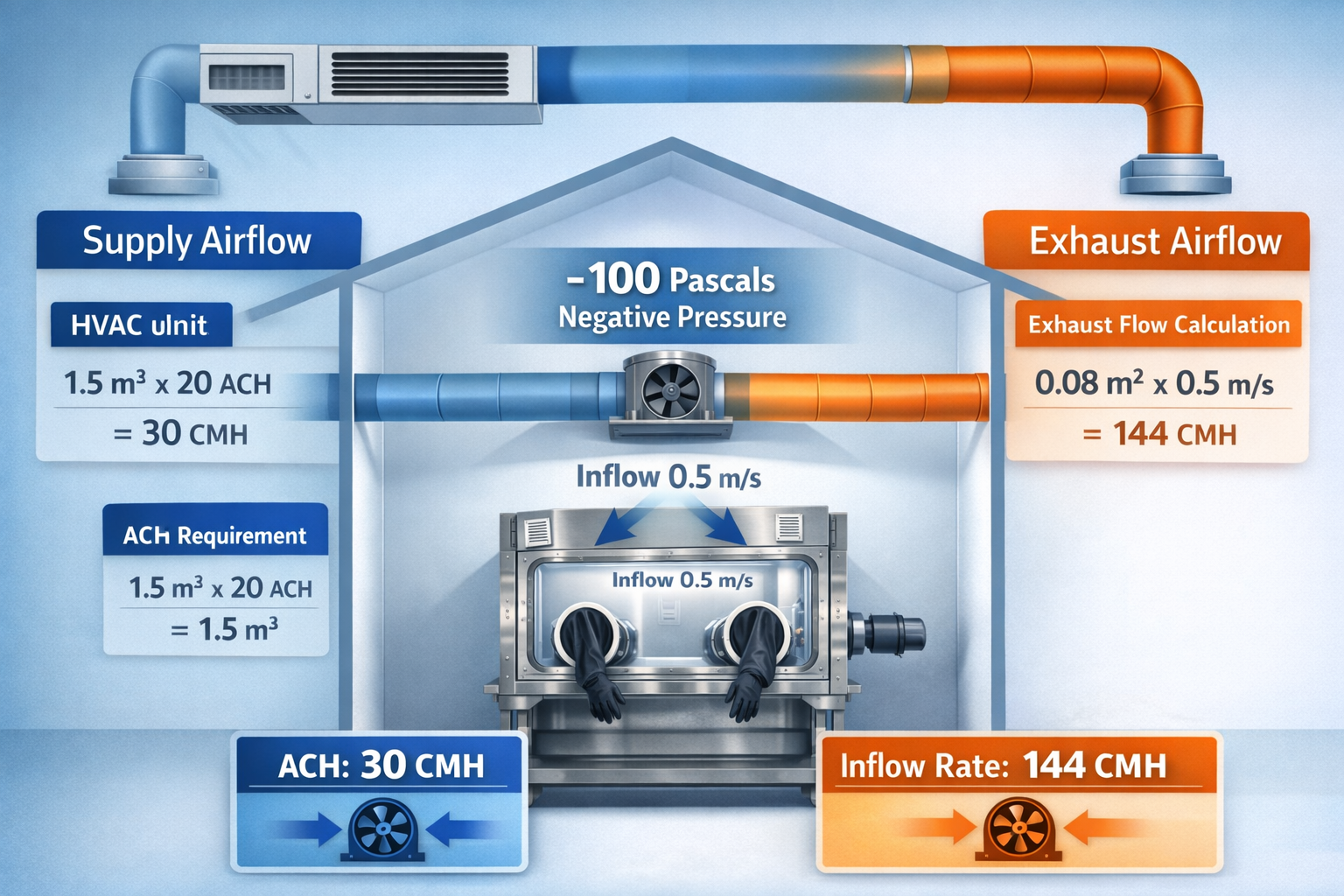
Scenario: A Glove Box Isolator in a sterile injectable facility requires a negative pressure cascade. Objective: Perform an exhaust fan air flow calculation to maintain a containment of 100 Pascals negative pressure relative to the room, while maintaining an inflow velocity of 0.5 m/s through the open glove ports.
Parameters:
- Total leakage area (gloves, ports) = 0.08 m²
- Target inflow velocity (v) = 0.5 m/s
- Internal volume = 1.5 m³
- Desired ACH = 20 (for particulate control)
Calculation:
- Inflow Requirement (Volumetric): Q=A×v Q=0.08 m2×0.5 m/s=0.04 m3/s Converting to CMH: 0.04×3600=144 CMH
- ACH Requirement (Volumetric): Q=Volume×ACH Q=1.5 m3×20 hr−1=30 CMH
- Fan Sizing: The governing factor is the higher of the two values. Therefore, the exhaust fan must be sized for 144 CMH. However, to maintain the negative pressure of 100 Pa, the fan must overcome this resistance. We select a fan capable of generating 144 CMH at a static pressure of at least 150 Pa (safety factor applied).
Use Case 2: Industrial Spray Booth Exhaust
Scenario: An automotive spray booth requires exhaust to remove paint overspray. Objective: Conduct a spray booth air flow calculation to ensure cross-draft velocity.
Parameters:
- Booth dimensions: Width = 4m, Height = 3m, Length = 10m
- Required cross-draft velocity = 0.6 m/s
- Filter resistance (dirty) = 250 Pa
- Dwork static pressure loss = 100 Pa
Calculation:
- Air Flow Rate (Q): Cross-sectional area (A) facing the airflow = Width × Height = 4×3=12 m2 Q=A×v Q=12 m2×0.6 m/s=7.2 m3/s In CMH: 7.2×3600=25,920 CMH
- Static Pressure Requirement: Total Static Pressure = Filter Loss + Duct Loss + Entry Loss TSP=250+100+50 (estimated entry)=400 Pa Result: The axial fan selection must be capable of moving 25,920 CMH against a static pressure of 400 Pa.
Use Case 3: Orifice Plate Flow Measurement (Chilled Water AHU)
Scenario: Verifying the airflow of a large Air Handling Unit (AHU) using an orifice plate located in the main supply duct. Objective: Perform an air flow rate calculation using pressure.
Parameters:
- Differential Pressure reading (ΔP) = 75 Pa
- Air Density (ρ) = 1.2 kg/m³ (standard conditions)
- Discharge Coefficient (Cd) for orifice plate = 0.61
- Orifice Area (A) = 0.5 m²
Calculation:
- Velocity Calculation: v=Cd×ρ2×ΔP v=0.61×1.22×75 v=0.61×125 v=0.61×11.18≈6.82 m/s
- Flow Rate Calculation: Q=A×v Q=0.5 m2×6.82 m/s=3.41 m3/s In CMH: 3.41×3600≈12,276 CMH This air conditioning air flow calculation allows the commissioning engineer to balance the system against the design specs.
Conclusion
The discipline of air flow calculation is a rigorous field that integrates physics, fluid mechanics, and practical engineering constraints. From the mass air flow calculation needed for internal combustion engines to the precise ridge vent air flow calculation required for passive building cooling, the principles remain constant while the application demands evolve.
At Enviguard, our approach combines these fundamental formulas with advanced measurement techniques and industry-specific standards. Whether executing an exhaust air flow rate calculation for a high-rise kitchen or a louver air flow calculation for a power plant intake, the reliance on accurate data ensures system integrity, energy efficiency, and operational safety. By mastering these calculations, engineers ensure that the invisible medium of air is controlled effectively to serve the tangible needs of modern industry.