Skip to content
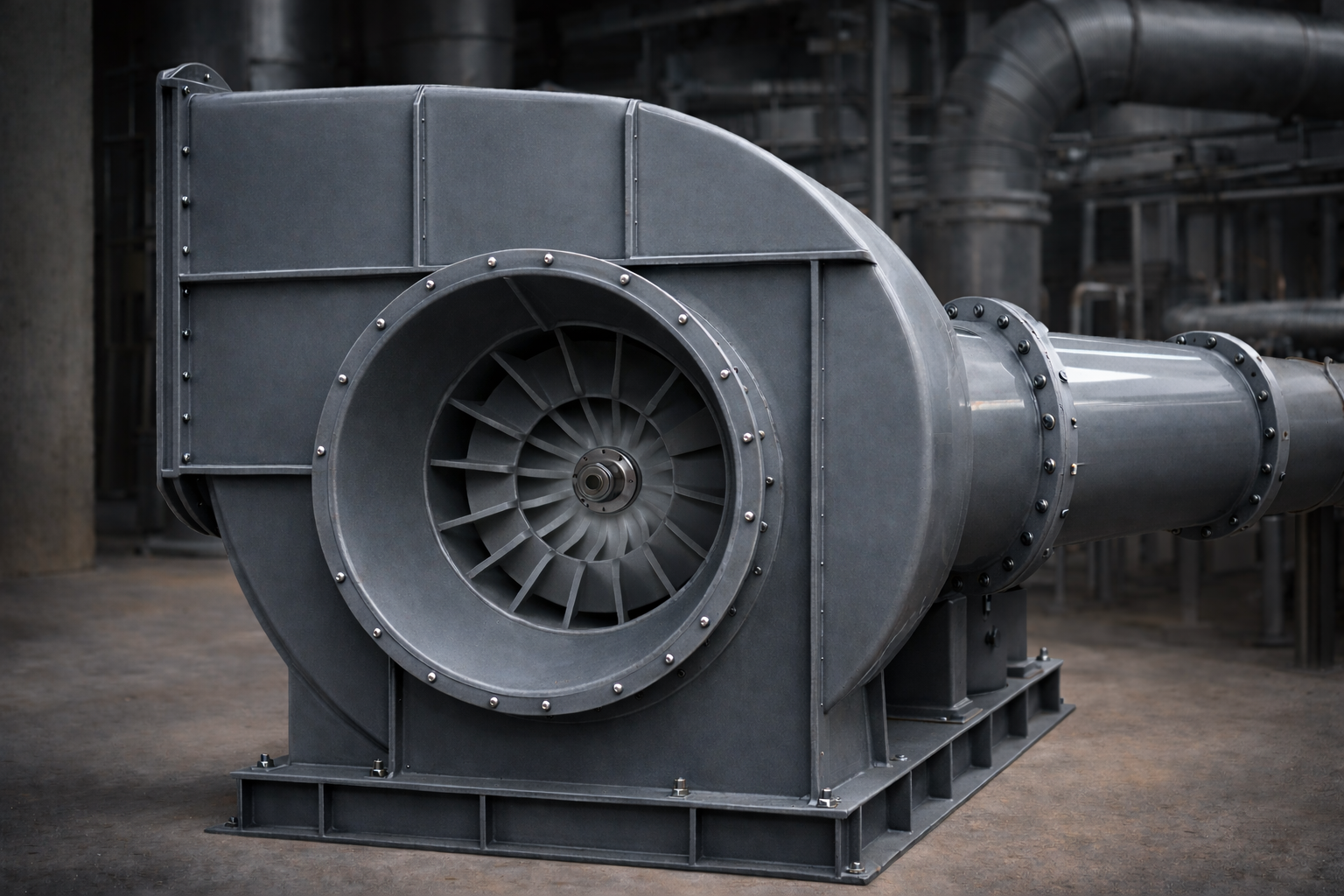
A standard centrifugal blower can generate air pressures 50 times higher than a traditional axial fan, making it the primary engine behind modern manufacturing. These machines act as the high-pressure lungs of a factory, moving air through miles of restrictive ducting or dense filtration systems that would cause other fans to fail.
Fundamentals of Centrifugal Blower Technology and Performance
The core function of a centrifugal blower is the conversion of velocity into pressure. This process begins when air enters the blower housing through an inlet located at the center of a rotating impeller. As the impeller spins at high speeds, it accelerates the air molecules outward using centrifugal force. This kinetic energy is then transformed into static pressure as the air slows down within the scroll-shaped volute housing. This 90-degree change in direction is what allows a centrifugal fan to generate much higher pressures than axial designs.
Impeller Blade Geometry and Performance Profiles
The performance of an industrial air blower is dictated by the shape of its impeller blades. Engineers select from three primary geometries based on the specific needs of the air stream:
- Radial Blades: These blades extend straight from the hub. They are the most durable choice for moving air contaminated with dust, wood chips, or metal shavings. Because of their flat shape, they do not allow material to build up on the blades, which prevents imbalance and vibration. However, they are the least efficient in terms of power consumption.
- Forward-Curved Blades: These blades curve in the direction of the impeller’s rotation. They can move large volumes of air at low speeds, which makes them very quiet. They are common in HVAC systems but are prone to “overloading” the motor if the system resistance drops unexpectedly.
- Backward-Inclined Blades: These blades curve away from the direction of rotation. They represent the peak of efficiency for clean air applications. They have a “non-overloading” power characteristic, meaning the motor will not burn out even if the air resistance changes.
The Physics of the Volute Housing
The housing, or volute, is not just a protective shell. It is a precision-engineered chamber that expands in volume as it nears the discharge outlet. This expansion is vital because it follows Bernoulli’s principle. As the area increases, the velocity of the air decreases, and that energy is traded for static pressure. This design makes the industrial air blower superior for overcoming high system resistance, such as pushing air through a 500-foot pipe or a series of HEPA filters.
Comparing Single-Stage and Multistage Centrifugal Blower Architectures
When selecting a centrifugal blower, the most fundamental architectural decision is whether to use a single-stage or multistage configuration. A single-stage unit features a single impeller mounted on the motor shaft or a belt-driven assembly. These units are typically capable of producing pressures up to 3.5 pounds per square inch (PSI) or roughly 100 inches of water column. They are the workhorses of local exhaust systems and small-scale pneumatic lines.
Cumulative Pressure Gains in Multistage Systems
A multistage centrifugal blower functions by stacking multiple impellers on a single long shaft. The air enters the first impeller, gains pressure, and is then channeled through a series of internal baffles or “return channels” into the eye of the next impeller. This process repeats, with each stage adding more pressure to the air stream. A 10-stage blower can reach pressures exceeding 25 PSIG. These units are essential for deep-tank wastewater aeration or high-vacuum industrial cleaning where a single impeller simply cannot generate the necessary lift.
Criteria for Industrial Selection
The choice between these two architectures often comes down to the “compression ratio” required by the process.
- Single-Stage: Best for high-volume, low-pressure tasks. They have a smaller footprint and fewer rotating parts, which simplifies the inventory of spare parts.
- Multistage: Best for applications requiring 5 to 25 PSI. While they are more expensive upfront, they offer a very flat performance curve. This means that if the air demand fluctuates, the pressure remains relatively constant, which is a vital requirement for gas compression or chemical processing.
Maintenance and Complexity Trade-offs
The complexity of a multistage industrial air blower introduces specific maintenance challenges. Because the shaft is longer and supports more weight, the bearings must be of a much higher grade, often requiring forced-oil lubrication systems rather than simple grease fittings. Precision balancing is also more difficult; if one impeller in a seven-stage stack becomes slightly fouled, the entire unit may experience harmonic vibrations. Single-stage units, by contrast, are often “overhung” designs where the impeller is mounted directly on the motor shaft, eliminating the need for separate blower bearings and couplings. This simplicity reduces the time needed for routine inspections and lowers the risk of catastrophic mechanical failure.
Engineering the Perfect Fit: Calculating CFM and Static Pressure Requirements
Sizing an industrial air blower is a precise science that prevents two common problems: “under-sizing,” which leads to insufficient air flow, and “over-sizing,” which leads to wasted electricity and mechanical surging. The first step is determining the Volumetric Flow Rate, measured in Cubic Feet per Minute (CFM).
Step 1: Calculating Required CFM
In pneumatic conveying, the CFM is determined by the “saturation” of the air. For example, if you need to move 5,000 pounds of plastic pellets per hour, you must find out the minimum air velocity required to keep those pellets suspended in the pipe (the saltation velocity). If that velocity is 4,000 feet per minute in a 4-inch pipe, you multiply the cross-sectional area of the pipe by the velocity to find the required CFM. In ventilation, the CFM is usually determined by the number of “air changes per hour” required by local safety codes for a specific room volume.
Step 2: Determining Total System Resistance (Static Pressure)
The centrifugal fan must be strong enough to overcome the friction of the entire system. This resistance is called Static Pressure (SP) and is measured in inches of water column (in. wg). You must add up the pressure drops from every component:
- Ductwork Friction: Every 100 feet of straight pipe creates a specific amount of drag based on the air speed.
- Elbows and Fittings: A single 90-degree elbow can have the same resistance as 20 or 30 feet of straight pipe.
- Filters and Scrubbers: A dirty filter can double the static pressure of a system overnight.
- Dampers and Grilles: These components create turbulence that the blower must overcome.
Step 3: Interpreting Manufacturer Fan Curves
Once you have your CFM and SP numbers (for example, 2,000 CFM at 15 in. wg), you look at a fan curve provided by the manufacturer. A fan curve is a graph showing the relationship between flow and pressure for a specific high pressure blower. You want your “operating point” to fall in the middle of the curve, known as the Best Efficiency Point (BEP). If your operating point falls too far to the left, the blower will enter a “stall” or “surge” condition. This is where the air physically breaks away from the impeller blades, causing loud banging noises, high vibration, and eventual shaft breakage. Operating too far to the right of the curve will overload the motor, causing it to trip the circuit breaker or burn out the internal windings.
Optimizing Industrial Workflows: Centrifugal Fans vs. Axial and Rotary Alternatives
Industrial facilities often struggle to decide between a centrifugal fan and an axial fan. The difference lies in how they handle resistance. Axial fans, like the propellers on an airplane, move air parallel to the shaft. They are excellent for moving massive amounts of air at very low pressures, such as in a warehouse cooling fan. However, if you add even a small amount of ductwork, the axial fan’s performance drops off a cliff. A centrifugal blower is the opposite; it thrives in restrictive environments because its design allows it to “bite” into the air and compress it.
Centrifugal vs. Rotary Lobe Blowers
In high-pressure applications, the competition is between centrifugal technology and rotary lobe (Roots-style) blowers.
- Flow Characteristics: Rotary lobe blowers are positive displacement machines. They trap a specific volume of air and move it to the discharge. This creates “pulses” in the air stream, which can cause vibration in the piping. A centrifugal fan provides a smooth, continuous flow of air with no pulsation.
- Noise Levels: Because of the pulsing action, rotary lobe blowers are incredibly loud, often requiring massive silencers. Centrifugal units are generally quieter, with the noise being a high-frequency whine that is much easier to insulate with standard acoustic blankets.
- Efficiency: Centrifugal blowers are generally more efficient at a specific design point. However, rotary lobe blowers maintain better efficiency if the pressure in the system changes significantly.
Cost-Benefit and Durability Analysis
While a centrifugal blower might have a higher initial purchase price than a basic axial fan, its lifecycle cost is often lower in industrial settings. The heavy-duty construction of an industrial air blower, using thick plate steel or cast aluminum, allows it to run for 20 years with proper care. Axial fans often use lighter materials that can flex or fatigue under the stress of continuous industrial use. Additionally, the ability to repair a centrifugal unit by simply replacing the bearings or re-balancing the impeller makes it a more sustainable long-term investment for a factory.
Maximizing Energy Savings: Efficiency Ratings and VFD Integration
Electricity accounts for nearly 80% of the total cost of owning an industrial air blower over its lifetime. To minimize these costs, you must look at the motor efficiency ratings. Most modern blowers are paired with motors that meet IE3 (Premium Efficiency) or IE4 (Super Premium Efficiency) standards. Switching from an older standard motor to an IE4 motor can reduce energy consumption by 3% to 5%, which translates to thousands of dollars in savings for a blower that runs 24/7.
The Role of Variable Frequency Drives (VFDs)
The most effective way to save energy is by using a Variable Frequency Drive (VFD). In many industrial processes, the demand for air changes throughout the day. Without a VFD, a centrifugal blower runs at 100% speed all the time, and operators use “dampers” (like giant valves) to choke the air flow. This is like driving a car with the gas pedal floored and using the brake to control your speed. A VFD allows you to slow down the motor itself. According to the Fan Laws, if you reduce the fan speed by 20%, the power consumption drops by nearly 50%. This is because power consumption is proportional to the cube of the speed.
Preventing Surging and Improving Turndown
A VFD also helps manage the “turndown” ratio of a high pressure blower. Turndown is the ability of the blower to operate at lower-than-rated flows without becoming unstable. If you slow the blower down too much, it may hit the “surge line,” where the pressure in the pipe is higher than the pressure the blower is producing, causing the air to rush backward into the impeller. Modern VFD controllers have “anti-surge” software that monitors the motor’s amperage and pressure sensors to make sure the blower stays within its safe operating window. This level of control is vital for systems like wastewater aeration, where the oxygen demand of the bacteria changes based on the time of day and the volume of incoming waste.
Top Industrial Use Cases: From Pneumatic Conveying to Wastewater Aeration
The versatility of the centrifugal blower makes it a staple in diverse sectors. One of its most common roles is in pneumatic conveying. In this application, the blower creates a high-velocity air stream that carries bulk solids, such as flour, plastic resin, or cement powder, through a network of pipes. Because these systems often involve long distances and many turns, the high pressure blower must provide consistent force to prevent the material from settling and clogging the line.
Wastewater Treatment and Aeration
In municipal wastewater treatment, centrifugal fans are used to blow air into large aeration tanks. This air provides the oxygen necessary for aerobic bacteria to break down organic matter. Aeration is typically the single largest energy expense for a city’s utility department. High-efficiency centrifugal units, particularly those using “air-bearing” technology, have become the standard because they can run continuously for years with almost no maintenance while providing the precise air flow needed to keep the bacterial colonies alive.
Chemical Processing and Combustion Air
Chemical plants use industrial air blowers to move corrosive or explosive gases. In these cases, the blowers are often constructed from 316 stainless steel or coated with specialized epoxy to prevent chemical attack. They are also used to provide “combustion air” to large industrial boilers and furnaces. For a flame to burn efficiently and cleanly, it needs a very specific ratio of fuel to air. A centrifugal unit, controlled by a VFD, can adjust the air flow in real-time to match the fuel delivery, reducing emissions and saving fuel costs.
Ensuring System Longevity: Installation Best Practices and Maintenance Protocols
A centrifugal blower is a precision instrument, and its lifespan is determined the moment it is installed. The most common cause of early failure is poor shaft alignment. If the motor shaft and the blower shaft are off by even a few thousandths of an inch, it creates a “bending” force that destroys bearings and seals. Using laser alignment tools during installation is the best way to make sure the unit is perfectly straight. Additionally, the blower should be mounted on vibration isolation pads or an inertia base to prevent vibrations from the building from transferring into the machine.
Preventive Maintenance Schedules
To keep an industrial air blower running, you must follow a strict maintenance schedule:
- Lubrication: Over-greasing is just as dangerous as under-greasing. Use a calculated amount of high-quality grease (usually polyurea or lithium-based) every 2,000 hours of operation.
- Belt Tensioning: If the unit is belt-driven, check the tension after the first 24 hours of run time. Loose belts slip and create heat, while tight belts pull the bearings out of alignment.
- Impeller Cleaning: In dusty environments, material can build up on the blades. Even a few grams of dust can cause an imbalance that leads to catastrophic vibration.
Advanced Monitoring Techniques
Leading facilities now use vibration monitoring and thermal imaging for early detection of issues. A vibration sensor can “hear” a bearing failing weeks before a human can. Similarly, a thermal camera can show a “hot spot” on a motor or bearing housing, indicating a lack of lubrication or an electrical problem. By catching these issues early, you can schedule a repair during a planned shutdown rather than dealing with an expensive emergency breakdown.
Frequently Asked Questions
What is the main difference between a fan and a blower?
The difference is defined by the pressure ratio. A fan has a pressure ratio (discharge pressure divided by inlet pressure) of up to 1.11, while a centrifugal blower has a ratio between 1.11 and 1.20. Essentially, blowers are designed to push air against much higher resistance than fans.
Why is my centrifugal blower making a loud pulsing or “whoofing” noise?
This is likely a sign of surging. It happens when the system resistance is too high for the volume of air being moved, causing the air to momentarily flow backward through the impeller. You should check for clogged filters or closed dampers, or use a VFD to adjust the speed.
Can a centrifugal blower be used to move hot air or gases?
Yes, but you must select a unit with a “heat fan” or “cooling disk” on the shaft. This disk acts as a small heat sink to protect the bearings from the high temperatures of the air stream. Special alloys like 304 or 316 stainless steel are also used for temperatures exceeding 300 degrees Fahrenheit.
How do I know if I need a single-stage or multistage blower?
If your application requires less than 3.5 PSI, a single-stage industrial air blower is usually the most cost-effective choice. If you need higher pressures for tasks like deep-water aeration or long-distance pneumatic conveying, a multistage unit is required to reach those levels efficiently.
Key Takeaways
- Match the Blade to the Air: Use radial blades for dirty air and backward-inclined blades for maximum efficiency in clean air.
- Calculate Resistance Carefully: Always factor in the pressure drop of every elbow, filter, and foot of ductwork before choosing a blower.
- Use VFDs for ROI: A Variable Frequency Drive can pay for itself in less than a year through energy savings by following the Fan Laws.
- Prioritize Alignment: Laser-aligning the motor and blower shafts is the single most important step for preventing bearing failure.
- Monitor Vibration: Implement a simple vibration check routine to catch mechanical issues before they lead to a total system shutdown.