Skip to content
As a wet scrubber design and manufacturing engineer with over a decade of hands-on experience at Envigaurd, I have spent countless hours on shop floors, overlooking cement plant expansions, and squeezing into tight pharmaceutical facility utility rooms. The question I am often asked by plant heads and EHS managers, not just in conference rooms but amidst the hum of active machinery, is simple yet critical: “What is a wet scrubber, and is it the right solution for my plant?”
In the complex landscape of industrial air pollution control, understanding the wet scrubber working principle is not just about theory; it is about reliability, compliance, and operational cost.
What Is a Wet Scrubber?
To define it precisely from a practitioner’s standpoint: A wet scrubber is an air pollution control system that utilizes a liquid (usually water or a chemical reagent) to remove particulate matter and/or gaseous pollutants from an industrial exhaust stream.
Unlike dry filtration systems that trap particles in a filter media, a wet scrubber washes the contaminants out of the gas stream. It is a dynamic device where chemistry and fluid mechanics intersect. In our experience at Envigaurd, designing an effective industrial wet scrubber requires a deep understanding of the process parameters, flow rates, temperature, chemical composition, and the nature of the pollutants.
Whether you are dealing with acid fumes in a chemical plant or crushing dust in a cement unit, the goal remains the same: to clean the exhaust gas to meet stringent emission norms before it is released into the atmosphere.
How Does a Wet Scrubber Work? The Operational Logic
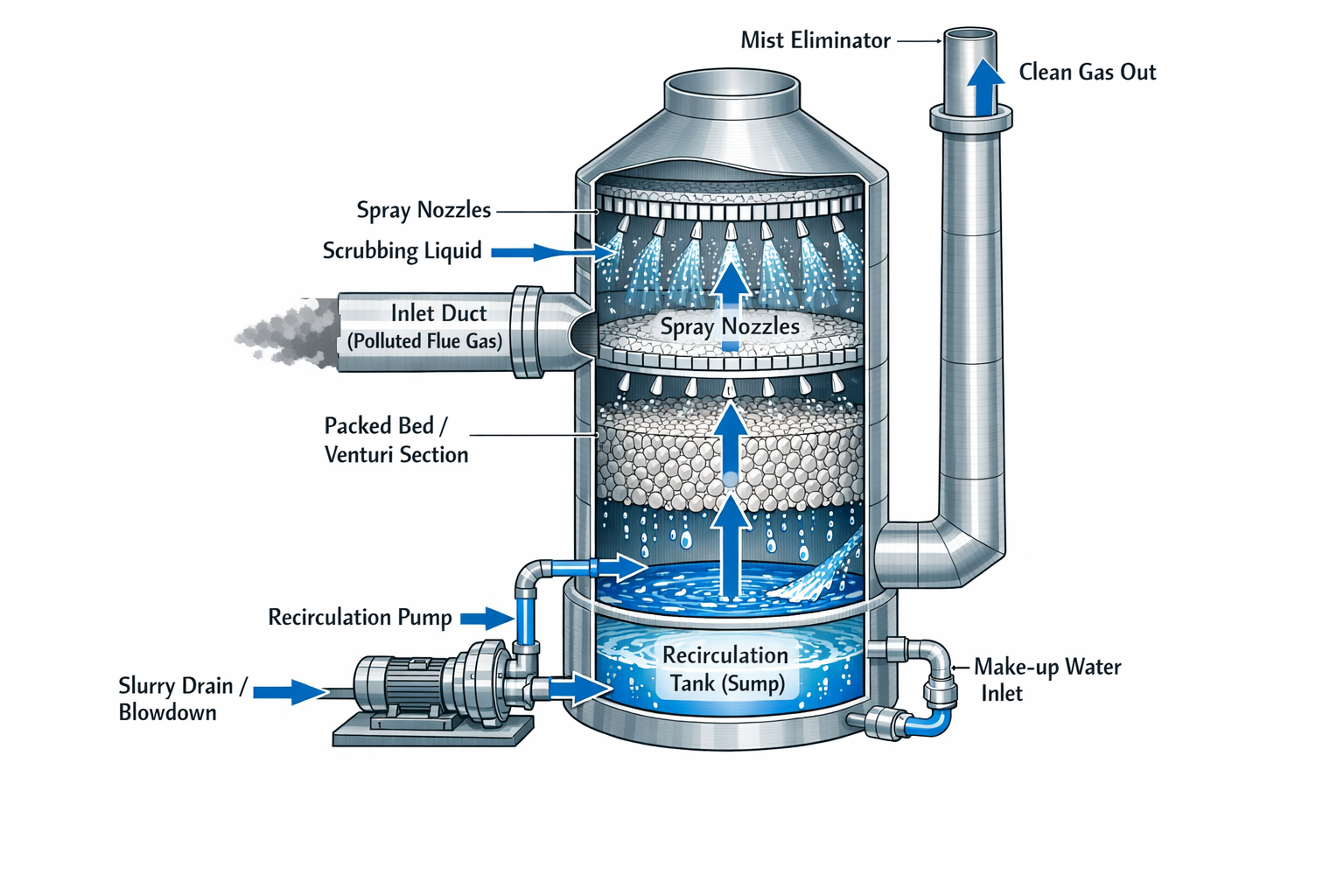
The efficiency of a wet scrubber hinges on the contact between the polluted gas stream and the scrubbing liquid. This isn’t just spraying water into a pipe; it is a controlled process of mass transfer and impaction.
Here is the breakdown of the operational logic we use in system design:

- Gas-Liquid Contact: The contaminated gas is forced into the scrubber vessel. Simultaneously, the scrubbing liquid is introduced via spray nozzles or distribution headers. The goal is to maximize the surface area of the liquid so the pollutants can collide with and dissolve into the droplets.
- Impaction & Interception (For Particles): For particulate matter (dust, smoke, aerosols), the mechanism is primarily inertial impaction. As the gas changes direction (often around packing material or through a Venturi throat), the heavier particles cannot follow the streamlines and crash into the liquid droplets, getting trapped.
- Absorption & Neutralization (For Gases): For gaseous pollutants like HCl, Cl2, or NH3, the process is absorption. The pollutant gas dissolves into the liquid. In many cases, we add a chemical reagent (like caustic soda for acids or dilute acid for ammonia) to chemically neutralize the pollutant, converting it into a harmless salt.
- Entrainment Separation: Once the gas is washed, it is saturated with moisture and carries fine liquid droplets (mist). If this gas leaves the scrubber, it creates a visible plume or causes corrosion downstream. A mist eliminator (demister) captures these droplets, ensuring only clean, dry gas exits the stack.
Key Components of an Industrial Wet Scrubber
Having fabricated and commissioned hundreds of systems, we know that the robustness of the components defines the system’s lifespan. A standard, high-quality industrial wet scrubber consists of the following:
- Scrubber Body (Vessel): The containment shell. Depending on the application, we manufacture these from FRP (Fiber Reinforced Plastic), PP (Polypropylene), or Stainless Steel (SS304/316). The selection dictates corrosion resistance and pressure vessel integrity.
- Spray System & Nozzles: This is the heart of the gas-liquid contact. We use full-cone or hollow-cone nozzles designed to resist clogging. In heavy dust applications, we specify anti-clogging designs to ensure continuous operation.
- Mist Eliminators: Usually made of PP or PVC, these mesh pads or vane packs remove the entrained water droplets. In our designs, we often include a wash-down system for the mist eliminator to prevent fouling.
- Cyclonic Separators: Used in Venturi scrubbers to separate the slurry from the gas stream using centrifugal force before the mist eliminator stage.
- Recirculation System (Pump & Tank): This includes the chemical dosing tank, the recirculation pump (often vertical turbine pumps for corrosive services), and piping. The pump must handle the specific gravity and viscosity of the slurry.
- ID Fan/Blower: The Induced Draft fan pulls the gas through the system. We calculate the static pressure carefully to account for the pressure drop across the scrubber, ensuring the fan handles the corrosive, often wet, environment.
Types of Wet Scrubbers: Selection Based on Application
Not all wet scrubbers are created equal. Selecting the wrong type is a common mistake we see during retrofits. Here is how we classify and select them based on industrial scenarios:
1. Venturi Scrubber
- Working Principle: Uses a constriction (throat) where gas velocity accelerates to 60,000 to 120,000 ft/min. The scrubbing liquid is injected into this high-velocity stream, shattering into fine droplets that capture particles.
- Where it is used: High dust loading applications.
- Typical Scenarios: Cement kiln dust, crusher dust, fly ash handling, and mining operations.
- Suitability: Heavy-duty. It is the go-to solution when you have hot gases laden with particulate matter. It handles high temperatures well but requires significant energy due to high pressure drops.
2. Packed Bed Scrubber
- Working Principle: The vessel is filled with packing media (plastic saddles, rings, or structured packing). The liquid flows down over the media, creating a thin film, while gas flows counter-currently. This provides massive surface area for gas absorption.
- Where it is used: Gaseous pollutant removal.
- Typical Scenarios: Acid gas fumes (HCl, HF, SO2) from chemical pickling lines, pharmaceutical reactor vents, and fertilizer plants.
- Suitability: Medium-duty. Excellent for removing soluble gases with high efficiency (>99%). Not suitable for high particulate loads as the packing will clog.
3. Spray Tower Scrubber
- Working Principle: Open vessel with only spray nozzles. Gas flows upward while liquid sprays downward. Relies solely on the droplet size and spray coverage for contact.
- Where it is used: Gas cooling and particulate removal of larger particles, or when high solubility gases are present.
- Typical Scenarios: Quenching hot gases, absorbing ammonia in fertilizer units, and odor control in food processing.
- Suitability: Light to medium duty. Lowest pressure drop among the types, making it energy-efficient, but less efficient for fine particulates or low-solubility gases.
Pollutants Removed by Wet Scrubbers
In our projects across India, the versatility of the air pollution control system is tested daily. Wet scrubbers are effective against a wide spectrum of contaminants:
- Particulate Matter (PM): From sub-micron fumes to heavy dust. We often use Venturi scrubbers for cement and mining dust where bag filters might struggle with moisture or sticky particles.
- Acidic Gases: HCl, H2SO4, HF, HNO3, and SO2. These are common in chemical industries and pickling lines. A packed bed scrubber using caustic soda (NaOH) is the standard engineering solution here.
- Ammonia (NH3): Common in fertilizer and refrigeration industries. We scrub this using water (dilute ammonia) or dilute sulfuric acid to produce ammonium sulfate.
- Odors and Fumes: Malodorous compounds like Hydrogen Sulfide (H2S) from food processing or wastewater treatment plants are effectively removed using chemical oxidants in the scrubbing liquid.
- Metal Fumes: In aerospace component manufacturing or battery production, wet scrubbers capture hazardous metal fumes that are water-soluble.
Industry-Wise Use Cases: Real-World Applications
To give you a better idea of how these systems function in the field, here are specific scenarios where Envigaurd has implemented wet scrubber solutions:
Pharmaceutical Industry
In API (Active Pharmaceutical Ingredient) manufacturing, reactions often generate HCl, HBr, or solvent fumes.
- The Challenge: Corrosive acid fumes mixed with organic solvents. Compliance with pharmaceutical GMP and safety standards is strict.
- The Solution: We typically design FRP Packed Bed Scrubbers. The packing provides the necessary surface area for the acid gas to react with the caustic scrubbing solution. We integrate interlocks to ensure the fan runs only if the recirculation pump is active, preventing release of raw acid fumes.
Cement Plants
Cement manufacturing generates massive amounts of dust at crushers, mills, and kilns.
- The Challenge: High-temperature gas streams with very high dust loading (loading can exceed 50 g/Nm³).
- The Solution: A high-energy Venturi scrubber. We design the throat to handle the specific gas volume. The slurry generated is heavy and abrasive, so we use wear-resistant linings and heavy-duty pumps. This system acts as a dedicated air pollution control device for specific point sources where baghouses are not feasible.
Mining and Mineral Processing
Extracting and processing ores releases silica dust and metallic fumes.
- The Challenge: Handling variable gas loads and abrasive dust.
- The Solution: Venturi or Cyclonic Spray Towers. These units are robust and less sensitive to flow fluctuations. We ensure the material of construction is robust enough to handle the abrasive nature of mineral dust.
Aerospace Manufacturing
Surface treatment, anodizing, and chemical milling in aerospace produce toxic fumes, often containing chromic acid or harsh etchants.
- The Challenge: Extremely hazardous, carcinogenic fumes that require zero-leak integrity.
- The Solution: Multi-stage packed bed scrubbers. Often, a fogging unit is added upstream to saturate the gas and cool it, followed by a packed tower for high-efficiency removal of acid mists. Materials of construction are usually high-grade PP or PVDF due to the aggressive chemicals.
Fertilizer Units
- The Challenge: Ammonia leaks and acid vapors during prilling or granulation.
- The Solution: Cross-flow or counter-current packed towers. For ammonia, we use an acid scrubbing solution. For the acid vapors (phosphoric or sulfuric acid mist), we use water or alkali. Efficiency is critical here to prevent local environmental damage.
Food Processing Plants
Cooking processes, rendering, and fermentation release steam mixed with odors and grease.
- The Challenge: The exhaust is wet, greasy, and smelly. Dry filters clog rapidly.
- The Solution: Spray towers or bio-scrubbers. The water scrubs out the grease and particulates, while a chemical additive in the water neutralizes the odor. This keeps the stack opacity within limits and prevents nuisance complaints in nearby areas.
Chemical Industry
- The Challenge: Highly corrosive exhausts involving mixed acids and solvents at high temperatures.
- The Solution: Custom-designed scrubber trains. For example, a quench tower followed by a packed bed scrubber, followed by a polishing scrubber. We focus heavily on material selection here (Dual Laminate FRP/PP or high-alloy SS) to ensure the vessel withstands the corrosive environment for years.
Design and Performance Considerations
When engineers at Envigaurd approach a design, we look beyond the immediate capture efficiency. We look at the Total Cost of Ownership (TCO). Here are the critical parameters we consider:
1. Capacity Sizing (Gas Flow Rate)
Sizing a scrubber isn’t just about matching the duct diameter. We analyze the peak flow rates and variations. Undersizing leads to channeling (gas bypassing the liquid) and poor efficiency. Oversizing increases capital cost unnecessarily. We calculate the superficial gas velocity to ensure optimal contact time in the vessel.
2. Liquid-to-Gas Ratio (L/G Ratio)
This is a critical parameter. It defines how many liters of scrubbing liquid are used per cubic meter of gas.
- Low L/G: Can lead to dry spots, scaling, and poor efficiency.
- High L/G: Increases pumping power costs and creates excessive wastewater.
We optimize this ratio to balance efficiency and utility consumption. For a Venturi scrubber, this ratio might range from 0.7 to 1.5 l/m³, while a packed bed might operate differently.
3. Pressure Drop
Pressure drop is the resistance the gas faces as it moves through the system.
- Venturi: High pressure drop (high energy consumption, high efficiency for particles).
- Packed Bed: Moderate pressure drop (depends on packing depth and gas velocity).
- Spray Tower: Low pressure drop.
A good design minimizes pressure drop while maximizing efficiency. High pressure drop means your ID fan motor draws more power, increasing operational expenditure.
4. Material Selection (Corrosion Management)
This is where many projects fail if not specified correctly.
- FRP (Fiber Reinforced Plastic): Excellent for broad corrosion resistance, good for large diameters. Standard for most acid gases up to 80-90°C.
- PP (Polypropylene): Superior chemical resistance to many acids and alkalis. Used for smaller diameters or internal linings.
- PVC: Good for lower temperatures and strong acids/alkalis.
- Stainless Steel (SS 304/316): Used when high structural strength is needed or when chlorides are absent (to avoid pitting). We use high-grade alloys only if chemically justified, as the cost is significantly higher.
5. Corrosion and Maintenance Planning
A wet scrubber manufacturer must design for maintenance. We include manways, inspection ports, and access ladders. We design the recirculation tank with easy clean-out arrangements. For the mist eliminator, we specify a wash system because scaling (salt buildup) is the number one cause of increased pressure drop and fan trips.
Wet Scrubbers vs. Dry Scrubbers: A Comparative View
Clients often ask: “Should we go wet or dry?” As an EPC partner, we present the engineering facts.
| Feature | Wet Scrubber | Dry Scrubber (e.g., Spray Dry Absorber) |
|---|---|---|
| Mechanism | Uses liquid slurry to wash pollutants. | Uses dry sorbent (lime/activated carbon) sprayed into flue gas. |
| Temperature | Cools the gas significantly (saturation). | Gas remains hot; useful if stack buoyancy is needed. |
| Waste Product | Generates a wet slurry/sludge. Requires dewatering. | Generates a dry powder. Easier to handle. |
| Efficiency (Gases) | Very high for acid gases if L/G ratio is right. | Good, but often requires higher sorbent usage. |
| Space Footprint | Generally larger due to tank and recirculation system. | More compact. |
| Water Usage | High (fresh water make-up required). | Negligible. |
| Best For | Acid gases, sticky dust, soluble pollutants, high humidity applications. | Acid gases in coal-fired plants, where waste disposal of sludge is an issue. |
Advantages of Wet Scrubbers
- Versatility: Can handle both particulates and gases simultaneously.
- Cooling: Inherently quenches hot gases, protecting downstream components.
- Fire Safety: The system is wet, eliminating the risk of fire from combustible dust or solvent fumes inside the scrubber.
- High Efficiency: Capable of achieving sub-micron particulate removal and >99% acid gas removal.
Limitations of Wet Scrubbers
- Wet Waste Handling: Produces sludge that must be treated and disposed of, adding to the wastewater treatment load.
- Corrosion: Requires high-grade materials (FRP/PP/SS), increasing capital cost.
- Visible Plume: In cold weather, the saturated gas can form a visible steam plume (condensed water vapor), which, while harmless, is sometimes mistaken for pollution.
- Freezing Risk: In extreme cold climates, outdoor units require heat tracing to prevent freezing.
Conclusion: Selecting the Right Partner for Your Wet Scrubber Needs
Deciding to install an industrial wet scrubber is a strategic move toward environmental compliance and operational safety. However, the performance of the system relies entirely on the quality of the engineering design, the fabrication standards, and the commissioning rigor.
At Envigaurd, our approach is rooted in the reality of Indian industrial conditions. We understand that a scrubber in a cement plant faces different challenges than one in a sterile pharmaceutical facility. We design our systems to handle these variations, focusing on parameters like Liquid-to-Gas ratios, pressure drop management, and corrosion resistance to ensure the system operates seamlessly for years.
When choosing a wet scrubber manufacturer, look beyond the price tag. Assess their ability to provide turnkey solutions, from the initial engineering study and structural design to fabrication, installation, and post-commissioning support. A well-designed wet scrubber is not just a compliance tool; it is an asset that ensures your plant runs without environmental interruptions.
If your industry involves handling corrosive fumes, hazardous dust, or strict odor control requirements, a wet scrubber is likely the most robust engineering solution available. Ensure it is designed by experts who understand your process.
FAQ: Wet Scrubbers for Industrial Applications
Based on inquiries from procurement teams and plant engineers across India, here are answers to the most common questions:
1. What is the difference between a packed bed and a Venturi scrubber?
A packed bed scrubber is primarily used for absorbing gaseous pollutants (like acid fumes) using packing media to increase surface area. A Venturi scrubber is used to remove particulate matter (dust) using high-velocity gas to crash particles into liquid droplets.
2. How often do I need to change the scrubbing liquid?
It is a continuous process. You don’t change the liquid; you continuously recirculate it. However, you must continuously “blowdown” a portion of the concentrated slurry and add fresh water (called “make-up water”) to maintain the concentration and pH of the scrubbing solution.
3. Can a wet scrubber handle combustible dust?
Yes. One of the significant advantages of a wet scrubber is that it eliminates the fire and explosion hazard associated with handling combustible dust in dry filters.
4. What is the typical lifespan of an FRP wet scrubber?
With proper design, chemical-resistant resin selection, and regular maintenance, an FRP scrubber can easily last 15-20 years in a chemical plant environment.
5. Is a wet scrubber suitable for removing VOCs (Volatile Organic Compounds)?
Standard wet scrubbers are not efficient for removing low-solubility VOCs. For VOCs, we often look at thermal oxidizers or carbon adsorbers. However, if the VOC is water-soluble (like alcohol), a wet scrubber can reduce the load effectively.