
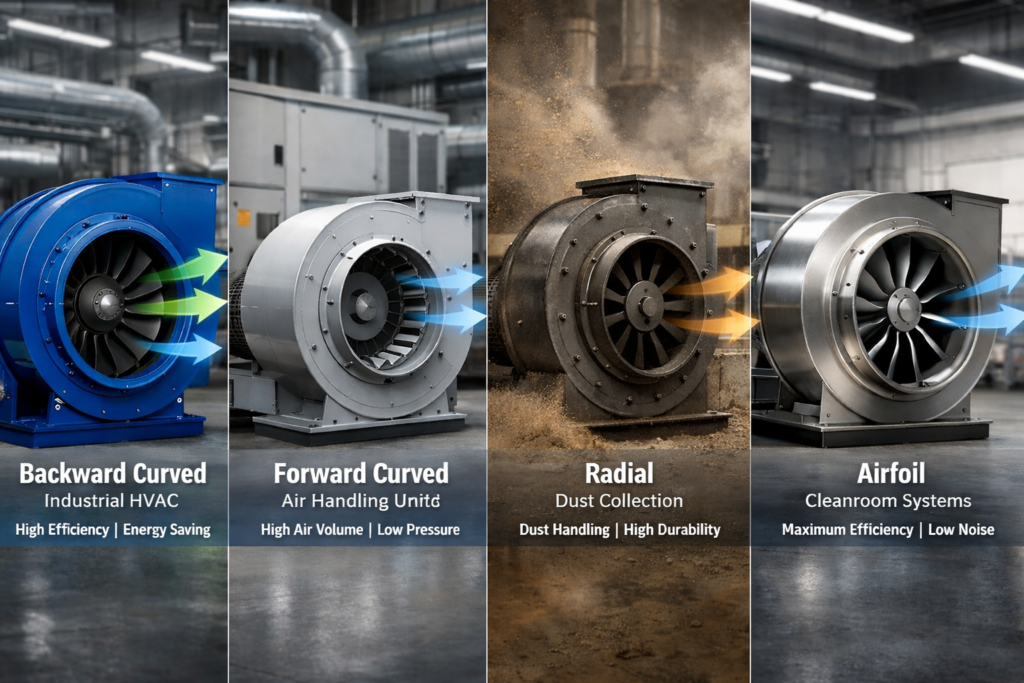
QUICK ANSWER: TYPES OF CENTRIFUGAL BLOWERS
| The four types of centrifugal blower blades are: backward curved, backward inclined, forward curved, and radial (paddle wheel). A fifth high-performance variant the airfoil blade is classified within the backward curved family but warrants separate treatment due to its distinct geometry and superior efficiency. Each blade type produces a fundamentally different pressure-flow curve, efficiency level, noise signature, and suitability for contaminated airstreams. |
Backward curved and airfoil blades are the industry-preferred selections in 2026 because they are non-overloading, achieve the highest static efficiency (75 to 90 percent), and meet tightening energy compliance requirements. Forward curved blades suit residential and light commercial HVAC where low rotational speed and compact size matter more than peak efficiency. Radial blades are reserved exclusively for heavy-duty material-handling service where airstream contamination would destroy any other impeller type.
Key Highlights of Centrifugal Blowers Types
- Four main blade types: backward curved, backward inclined, forward curved, and radial (paddle wheel).
- Backward curved and airfoil blades offer the highest efficiency and are non-overloading industry preferred in 2026.
- Forward curved blades produce higher flow at lower speeds but can overload the motor at high system resistance.
- Radial blades are the most robust, used where abrasive or sticky materials are present.
- Blade selection directly impacts energy consumption, noise levels, and total lifecycle cost.
Comparison Table: Centrifugal Blower Blade Types (8 Parameters)
The table below compares all five blade configurations across eight engineering parameters to support direct selection.
| Parameter | Backward Curved | Backward Inclined | Forward Curved | Radial / Paddle | Airfoil |
|---|---|---|---|---|---|
| Peak Static Efficiency | 75 to 82% | 70 to 78% | 55 to 68% | 55 to 65% | 82 to 90% |
| Power Curve / Overloading Risk | Non-overloading | Non-overloading | Overloading risk | Moderate risk | Non-overloading |
| Noise Level | Low | Low to moderate | Moderate (low RPM) | High | Lowest |
| Particulate Tolerance | Moderate | Moderate to good | Moderate | Excellent | Poor (clean air only) |
| 2026 Energy Compliance | High | Good | Low (industrial) | Application-specific | Highest |
| Relative First Cost | Moderate | Low to moderate | Low | Low | Higher |
| Lifecycle Operating Cost | Low | Low to moderate | High | High | Lowest |
| Typical Applications | HVAC, process ventilation, clean exhaust | Light dust, general industrial | Residential HVAC, light commercial | Abrasives, wood chips, grain, biomass | Clean room, pharma, large HVAC, data centers |
Why Blade Type Matters in Centrifugal Blower Selection
The blade geometry of a centrifugal blower is the single most consequential design variable governing how a blower converts motor shaft power into useful airflow. Every parameter an engineer cares about peak efficiency, pressure generation, noise signature, motor loading behavior, and suitability for contaminated airstreams traces directly back to the shape, angle, and number of impeller blades.
In industrial practice, selecting the wrong blade type for a given process frequently results in motors that run hot, systems that consume 20 to 40 percent more energy than necessary, or catastrophic overload conditions when system resistance unexpectedly shifts. In a regulatory environment where energy compliance targets tighten with every revision cycle, this is no longer an acceptable margin of error.
The 2026 engineering landscape is defined by two converging pressures: stricter minimum efficiency requirements under programs such as the European Ecodesign Regulation for fans and the evolving U.S. DOE fan efficiency guidelines, and sustained pressure to reduce lifecycle operational costs. Together, these forces have accelerated the industry’s shift away from legacy forward curved and flat radial designs toward backward curved and airfoil impellers in all applications where the process permits it.
Backward Curved Centrifugal Blower
Design Geometry
A backward curved impeller is characterized by blades that curve away from the direction of rotation. When viewed from the front, the trailing edge of each blade leans backward relative to the impeller’s rotational path. Blade inlet angles typically range from 20 to 40 degrees relative to the radial, and outlet angles sit between 20 and 50 degrees backward from the tangential direction. The blades are generally single-thickness sheet steel, stamped or rolled to the required curvature.
This geometry means that as the impeller rotates, air is accelerated through the blade passages and exits at a relative velocity that has a rearward-leaning component. The result is that the absolute exit velocity of the air has a smaller tangential component than in a forward curved design a condition with significant aerodynamic consequences for efficiency.
Performance Characteristics
The most important performance attribute of backward curved blades is the shape of their power curve. As flow increases toward wide-open conditions, the shaft power drawn rises gradually and then levels off. It does not continue climbing steeply beyond the peak efficiency point. This characteristic is referred to as non-overloading: if system resistance drops unexpectedly, the motor will not be overdriven past its rated capacity.
Peak total efficiency for backward curved impellers in well-engineered configurations typically falls in the range of 75 to 82 percent static efficiency, depending on specific speed. The backward curved centrifugal blower operates with comparatively low noise because the exit velocity triangles produce smooth flow attachment along the blade trailing edge, minimizing the turbulent separated flow regions that generate broadband noise in other designs.
The pressure-flow curve of backward curved blades is relatively steep and stable. This means the blower will hold close to the same pressure across a moderate range of flow variation a feature that simplifies system balancing in multi-branch duct networks.
BACKWARD CURVED KEY ENGINEERING PARAMETERS
| STATIC EFFICIENCY75 to 82% | POWER CURVENon-overloading |
| NOISE LEVELLow to moderate | PRESSURE CURVESteep, stable |
| BLADE MATERIALSheet steel (stamped or rolled) | CONTAMINATION TOLERANCEModerate (smooth surfaces) |
Applications
Backward curved blowers are the workhorses of industrial HVAC systems, clean-air process ventilation, central air handling units, and general exhaust in manufacturing environments where the airstream is reasonably clean. They are specified in boiler combustion air systems, dust collector returns, pneumatic conveying exhaust, and commercial kitchen makeup air systems. Their combination of efficiency and motor safety makes them the default selection for most clean-air applications when energy performance is a requirement.
Backward Inclined Centrifugal Blower
Backward inclined blades are closely related to backward curved blades but are manufactured as flat plates rather than curved surfaces. The blade is positioned at a backward-leaning angle relative to the radial typically between 10 and 25 degrees but does not follow a true aerodynamic curvature along its length.
This simplification in geometry produces several practical consequences. Manufacturing cost is lower because flat plate blades require no complex rolling or stamping operations. Maintenance is also simplified: flat surfaces are easier to clean when contaminated, and field replacement of individual blades is more practical in heavy-duty impeller configurations.
The aerodynamic performance of backward inclined blades is slightly below that of backward curved designs, with peak static efficiencies in the 70 to 78 percent range in most industrial configurations. The power curve retains the non-overloading characteristic, which is the critical operational safety attribute.
In 2026 engineering practice, backward inclined blades occupy a niche between the high-performance airfoil and backward curved designs on one end, and the more robust radial blade on the other. They are frequently selected when the airstream contains light particulate or when the application requires a design that is easier to clean in place without full impeller disassembly. Dust collection return fans and grinding room exhaust systems are common applications.
Forward Curved Centrifugal Blower
Forward curved centrifugal blowers use blades that curve in the direction of rotation. The blade trailing edge leans forward relative to the tangential direction, which means that as air exits the impeller, it carries a larger tangential velocity component than in backward curved designs. This kinetic energy must then be recovered as static pressure in the volute housing a conversion that is thermodynamically less efficient.
Despite the efficiency penalty, forward curved blades have genuine engineering value in specific scenarios. Because the exit velocity triangle delivers higher absolute air velocity for a given impeller tip speed, a forward curved impeller can generate significant airflow at substantially lower rotational speeds than a backward curved unit of equivalent size. This translates directly to lower operating noise levels in installations where acoustic output is a primary constraint residential or light commercial HVAC being the classic example.
The forward curved centrifugal blower typically achieves peak static efficiencies in the 55 to 68 percent range, meaningfully below backward curved configurations. The critical operational limitation is motor overloading. The power curve for forward curved impellers rises continuously as flow increases toward wide-open conditions. If system resistance drops below the design point for any reason, the motor will be driven toward overload conditions.
| Motor Sizing Note: Forward curved impellers require motor service factors of at least 1.15 to 1.25 to protect against overload at low-resistance operating points. Undersizing the motor is the most common commissioning error encountered in forward curved installations. |
From a 2026 energy compliance standpoint, forward curved blowers face increasing scrutiny. They remain technically permissible in many residential and light commercial applications, but the efficiency gap relative to backward curved and airfoil designs makes them difficult to justify in industrial settings where energy reporting is required.
Radial Blade / Paddle Wheel Centrifugal Blower
Radial blade impellers also called paddle wheel fans use blades that project straight outward from the hub with no backward or forward curvature. The geometry is as simple as a fan blade can be: flat plates oriented radially, welded or bolted to the hub and back plate with robust structural connections.
This simplicity is the radial blade’s primary engineering virtue. Because there are no curved surfaces or complex blade passages, the impeller can be built to extremely high structural strength at relatively low cost. There are no thin leading or trailing edges to erode, no curved surfaces for material to accumulate in, and the open, self-cleaning geometry resists buildup of sticky, fibrous, or wet materials that would immediately clog a backward curved or airfoil impeller.
Peak static efficiency for radial blade impellers is typically in the 55 to 65 percent range, making them the least efficient of the four principal blade types under clean-air conditions. Noise levels are also the highest of the four types, because the abrupt, separated flow around flat radial blades generates intense broadband and tonal noise content.
In 2026 industrial practice, radial blade blowers are selected specifically and exclusively for applications where the airstream contains materials that would destroy any other impeller type. Wood chip conveying, grain handling, bulk material pneumatic conveying, fly ash collection, and sawdust exhaust are the canonical use cases. In these environments, the question is not efficiency optimization but survival the impeller must handle large, abrasive, or sticky particles without plugging, erosion failure, or catastrophic imbalance.
When specifying radial impellers for abrasive service, blade thickness and wear plate specifications are the critical design parameters. For sticky materials such as wet woodchips or green biomass, the self-cleaning geometry of the open radial blade is often the only design that maintains balance over operational hours.
Airfoil Centrifugal Fan
The airfoil blade represents the aerodynamic peak of centrifugal impeller design. Rather than using a simple flat or uniformly curved plate, each blade has a cross-section profile drawn from wing aerodynamics: a rounded leading edge, a cambered pressure surface, and a tapered trailing edge. This geometry is typically fabricated by welding or riveting sheet metal into a hollow airfoil section, or by extrusion in aluminum for smaller diameter impellers.
The aerodynamic advantage of airfoil blade geometry comes from the elimination of flow separation. On a simple plate or curved sheet blade, the boundary layer on the suction surface tends to separate as angle of attack varies across the operating range. This separation generates turbulent wakes, increases drag, and produces noise. An airfoil profile delays separation through the same mechanism that sustains lift on aircraft wings: the progressive acceleration and deceleration of flow along the curved suction surface maintains attached flow across a wider range of conditions.
The result is peak static efficiencies in the 82 to 90 percent range in well-matched system designs the highest available from any centrifugal impeller configuration. The power curve is firmly non-overloading. Noise levels are the lowest of any blade type, because attached flow produces less turbulent kinetic energy in the blade wakes, and the shaped trailing edge reduces the discrete frequency tonal noise associated with blade passing.
The practical limitation of airfoil impellers is their sensitivity to contamination. The hollow internal structure can collect moisture or process dust if the blade has any surface defects, leading to internal corrosion or buildup-induced imbalance. The thin trailing edge is also more vulnerable to erosion in particulate-laden airstreams. Airfoil impellers are therefore reserved for clean-air applications: central station air handling, clean room supply and return, pharmaceutical process ventilation, turbine inlet systems, and data center cooling.
| 2026 Energy Trend: In the context of tightening 2026 energy efficiency regulations, airfoil impellers are increasingly the specification of choice for large-scale industrial HVAC and process air systems. The payback period on the efficiency premium has shortened as electricity costs have risen, with lifecycle savings over 15 to 20 years routinely dwarfing the initial capital cost difference between airfoil and simpler backward curved designs. |
How Envigaurd Selects Blade Type for Your Process
The selection methodology at Envigaurd begins with process characterization rather than catalog selection. Before a blade type is proposed, the engineering team gathers five categories of information: the airstream composition (clean air, light dust, heavy particulate, fibrous material, corrosive gases), the required operating point in terms of volume flow and static pressure, the shape of the system curve and how it may vary during operation, motor and drive constraints including available voltage and space envelope, and regulatory requirements applicable to the installation location and industry sector.
This information is then analyzed against fan law relationships and efficiency targets. The specific speed of the required operating point a dimensionless parameter that captures the fundamental aerodynamic regime of the application is used as the primary filter for impeller type. High specific speed applications favor backward curved and airfoil designs. Low specific speed, high-pressure requirements often point toward radial or backward inclined configurations.
The airstream composition assessment is conducted with particular rigor for any application involving particulate, moisture, or chemically active gases. An airfoil impeller that achieves 88 percent efficiency in its first year of service but fails by erosion or corrosion in year three is not a sound lifecycle selection, regardless of its nameplate efficiency figure. For these applications, material specifications blade thickness, abrasion-resistant overlays, surface coatings, and impeller balancing protocols after wear are as important as aerodynamic geometry.
In 2026, Envigaurd’s selection process also incorporates efficiency index calculations for all industrial blower specifications above five kilowatts, in line with emerging reporting requirements. This calculation compares the selected blower’s efficiency at the rated operating point against the minimum required efficiency target, expressed as a fan energy index or comparable metric depending on the applicable standard.
| VFD Integration Note: Variable frequency drive (VFD) integration has become nearly universal in new industrial blower specifications above 15 kW. The combination of VFD control with backward curved or airfoil impellers which maintain high efficiency across a range of speeds produces system energy savings of 30 to 60 percent compared to fixed-speed installations with forward curved impellers throttled by dampers. |
Frequently Asked Questions
-
Q What is the most energy-efficient centrifugal blower blade type?
Airfoil blades achieve the highest static efficiency, typically 82 to 90 percent in well-matched systems, followed closely by backward curved blades at 75 to 82 percent. Both are non-overloading and are the preferred designs for energy-compliant specifications in 2026. The choice between the two depends primarily on airstream cleanliness and budget: airfoil impellers carry a cost premium that is justified by efficiency gains in large, continuously operating systems.
-
Q Can a forward curved blower be used in an industrial process ventilation system?
Forward curved blowers can be used in industrial applications but carry inherent motor overloading risk that must be carefully managed through motor service factor selection and system design. Their efficiency range of 55 to 68 percent makes them increasingly difficult to justify against minimum efficiency requirements applicable to industrial fans in many jurisdictions. For clean-air industrial ventilation above 7.5 kW, backward curved or airfoil designs should be evaluated before selecting a forward curved impeller.
-
Q When should I specify a radial blade blower instead of backward curved?
Specify a radial blade blower when the airstream contains coarse particulate, abrasive materials, fibrous matter, or sticky bulk solids that would cause plugging, erosion, or severe imbalance on a backward curved or airfoil impeller. Common examples include wood chip exhaust, grain handling, fly ash conveying, and wet biomass processing. In these applications, the efficiency penalty of the radial design is the cost of operating in a harsh environment no other blade geometry will survive the service conditions.
-
Q What does non-overloading mean in practical terms?
Non-overloading means that as system resistance decreases toward zero static pressure (wide-open duct or catastrophic duct failure), the power drawn by the impeller does not exceed the motor’s rated capacity. In a non-overloading design, the power curve flattens or turns downward at high flow rates. In an overloading design (forward curved), the power curve continues rising steeply, and the motor can be driven into thermal overload if system resistance drops below the design point.
-
Q How does blade type affect centrifugal blower noise?
Blade type affects noise through two primary mechanisms: the amount of turbulent kinetic energy in the blade wakes (broadband noise), and the intensity of the pressure pulse generated each time a blade passes the volute cutoff (tonal blade-passing frequency noise). Airfoil blades produce the least broadband noise due to attached flow on the blade surfaces and a shaped trailing edge that reduces wake intensity. Radial blades produce the most noise due to abrupt separated flow and strong pressure pulsations.
-
Q How do 2026 energy regulations affect blower selection?
The regulatory trend in 2026 is toward minimum efficiency performance standards expressed as fan energy index (FEI) or similar metrics, which set a floor on the efficiency a blower must achieve at its rated operating point. These standards effectively disqualify forward curved and flat radial impellers for many industrial applications above certain power thresholds. Backward curved and airfoil designs are the compliant options for most large industrial installations. In Europe, Ecodesign Regulation requirements have progressively tightened, and similar frameworks are advancing in North American regulatory environments.
Conclusion
The four principal centrifugal blower blade types backward curved, backward inclined, forward curved, and radial occupy distinct and largely non-overlapping application spaces. The choice between them is not a matter of preference but of aerodynamic physics, process requirements, and regulatory compliance.
For clean-air process ventilation, HVAC, and all applications where the 2026 energy compliance framework applies, backward curved and airfoil impellers are the engineering-first choice. Their non-overloading power curves, high static efficiency, and low noise output represent the current state of the art in centrifugal blower design. The airfoil offers the highest efficiency ceiling; the backward curved offers nearly comparable performance with greater tolerance for minor airstream contamination and lower fabrication cost.
Forward curved impellers remain technically valid in residential and light commercial HVAC at low power levels, where their low-speed, low-noise operation and compact size outweigh the efficiency penalty. Radial blades serve a distinct and irreplaceable function in heavy-duty material-handling applications where no other impeller design can be specified with confidence.
The blade type selection is, in practice, a lifecycle investment decision. An efficiency difference of 10 percentage points between blade types, at 30 kW of shaft power running continuously at 6,000 hours per year, represents a material difference in annual energy cost. Over a 20-year equipment life, this difference accumulates to a figure that dwarfs the initial capital cost difference between designs.
Envigaurd’s engineering team is available to perform site-specific assessments and system analysis for any centrifugal blower application, from initial feasibility through detailed specification and manufacturing.
Which Centrifugal Blower Blade Type Is Right for Your Process? Envigaurd engineers perform site assessment and system analysis to recommend and manufacture the optimal centrifugal blower. Talk to a Blower Engineer: www.envigaurd.com/contact
Disclaimer: All efficiency figures are indicative ranges for standard industrial configurations. Final performance is subject to system-specific design and acceptance test data. Envigaurd Engineering Team | 2026.