
| KEY HIGHLIGHTS |
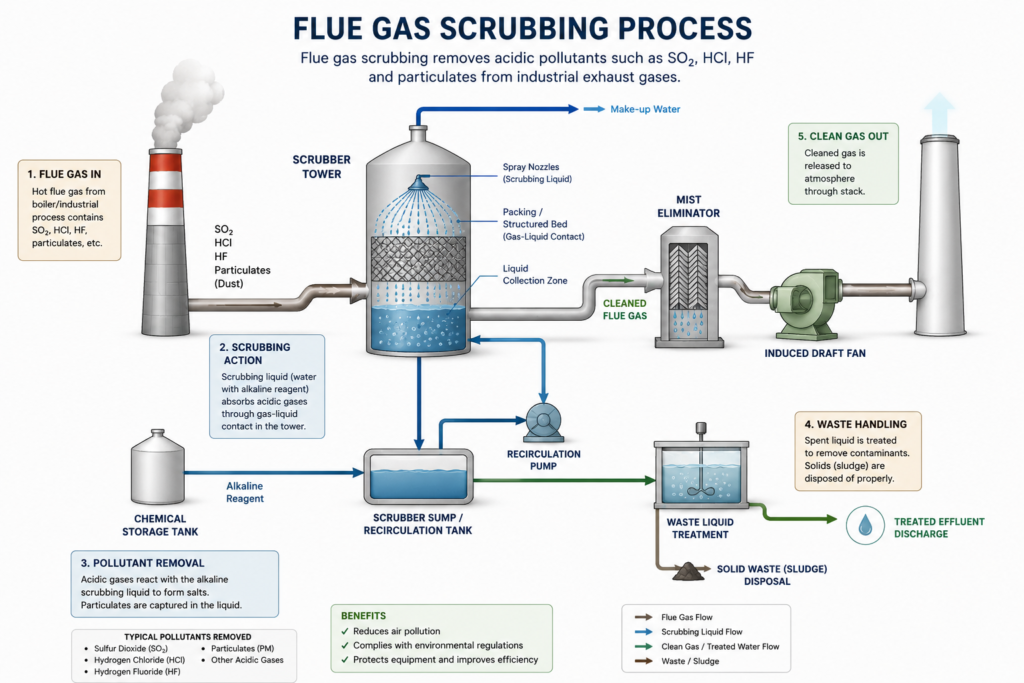
| Flue gas scrubbing removes SO2, HCl, NH3, H2S, Cl2, and HF from industrial exhaust before atmospheric discharge. |
| CPCB mandates a particulate matter stack emission limit of 150 mg/Nm3 for general industries; SO2 limit is 200 mg/Nm3 for boilers. |
| Wet packed bed scrubbers achieve up to 99% removal efficiency for soluble acid gases when correctly sized. |
| PP FRP (polypropylene + fibreglass-reinforced plastic) offers 15-25 year service life in acid gas environments with zero painting required. |
| Envigaurd has 500+ scrubber systems operating across 18+ Indian states serving pharma, chemical, cement, fertilizer, and oil and gas industries. |
Flue Gas Scrubbing Process: A Complete Technical Guide for Industrial Plants
The flue gas scrubbing process is the most widely used method for removing toxic industrial pollutants including SO2, HCl, NH3, H2S, and chlorine from combustion exhaust and chemical process gas streams before they discharge through a plant stack. If your facility burns fuel, processes chemicals, or generates reactive gases as a byproduct, a properly designed scrubber system is both a legal requirement under CPCB emission standards and a critical engineering safeguard for workers, equipment, and the surrounding community.
This guide explains exactly how flue gas scrubbing works, the types of systems available, which pollutants each system removes, and how to select the right technology for your industry. Whether you are a plant head evaluating compliance equipment, an EPC consultant specifying a new pollution control system, or an EHS manager reviewing your existing setup, you will find the technical detail you need here.
What Is the Flue Gas Scrubbing Process?
The flue gas scrubbing process is a gas-liquid or gas-solid contacting operation in which contaminated exhaust gas passes through a scrubbing medium typically an aqueous alkaline or acidic solution that chemically absorbs and neutralizes target pollutants. The clean gas exits the system at the top of the scrubber tower and discharges through the plant stack at concentrations that meet regulatory limits. The spent scrubbing liquid carries the captured contaminants to a recirculation tank or wastewater treatment system.
In simple terms: dirty industrial gas enters the scrubber, contacts a liquid that reacts with and captures the pollutants, and clean gas exits.
This process differs from filtration (which captures particulates mechanically) and incineration (which destroys VOCs thermally). Scrubbing chemically neutralizes reactive gases which is why it is the dominant technology for acid gases like SO2, HCl, HF, NH3, and H2S across Indian chemical, pharma, cement, and power industries.
How Does a Flue Gas Scrubber Work? Step-by-Step
Understanding the operating principle helps you evaluate supplier claims, diagnose performance problems, and set realistic expectations for outlet emissions. Here is the sequence inside a standard counter-flow wet packed bed scrubber:
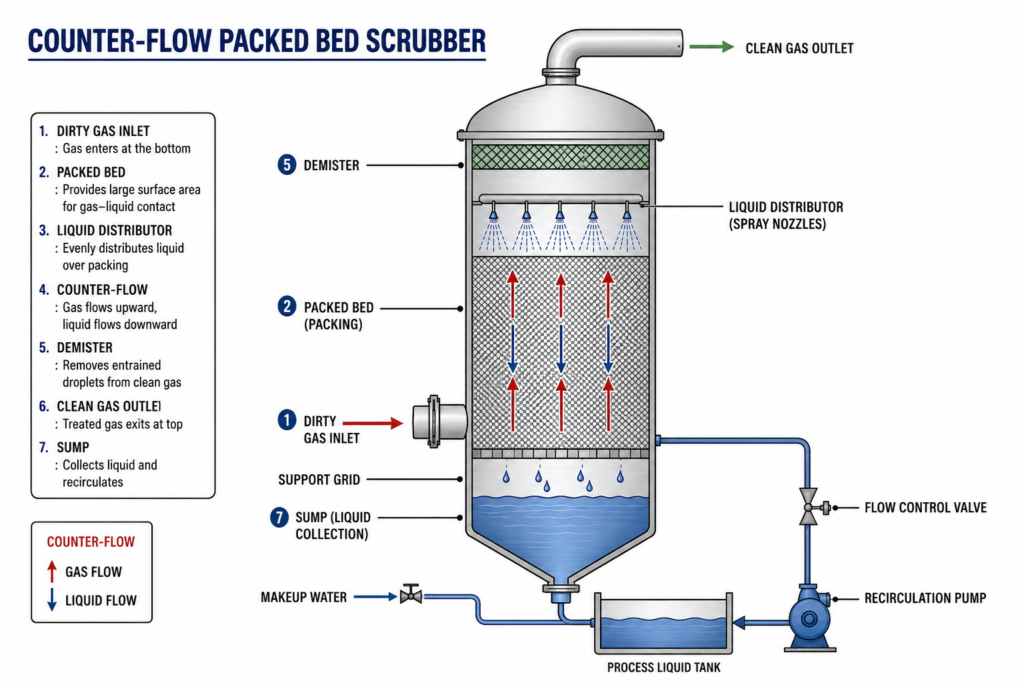
| STEP 1 | Polluted Gas Entry and Quench Flue gas exits the industrial process (boiler, reactor, kiln, or dryer) at temperatures from 80 to over 400 degrees C. An inlet quench section fabricated from MS or SS 316 cools the gas below 60 degrees C before it contacts the PP or FRP scrubber body. Skipping quench design causes thermal stress damage and reduces absorption efficiency. |
| STEP 2 | Upward Gas Flow Through Packed Bed Cooled gas flows upward through the main scrubber tower through layers of structured or random packing (PP or ceramic). Packing provides 100-250 m2/m3 of gas-liquid contact surface area depending on the design. |
| STEP 3 | Counter-Current Liquid Distribution Scrubbing liquid NaOH for SO2/HCl/HF, dilute H2SO4 for NH3, NaOCl for H2S/Cl2 is pumped from the recirculation tank and sprayed downward through the packing counter-current to the rising gas. Counter-current flow maximizes the absorption driving force throughout the bed height. |
| STEP 4 | Chemical Absorption and Neutralization Pollutant molecules dissolve into the liquid film on packing surfaces. Chemical reactions occur in milliseconds. SO2 + 2NaOH = Na2SO3 + H2O. HCl + NaOH = NaCl + H2O. Reaction products remain in solution and are managed in the recirculation system. |
| STEP 5 | pH Control and Reagent Dosing A pH sensor in the recirculation sump monitors alkalinity. When pH drops below the setpoint (typically pH 7-9 for alkali scrubbing), a dosing pump injects fresh NaOH. Automatic pH control is not optional for compliance-grade scrubbers pH drop is the single most common cause of outlet emission exceedance during CPCB stack tests. |
| STEP 6 | Mist Elimination Gas exiting the packed bed carries fine liquid droplets. A chevron-type or mesh-type mist eliminator in PP removes these droplets before the gas reaches the stack. Without a functioning mist eliminator, scrubbing liquid carryover corrodes downstream ductwork. |
| STEP 7 | Clean Gas Discharge Cleaned gas exits through the outlet duct to the plant stack. CEMS tapping points are provided at inlet and outlet per IS 11255 and CPCB CEMS guidelines so you can verify compliance in real time and generate records required by state pollution control boards. |
Types of Flue Gas Scrubber Systems
Selecting the right scrubber type depends on gas flow rate, pollutant type and concentration, temperature, available footprint, and water availability.

1. Wet Packed Bed Scrubber
Working principle: Counter-current gas-liquid contact through structured or random packing. The dominant design for acid gas removal in Indian pharma, chemical, and specialty gas industries.
- Removal efficiency: Up to 99%+ for soluble gases (HCl, NH3, Cl2)
- Scalable from 100 m3/hr to 100,000+ m3/hr
- Suitable for multi-pollutant removal in a single unit
- Generates liquid waste requiring treatment; ID fan required for pressure drop
- Industries: Chemical plants, pharma, fertilizer, R&D labs, food processing
2. Venturi Scrubber
Working principle: High-velocity gas stream passes through a converging-diverging venturi throat where scrubbing liquid is injected. Turbulence atomizes liquid into fine droplets that capture particulates and soluble gases simultaneously.
- Effective for combined particulate and gas removal; handles high-dust-loading streams
- Higher energy consumption and lower gas absorption efficiency versus packed beds
- Industries: Cement plants, foundries, fertilizer granulation, waste incineration
3. Spray Tower Scrubber
Working principle: Scrubbing liquid is sprayed as fine droplets into an open cylindrical tower through which gas flows upward. No packing is used.
- Lowest gas-absorption efficiency; suitable as a pre-scrubber upstream of packed beds
- Handles heavily particulate-laden gas without fouling risk
- Industries: Coarse particulate suppression, low-concentration acid gas pre-treatment
4. PP FRP Scrubber System
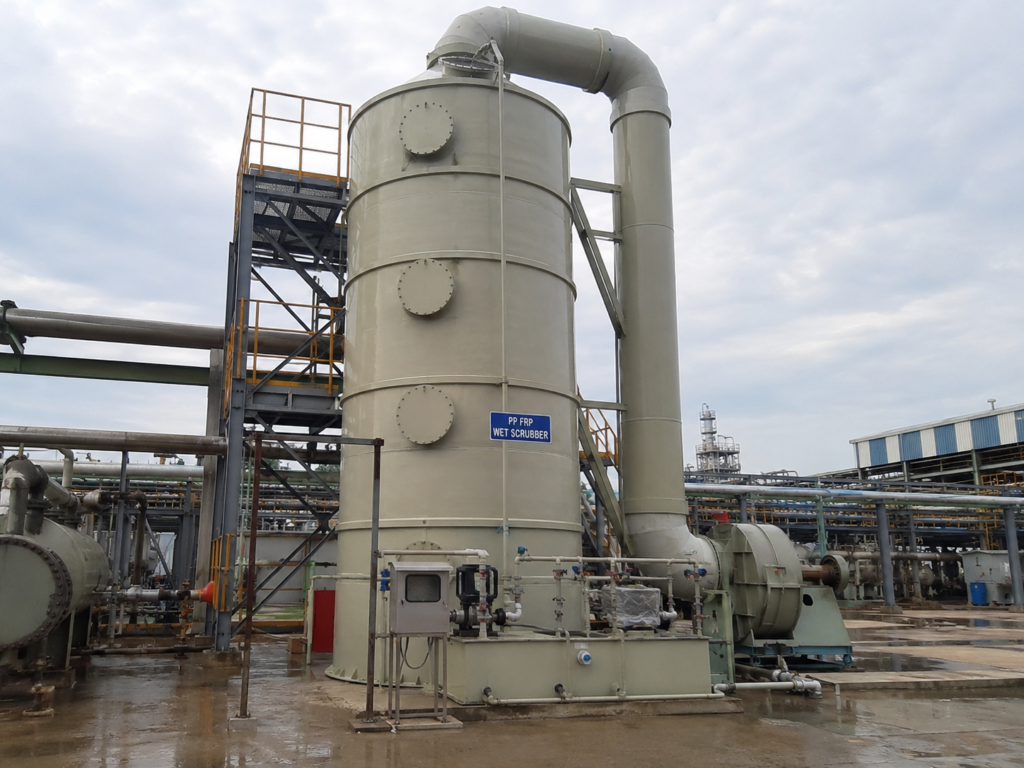
Working principle: Same as packed bed or venturi, but tower body, sump, and liquid distribution components are fabricated from polypropylene (PP) with a fibreglass-reinforced plastic (FRP) outer shell.
- PP is chemically inert to virtually all acids, alkalis, and chlorinated compounds
- FRP outer lamination: mechanical strength equivalent to mild steel at 40-50% of the weight
- Service life: 15-25 years in acid gas environments vs 8-12 years for MS with coatings
- No painting or surface treatment required zero recoating maintenance cost
- Dual lamination: PP inner liner bonded to FRP outer shell for superior structural integrity
5. Dry Scrubber
Working principle: Dry reagent lime, sodium bicarbonate, or activated carbon is injected into the gas stream or passed through a fixed bed. Reaction products are collected in a downstream baghouse or electrostatic precipitator.
- No liquid waste generation; suitable for water-scarce sites
- Effective for SO2 and HCl at moderate concentrations; lower efficiency (70-90%)
- Industries: Cement plants with waste heat recovery, coal-fired boilers in water-restricted regions
Wet vs. Dry Scrubber: 10-Parameter Comparison
| Parameter | Wet Packed Bed Scrubber | Dry Scrubber |
| Removal efficiency | Up to 99%+ for soluble gases | 70-90% for SO2/HCl at moderate loads |
| Water requirement | High (recirculation system required) | None |
| Liquid waste | Yes (wastewater treatment needed) | No |
| Solid waste | Minimal | Yes (spent reagent + captured salts) |
| Best application | High-concentration acid gases: SO2, HCl, NH3, H2S | Lower concentrations; water-scarce sites |
| Operating cost | Moderate (pump + NaOH consumption) | Higher reagent cost per unit removal |
| Capital cost (India) | Moderate | Higher (requires fabric filter downstream) |
| Primary materials | PP FRP, SS 316, HDPE | MS with coating, SS |
| Temperature tolerance | Up to 400 degrees C with inlet quench | Up to 400 degrees C (certain designs) |
| CPCB compliance | Proven track record for SO2/HCl/NH3 limits | Adequate for moderate loads only |
Pollutants Removed by the Flue Gas Scrubbing Process
A correctly designed wet scrubber system removes the following industrial pollutants:
SO2 Sulphur Dioxide
Produced by combustion of sulphur-containing fuels (coal, pet coke, heavy fuel oil) and by sulphuric acid plants, smelters, and boilers. NaOH or lime slurry scrubbing achieves greater than 95% SO2 removal. CPCB prescribes an SO2 stack emission limit of 200 mg/Nm3 for general industry boilers under the Environment Protection Act.
HCl Hydrochloric Acid
Generated by PVC processing, chlorinated solvent manufacturing, pharmaceutical synthesis, and waste incineration. NaOH scrubbing achieves greater than 99% HCl removal. Uncontrolled HCl causes severe equipment corrosion and worker respiratory damage.
NH3 Ammonia
Released by fertilizer plants, wastewater treatment facilities, cold storage refrigeration circuits, and pharmaceutical API synthesis. Dilute sulphuric acid scrubbing removes greater than 98% of NH3. Standard equipment in Indian fertilizer and pharma plants.
H2S Hydrogen Sulphide
Produced by refineries, tanneries, sewage treatment plants, and viscose rayon manufacturing. NaOCl (sodium hypochlorite) or caustic scrubbing removes H2S. Designed for both low and high H2S concentration streams.
Cl2 Chlorine Gas
Used and released in water treatment, paper bleaching, PVC manufacture, and chlor-alkali plants. Caustic NaOH scrubbing is effective: Cl2 + 2NaOH = NaCl + NaOCl + H2O. Systems are rated for IDLH (Immediately Dangerous to Life and Health) concentration events.
HNO3 Nitric Acid Fumes
Generated by nitric acid plants, ceramics kilns, and fertilizer manufacturing. Alkali wet scrubbing removes nitric acid vapours to CPCB-compliant outlet concentrations. Applied in ceramics, explosives, and specialty chemical production.
HF Hydrofluoric Acid and VOCs
HF is generated by glass etching, aluminium smelting, and semiconductor fabrication. Caustic scrubbing effectively removes HF. For high-VOC streams with lower water solubility, a combination of wet scrubbing and activated carbon adsorption provides the most complete control.
Industrial Applications of Flue Gas Scrubber Systems
| Industry | Primary Pollutants | Scrubber Type |
| Chemical Plants | SO2, HCl, Cl2, HF, H2S, NH3 | Multi-stage PP FRP packed bed |
| Pharmaceutical Manufacturing | HCl, H2SO4 fumes, NH3, solvents | Wet packed bed, CEMS-verified |
| Cement Plants | SO2, HCl, particulate matter | Venturi + packed bed polishing |
| Thermal Power Plants | SO2 (high concentration) | FGD limestone / NaOH scrubber |
| Steel and Pickling Lines | HCl, H2SO4 fumes | PP FRP packed bed |
| Fertilizer Plants | NH3 (high loading) | Acid (H2SO4) wet scrubber |
| Oil and Gas Refineries | H2S, SO2 from Claus tail gas | Packed bed caustic scrubber |
| Battery Manufacturing | HF from electrolyte decomposition | PP FRP wet scrubber |
| Food Processing | NH3 (refrigeration), odour compounds | Caustic wet scrubber |
Clients including Dr. Reddy’s, GSK, and Syngenta have relied on Envigaurd wet scrubber systems for CPCB and cGMP compliance across pharma and specialty chemical facilities.
Scrubber System Design Considerations
No two industrial gas streams are identical. Correct scrubber sizing requires the following process data before engineering begins:
| Design Parameter | Why It Matters |
| Gas flow rate (m3/hr actual) | Determines tower diameter and fan capacity |
| Inlet gas temperature (degrees C) | Controls quench section design and packing material selection |
| Pollutant type and inlet concentration (mg/Nm3 or ppm) | Sets packing height, L:G ratio, and reagent dosing rate |
| Required outlet concentration (mg/Nm3) | Determines removal efficiency target and safety factor |
| Moisture content of gas (%) | Affects liquid entrainment and mist eliminator sizing |
| Pressure drop budget (Pa) | Constrains ID fan selection and packing type choice |
| Available space (H x W footprint) | May require horizontal or compact vertical design |
| Material compatibility | Selects between PP FRP, SS 316, HDPE, or PVDF |
Supplying incomplete process data to a scrubber manufacturer is the most common cause of under-performing systems. Envigaurd provides a structured sizing questionnaire and returns a technically grounded proposal within 48 hours of receiving your data.
Why PP FRP Scrubber Systems Are the Preferred Choice in India
Polypropylene with fibreglass-reinforced plastic (PP FRP) construction has displaced mild steel with anti-corrosion coating as the dominant material for Indian industrial scrubbers for these measurable reasons:
- Corrosion resistance: PP is chemically inert to virtually all acids, alkalis, and oxidizing agents in scrubbing applications at service temperatures up to 80 degrees C.
- Mechanical strength: FRP outer lamination provides tensile strength equivalent to mild steel at 40-50% of the weight, reducing civil and structural foundation costs.
- Service life: PP FRP scrubber systems in acid gas service routinely achieve 15-25 year operational lifetimes without internal lining replacement.
- No painting required: Painted MS scrubber bodies in acid gas environments require recoating every 1-3 years. PP FRP eliminates this recurring maintenance cost entirely.
- Dual lamination: PP inner liner bonded to FRP outer shell is structurally superior to single-layer FRP and provides both chemical resistance and mechanical integrity.
- Cost efficiency: 30-40% lighter than equivalent SS 316 units, reducing structural support, transport, and installation costs on multi-story industrial facilities.

| Get a Custom PP FRP Scrubber System Quote |
| Share your gas volume, temperature, and pollutant data. Envigaurd returns a technically grounded proposal within 48 hours. |
| Contact Envigaurd: envigaurd.com/contact-us | +91-8147606843 |
Maintenance Best Practices for Industrial Scrubber Systems
Planned maintenance is the difference between a scrubber that passes every CPCB stack test and one that causes consent violations. Follow this schedule:
Daily Monitoring (Operator Checklist)
- Verify recirculation pump is running and liquid flow is visible at spray nozzles
- Check pH meter reading against setpoint (typical: pH 8-10 for alkali scrubbing)
- Verify NaOH or reagent day tank level and refill as needed
- Check ID fan current draw deviation indicates pressure drop change
Monthly Inspection
- Inspect spray nozzles for blockage or erosion; replace blocked nozzles immediately
- Check mist eliminator for scaling or fouling; clean with water jet if pressure drop has increased
- Test pH sensor calibration against buffer solution; replace probe if drift exceeds plus/minus 0.3 pH units
Quarterly Inspection
- Sample scrubbing liquid for dissolved solids; purge sump if TDS exceeds design limit
- Inspect packing for biological growth, scaling, or collapse; replace damaged sections
- Check recirculation pump impeller clearance; replace wear parts per manufacturer schedule
Annual Shutdown Inspection
- Full internal inspection of scrubber body, sump, and all pipe connections
- Pressure test recirculation piping for leaks
- Verify CEMS tapping point integrity and instrument calibration
- Stack test for regulatory compliance confirmation and CPCB consent renewal documentation
Common Challenges in Flue Gas Scrubbing and Solutions
| Challenge | Root Cause | Engineering Solution |
| pH Drift / Reagent Depletion | Failed pH probe or inadequate NaOH dosing | Install redundant pH probe; set auto-dosing to activate at pH 7.5 to maintain buffer |
| Packing Fouling and Blockage | Particulate-laden inlet gas streams | Install pre-scrubber or venturi throat upstream to remove bulk particulates |
| Nozzle Erosion and Spray Failure | Worn or blocked nozzles creating dry spots | Use PP or PVDF nozzles rated for scrubbing chemistry; inspect monthly on planned cycle |
| Scaling on Packing and Nozzles | Hard water or high-calcium scrubbing liquids | Use softened make-up water; add anti-scalant; flush with dilute acid on schedule |
| Fan Undersizing Under Fouling | Packing fouling increases system pressure drop | Size ID fan with 20-25% pressure drop margin above clean-packing design value |
Future Trends in Industrial Scrubber Technology
IoT-Enabled Performance Monitoring
Smart sensors integrated into scrubber systems now transmit pH, flow rate, pressure drop, and fan current data in real time to plant DCS or cloud dashboards. Envigaurd’s newer installations include SCADA-compatible instrumentation that flags performance deviations before they cause compliance exceedances reducing emergency maintenance by an estimated 30-40% compared to manual monitoring programs.
CEMS Integration per CPCB 2018 Guidelines
CPCB’s revised Continuous Emission Monitoring System (CEMS) guidelines require large Red and Orange category industrial plants to maintain online SO2, HCl, and opacity monitors at stack inlets and outlets. Scrubber systems designed with CEMS tapping points built into the inlet and outlet ductwork per IS 11255 reduce expensive retrofit costs at consent renewal time.
Hybrid Wet-Dry Systems
Combining a spray dryer absorber (SDA) upstream with a wet packed bed polishing scrubber downstream is becoming standard for cement plants burning alternative fuels with high SO2 and HCl variability. The SDA handles bulk removal (50-80%); the wet polisher guarantees outlet compliance under peak load conditions.
Variable Frequency Drives for Energy Efficiency
Variable frequency drives (VFDs) on recirculation pumps and ID fans are reducing scrubber system power consumption by 15-30% compared to fixed-speed motor operation, improving ROI and ESG performance metrics a critical consideration as Indian industries face increasing pressure from lenders and investors on Scope 1 emission reduction commitments.
Why Choose Envigaurd for Your Flue Gas Scrubber System?
Envigaurd Engineering and Turnkey Projects Pvt Ltd is a Bangalore-based manufacturer with 10+ years of application-specific experience in industrial air pollution control. Key differentiators:
- 500+ systems in operation across 18+ Indian states application-specific engineering, not catalogue sizing.
- No subcontracting: design, fabrication, installation, and AMC executed by Envigaurd’s own engineering team, eliminating quality gaps and providing single-point accountability.
- Performance guarantees backed by stack test reports: contractual outlet concentration targets validated by third-party stack test at commissioning the evidence your CPCB compliance file needs.
- Certified manufacturer: ISO 9001, EMS 14001, and OHSAS 45001 certified with PSU, MSME, and government tender compliance documentation.
- Pan-India service coverage: regional installation and service teams across 18+ states reduce mobilization time for commissioning and emergency breakdown response.
- Lead times: standard PP FRP packed bed scrubber in 3-5 weeks from design approval; fast-track options available for urgent compliance projects.
Complete Range of Scrubber Product Range
| Application | Product |
| Multi-pollutant industrial exhaust streams | Industrial Scrubber System |
| Acid gas, particulate, VOC control | Wet Scrubber System |
| Corrosive acid and alkali gas streams | PP FRP Scrubber System |
| SO2, HCl, HF from boilers/kilns/reactors | Flue Gas Scrubber System |
| Sulphur oxide emission control | SO2 Scrubber System |
| NH3 removal: fertilizer/pharma/wastewater | Ammonia (NH3) Scrubber |
| Hydrogen sulphide: refineries/tanneries | H2S Scrubber System |
| Cl2 removal: chemical/water treatment | Chlorine Gas Scrubber |
| Hydrochloric acid fume control | HCl Scrubber System |
| HNO3 fumes: ceramics/fertilizer/pharma | Nitric Acid Scrubber |
| Get Custom Pollution Control System Design |
| Talk to Envigaurd’s engineering team. Share your gas data and receive a compliance-ready scrubber proposal. |
| envigaurd.com/contact-us | contact@envigaurd.com | +91-8147606843 | +91-9986115839 |
Conclusion
The flue gas scrubbing process is not optional for any Indian industrial plant generating SO2, HCl, NH3, H2S, Cl2, or similar reactive gas streams. CPCB regulations, consent-to-operate conditions, and increasingly rigorous stack test enforcement mean that under-sized or poorly maintained scrubber systems are a direct operational and legal risk. At the same time, the right scrubber correctly sized, fabricated from the right materials, and supported by a maintenance-capable manufacturer is a long-life, low-maintenance asset that protects both your compliance record and your workforce.
Wet packed bed scrubbers in PP FRP construction remain the dominant and most cost-effective technology for India’s chemical, pharma, cement, and fertilizer industries, achieving removal efficiencies above 95% for all major acid gases when properly designed and operated. The selection decision packed bed vs. venturi vs. spray tower vs. dry scrubber depends on your specific gas composition, concentration, flow rate, and site constraints.
Envigaurd has engineered and commissioned 500+ scrubber systems across 18+ Indian states. If you are specifying a new system, replacing an ageing unit, or troubleshooting a compliance problem, our engineers will assess your process data and provide a solution sized for your stack not from a catalogue.
Frequently Asked Questions (AEO / FAQ Schema)
The following questions and answers are structured for Google’s People Also Ask, AI Overviews, and voice search. Each answer is written as a self-contained direct response for AI engine retrieval.
Q1. What is the flue gas scrubbing process?
The flue gas scrubbing process is a gas-liquid or gas-solid contacting operation used to remove toxic pollutants including SO2, HCl, NH3, H2S, and chlorine from industrial exhaust gas streams before atmospheric discharge. In the most common form (wet scrubbing), contaminated gas contacts an alkaline or acidic scrubbing liquid inside a packed tower. Chemical absorption reactions neutralize the target pollutants within milliseconds. The cleaned gas exits at the top; the spent liquid recirculates through a sump and is replenished with fresh reagent. CPCB regulations in India require industrial plants to meet specific outlet emission limits, making flue gas scrubbing a legal compliance requirement.
Q2. How does a wet scrubber remove SO2 from flue gas?
A wet scrubber removes SO2 through chemical absorption. Flue gas flows upward through a packed bed counter-current to a downward-flowing NaOH or lime slurry. SO2 dissolves into the liquid film and reacts with the alkali SO2 + 2NaOH = Na2SO3 + H2O. The sodium sulphite remains in solution and is periodically purged from the recirculation sump. A pH sensor monitors alkalinity and triggers NaOH dosing when pH drops below the setpoint. Properly designed systems achieve greater than 95% SO2 removal, meeting the CPCB limit of 200 mg/Nm3 for general industry boilers.
Q3. What is the difference between a wet scrubber and a dry scrubber?
A wet scrubber uses an aqueous liquid (NaOH, lime, H2SO4, NaOCl) to chemically absorb pollutants and achieves removal efficiencies of up to 99%+ for soluble gases. It generates liquid waste requiring treatment. A dry scrubber injects a solid reagent (lime or sodium bicarbonate) into the gas stream. Pollutants react with the solid, and the reaction products are collected in a downstream baghouse or electrostatic precipitator. Dry scrubbers suit water-scarce sites and lower pollutant concentrations but achieve lower efficiencies of 70-90% and generate solid waste. For high-concentration acid gases in Indian industry, wet packed bed scrubbers in PP FRP construction are the standard choice.
Q4. Which gases can a flue gas scrubber system remove?
Industrial wet scrubbers effectively remove SO2, HCl, HF, NH3, H2S, Cl2, HNO3, chlorine dioxide, and other water-soluble acid and alkali gases. Removal efficiency for each gas depends on its water solubility (Henry’s Law constant), the pH of the scrubbing liquid, and the liquid-to-gas ratio. Gases with low water solubility such as NO require specialized reagents or hybrid treatment. For multi-pollutant streams, two-stage scrubbers with different reagent circuits in each stage are used.
Q5. What CPCB emission limits apply to flue gas from Indian industrial plants?
Under the Environment Protection Act and its schedules, CPCB mandates that general industries maintain particulate matter (PM) stack emissions at or below 150 mg/Nm3 from boiler stacks. For SO2, general industry boilers burning sulphur-containing fuels must meet 200 mg/Nm3. Sulphuric acid plants face a separate sector-specific SO2 standard. State pollution control boards (KSPCB, MPCB, TNPCB) can prescribe stricter limits based on local conditions. Large Red and Orange category plants must install CEMS per CPCB CEMS guidelines (revised 2018). Non-compliance attracts consent withdrawal, financial penalties, and plant shutdown orders.
Q6. What is a PP FRP scrubber system and why is it preferred?
A PP FRP scrubber is a wet scrubber whose tower body, sump, and liquid distribution components are fabricated from polypropylene (PP) with a fibreglass-reinforced plastic (FRP) outer shell. PP provides chemical inertness to virtually all acids and alkalis used in industrial scrubbing. FRP adds mechanical strength and UV resistance. Combined, PP FRP scrubbers offer 15-25 year service lives in acid gas environments, require no painting or internal lining, and are 30-40% lighter than equivalent stainless steel units. Dual lamination (PP inner liner bonded to FRP outer shell) makes them structurally superior to single-layer FRP constructions. This makes PP FRP the most cost-effective long-term choice for Indian industrial scrubber applications.
Q7. How do I calculate the size of a scrubber system for my plant?
Scrubber sizing requires five key inputs: (1) actual gas flow rate in m3/hr at operating temperature, (2) inlet pollutant concentration in mg/Nm3 or ppm, (3) required outlet concentration for regulatory compliance, (4) gas temperature at the scrubber inlet, and (5) available pressure drop budget. From these parameters, an engineer calculates tower diameter from superficial gas velocity, packing height from transfer unit analysis, liquid-to-gas ratio, and reagent dosing rate. Envigaurd provides a sizing questionnaire and returns a detailed technical proposal within 48 hours. Incomplete process data is the most common cause of under-performing scrubber systems.
Q8. How efficient are industrial wet scrubber systems?
A well-designed wet packed bed scrubber achieves 95-99%+ removal efficiency for highly soluble gases like HCl, NH3, and Cl2. For SO2, efficiency of 90-98% is achievable depending on the scrubbing reagent, packing height, and liquid-to-gas ratio. These efficiencies drop significantly if pH control fails, nozzles block, or packing fouls which is why a structured maintenance program is essential for sustained CPCB compliance.
Q9. What chemicals are used in industrial wet scrubber systems?
The scrubbing reagent depends on the target pollutant. NaOH (caustic soda) is used for SO2, HCl, HF, Cl2, and H2S removal. Dilute H2SO4 (sulphuric acid) is used for NH3 scrubbing. Ca(OH)2 (lime slurry) is used for SO2 in power plant FGD applications. NaOCl (sodium hypochlorite) is preferred for H2S and Cl2 where oxidative scrubbing is required. Water is the carrier medium. Reagent concentration and pH are controlled automatically by pH sensors and dosing pumps integrated into the recirculation system.
Q10. How long does it take to manufacture and install an industrial scrubber system?
For a standard PP FRP packed bed scrubber, typical lead times are: design and documentation in 5-7 working days; fabrication in 3-5 weeks; site delivery and installation in 1-2 weeks; and commissioning including stack test in 2-3 days. Complex multi-stage or high-temperature systems require 6-10 weeks fabrication. Envigaurd provides fast-track delivery options for urgent consent compliance situations. Turnkey scope design, manufacture, installation, and AMC is executed by Envigaurd’s own engineering team with no subcontracting.
Q11. Is a CEMS system mandatory with a flue gas scrubber in India?
For large industrial plants categorized as Red or Orange category by the state pollution control board, CPCB CEMS guidelines (revised August 2018, IS 11255) mandate continuous online monitoring of SO2, NOx, PM, and other parameters at the stack. CEMS tapping points at the scrubber inlet and outlet are required for verifying scrubber performance and generating the electronic records submitted to state PCBs. Envigaurd provides standard CEMS tapping points as part of every flue gas scrubber system design.
Q12. Can one scrubber system remove multiple pollutants simultaneously?
Yes multi-pollutant removal in a single vessel is achievable when pollutants respond to the same reagent. For example, NaOH simultaneously removes both SO2 and HCl in a single packed bed stage. For gas streams containing both acid gases (requiring alkali scrubbing) and alkaline gases such as NH3 (requiring acid scrubbing), a two-stage scrubber with separate packed beds and independent reagent circuits is required. Envigaurd engineers multi-pollutant scrubber systems routinely for chemical plant and pharma facility exhaust streams.
Authoritative External References
The following sources were used to verify regulatory limits, technical standards, and industry data cited in this article:
- CPCB Emission Standards and Effluent Limits: https://cpcb.nic.in/effluent-emission/
- CPCB Revised CEMS Guidelines (August 2018): https://cpcb.nic.in/upload/thrust-area/revised-ocems-guidelines-29.08.2018.pdf
- US EPA Wet and Dry Scrubbers Technical Chapter (7th Edition Control Cost Manual): https://www.epa.gov/sites/default/files/2021-05/documents/wet_and_dry_scrubbers_section_5_chapter_1_control_cost_manual_7th_edition.pdf
- WHO Ambient Air Quality and Health Fact Sheet: https://www.who.int/news-room/fact-sheets/detail/ambient-(outdoor)-air-quality-and-health
Image Suggestions and Alt Text
| Section | Image Description | Recommended Alt Text |
| Introduction | Photograph of installed PP FRP wet scrubber tower at Indian chemical plant | PP FRP wet scrubber system installed at Indian chemical plant Envigaurd Bangalore |
| How Scrubber Works | Schematic diagram: counter-flow packed bed scrubber with labeled components | Counter-flow packed bed wet scrubber working principle diagram |
| Types Section | Side-by-side comparison: packed bed, venturi, and spray tower scrubbers | Types of industrial wet scrubber systems: packed bed, venturi, spray tower |
| PP FRP Section | Close-up of PP FRP dual lamination scrubber body during fabrication | PP FRP scrubber body dual lamination fabrication Envigaurd manufacturing |
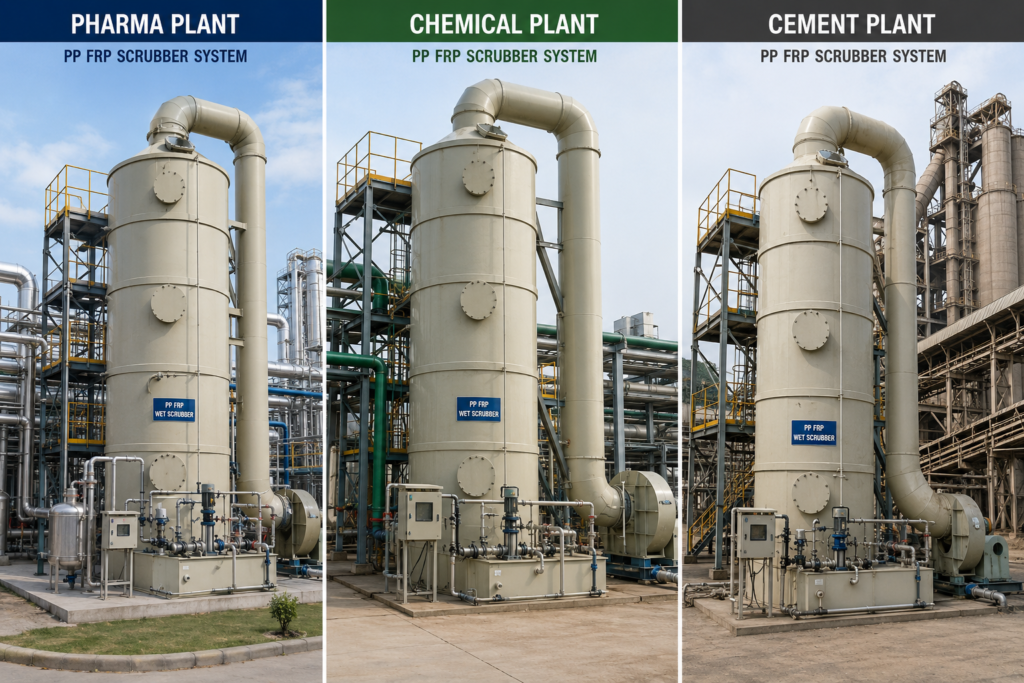
| Applications | Photo montage: pharma, chemical, and cement plant scrubber installations | Envigaurd scrubber systems installed across pharma, chemical, cement industries India |
| Talk to Our Industrial Scrubber Experts |
| 500+ systems installed. 18+ states served. No subcontracting. Performance guaranteed by stack test. |
| Contact Envigaurd: envigaurd.com/contact-us | +91-8147606843 | contact@envigaurd.com |