
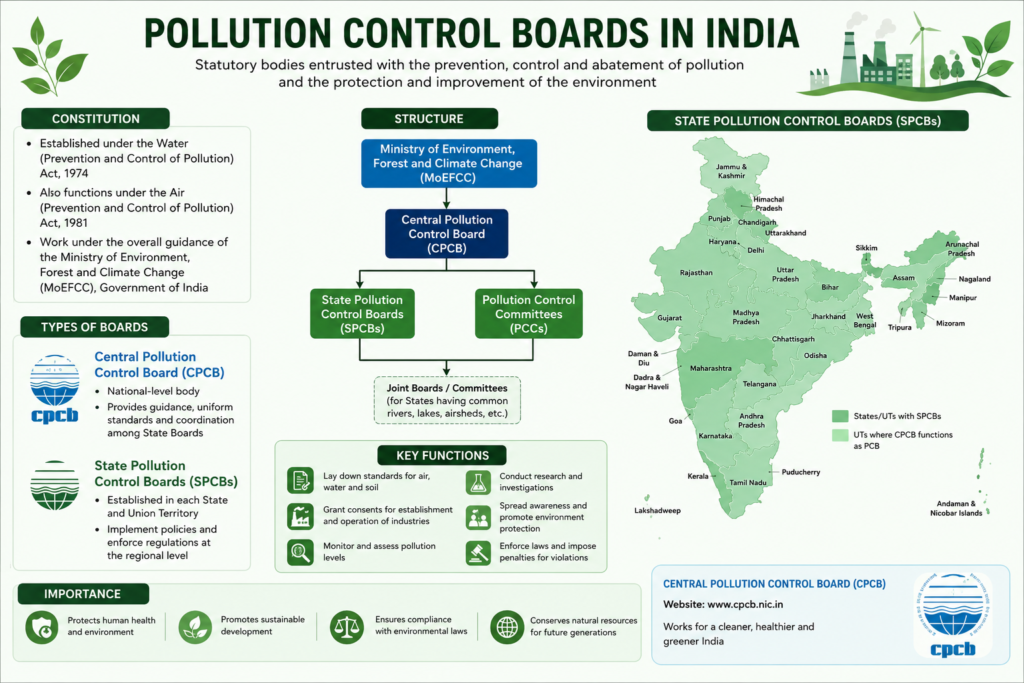
| Key Highlights of Pollution Control Boards in India |
|---|
| India has 1 Central Pollution Control Board (CPCB) + 28 State PCBs + 7 Pollution Control Committees (PCCs) = 36 bodies total |
| CPCB was constituted on September 23, 1974 under Section 3 of the Water (Prevention & Control of Pollution) Act, 1974 |
| CPCB runs 621 air quality monitoring stations across 262 cities under NAMP; water quality is tracked at 1,019 stations |
| Industries must obtain CTE (Consent to Establish) before construction and CTO (Consent to Operate) before starting production |
| Air pollution control equipment such as wet scrubber systems helps industries meet CPCB and SPCB emission standards |
1. Introduction: Why Pollution Control Boards Matter
India is among the world’s most industrially active nations, home to over 3.5 lakh registered industrial units (MoEFCC, 2023). This industrial scale brings both economic growth and an enormous environmental burden. Air quality in 132 Indian cities falls below national standards, 46% of rivers are critically polluted, and 128 identified hazardous waste sites require urgent remediation (CPCB, 2024). Against this backdrop, pollution control boards in India serve as the institutional backbone of the country’s environmental governance system.
The network of Central and State Pollution Control Boards (SPCBs) regulates industrial emissions, monitors water and air quality, enforces environmental laws, and grants critical approvals that determine whether businesses can legally set up and operate. Every factory, power plant, chemical unit, and waste treatment facility in India must interact with a pollution control board at some point in its lifecycle.
For industries, achieving compliance is not just about paperwork. It requires investing in certified air pollution control equipment. Companies like Envigaurd, a Bengaluru-based manufacturer of wet scrubber systems and industrial air pollution control equipment, play a critical role in helping industries meet CPCB and SPCB emission standards and obtain their Consent to Operate (CTO).
2. Legal Framework: Which Legislation Constitutes Pollution Control Boards?
Pollution control boards have been constituted as part of three core legislative frameworks. Each law expanded the role, mandate, and powers of these boards. Here is a detailed breakdown:
| Legislation | Year | Key Provisions |
|---|---|---|
| Water (Prevention & Control of Pollution) Act | 1974 | Constituted CPCB (S.3) & SPCBs (S.4); mandatory consent for effluent discharge; sets water quality standards |
| Water (P&CP) Cess Act | 1977 | Levies water-use cess on industry; incentivises effluent treatment investment |
| Air (Prevention & Control of Pollution) Act | 1981 | Extended CPCB & SPCB powers to air pollution; consent required in Air Pollution Control Areas |
| Environment (Protection) Act (EPA) | 1986 | Umbrella law post-Bhopal; CPCB is technical arm of MoEFCC; basis for all secondary rules |
| Hazardous & Other Wastes (Management) Rules | 2016 | Governs generation, storage, transport & disposal of hazardous industrial waste |
| E-Waste (Management) Rules | 2022 | Mandates Extended Producer Responsibility (EPR); SPCBs enforce locally |
2.1 The Water (Prevention and Control of Pollution) Act, 1974
This was India’s first comprehensive environmental law. Enacted on September 23, 1974, the Act constituted CPCB under Section 3 and directed each state to form its own State Pollution Control Board under Section 4. The Act mandated that no industry could discharge effluents into water bodies without obtaining a prior consent from the relevant SPCB. Full text is available at MoEFCC’s official portal.
2.2 The Air (Prevention and Control of Pollution) Act, 1981
This Act extended the mandate of CPCB and SPCBs to cover air pollution. States were required to designate ‘Air Pollution Control Areas,’ and industries within these areas needed a separate air consent before operating. As of 2024, all states in India have declared their entire territory as an Air Pollution Control Area, making air consents mandatory for all Red and Orange category industries. Industries achieve compliance partly by installing certified emission control equipment such as wet scrubbers, bag filters, and electrostatic precipitators.
2.3 The Environment (Protection) Act, 1986 (EPA)
Passed in the aftermath of the Bhopal Gas Tragedy, EPA 1986 is the umbrella environmental legislation in India. CPCB functions as the technical arm of the Ministry of Environment, Forest and Climate Change (MoEFCC) in executing these powers. The EPA is the basis for most of India’s secondary environmental rules, including the Hazardous Waste Rules, Plastic Waste Rules, and E-Waste Rules.
3. Central Pollution Control Board (CPCB): Overview & Governance
The Central Pollution Control Board (CPCB) is India’s apex statutory organization for pollution monitoring, standard-setting, and coordination. It operates under MoEFCC and was constituted on September 23, 1974.
| Attribute | Details |
|---|---|
| Full Name | Central Pollution Control Board (CPCB) |
| Established | September 23, 1974 |
| Parent Ministry | Ministry of Environment, Forest & Climate Change (MoEFCC) |
| Headquarters | Parivesh Bhawan, East Arjun Nagar, Shahdara, Delhi-110032 |
| Official Website | https://cpcb.nic.in/ |
| Phone (EPABX) | +91-11-43102030 |
| Email (Chairman) | ccb.cpcb@nic.in |
| Email (Member Secretary) | mscb.cpcb@nic.in |
| Legal Basis | Water (Prevention & Control of Pollution) Act, 1974 |
| Type | Statutory Organization under MoEFCC |
3.1 Governance Structure of CPCB
The CPCB is headed by a Chairman (IAS officer appointed by the Appointments Committee of the Cabinet). The Chairman is supported by a Member Secretary, divisional heads, and technical staff organized across nine major budget heads. The current CPCB Chairman can be contacted at ccb.cpcb@nic.in and the Member Secretary at mscb.cpcb@nic.in. For full staff directory, visit CPCB’s contact directory page.
3.2 Key Functions of CPCB
According to the Water Act (Section 16) and Air Act (Section 16), the principal functions of CPCB include:
- Advising the Central Government on prevention, control, and abatement of water and air pollution. See CPCB functions overview
- Planning and executing the National Air Quality Monitoring Programme (NAMP): 621 stations in 262 cities
- Operating the National Water Quality Monitoring Programme (NWMP): 2,500 locations in 28 states and 6 UTs
- Setting emission and effluent standards for all industry sectors, updated periodically on CPCB’s standards page
- Coordinating activities of all State Pollution Control Boards and resolving inter-state disputes
- Maintaining the Comprehensive Environmental Pollution Index (CEPI) for industrial clusters
- Providing technical guidance to SPCBs on compliance with air pollution control equipment norms, including standards for wet scrubber systems and other abatement technologies
4. State Pollution Control Boards (SPCBs): Role, Principles & Powers
State Pollution Control Boards (SPCBs) are state-level statutory bodies established under Section 4 of the Water Act, 1974, and empowered under the Air Act, 1981. India currently has 28 SPCBs and 7 Pollution Control Committees (PCCs) for Union Territories.
4.1 Functions of State Pollution Control Boards
The functions of SPCBs under the Water Act (Section 17) and Air Act (Section 17) include:
- Plan a comprehensive programme for the prevention, control, or abatement of pollution within the state
- Inspect sewage or trade effluents, and plants treating such effluents, including verifying installed pollution control equipment
- Lay down or annul effluent and emission standards for industries within the state
- Issue, refuse, or revoke consent (CTE / CTO) to industrial units
- Collaborate with CPCB on national monitoring programmes
- Collect and disseminate information relating to pollution within the state
- Render technical assistance and guidance to local bodies for sewage treatment
4.2 Principles Guiding Pollution Control Boards
- Polluter Pays Principle: Industries causing pollution bear remediation costs, as upheld in Indian Council for Enviro-Legal Action v. Union of India (1996)
- Precautionary Principle: Boards may deny consent or add conditions when scientific uncertainty exists about harm
- Sustainable Development: Economic growth balanced with environmental protection at approval stage
- Public Participation: Mandatory public hearings for Category A projects under the EIA Notification 2006 (as amended)
- Integration: Pollution boards coordinate with forest, water, urban departments and with National Green Tribunal (NGT)
4.3 Powers of Pollution Control Boards
- Enter and inspect any industry, treatment plant, or effluent discharge point at any time
- Take samples of air, water, effluents, or emissions for laboratory analysis
- Issue directions to close or restrict any industry causing excessive pollution (Section 33A, Water Act)
- Grant, refuse, revoke, or modify consents (CTE and CTO) based on installed pollution control infrastructure
- File criminal complaints; violations carry imprisonment up to 6 years under EPA 1986
- Levy environmental compensation under the Supreme Court’s polluter-pays framework
- Refer matters to the National Green Tribunal for adjudication
5. Complete List of Pollution Control Boards in India (2024–25)
India has 36 pollution control bodies: 28 SPCBs for states, and 7 PCCs for Union Territories. The table below is sourced from CPCB’s official SPCB directory (July 2024) and individual board websites. All website links are clickable.
| State/UT | Board Name | HQ | Official Website | Contact Details |
|---|---|---|---|---|
| Andhra Pradesh | AP Pollution Control Board (APPCB) | Vijayawada | https://pcb.ap.gov.in/ | 0866-2428099 | appcb@ap.gov.in |
| Arunachal Pradesh | Arunachal Pradesh Pollution Control Board | Itanagar | https://environment.arunachal.gov.in/ | 0360-2290494 |
| Assam | Assam Pollution Control Board (APCB) | Guwahati | https://www.pcbassam.org/ | 0361-2237430 | apcb@pcbassam.org |
| Bihar | Bihar State Pollution Control Board (BSPCB) | Patna | https://bspcb.bih.nic.in/ | 0612-2546284 | bspcb@nic.in |
| Chhattisgarh | Chhattisgarh Environment Conservation Board (CECB) | Raipur / Atal Nagar | http://www.enviscecb.org/ | 0771-2221311 | hocecb@gmail.com |
| Goa | Goa State Pollution Control Board (GSPCB) | Panaji (Saligao) | https://goaspcb.gov.in/ | 0832-2407700 | mail.gspcb@gov.in |
| Gujarat | Gujarat Pollution Control Board (GPCB) | Gandhinagar | https://gpcb.gujarat.gov.in/ | 079-23232165 | gpcb@gpcb.gov.in |
| Haryana | Haryana State Pollution Control Board (HSPCB) | Panchkula | https://hspcb.org.in/ | 0172-2581005 | hspcbho@gmail.com |
| Himachal Pradesh | Himachal Pradesh Pollution Control Board (HPPCB) | New Shimla | https://hppcb.nic.in/ | 0177-2673274 | chairmanpcbhp@gmail.com |
| Jharkhand | Jharkhand State Pollution Control Board (JSPCB) | Ranchi | https://jspcb.org.in/ | 0651-2401303 | jspcb.mse@gmail.com |
| Karnataka | Karnataka State Pollution Control Board (KSPCB) | Bengaluru | https://kspcb.karnataka.gov.in/ | 080-25588270 | chairman@kspcb.gov.in |
| Kerala | Kerala State Pollution Control Board (KSPCB) | Thiruvananthapuram | https://www.keralapcb.nic.in/ | 0471-2318150 | chn.kspcb@gov.in |
| Madhya Pradesh | MP Pollution Control Board (MPPCB) | Bhopal | https://mppcb.nic.in/ | 0755-2708113 | chairman-mppcb@mp.gov.in |
| Maharashtra | Maharashtra Pollution Control Board (MPCB) | Mumbai | https://mpcb.gov.in/ | 022-24010437 | mpcb@mpcb.gov.in |
| Manipur | Manipur State Pollution Control Board (MSPCB) | Imphal | http://manipurpcb.nic.in/ | 0385-2416505 |
| Meghalaya | Meghalaya State Pollution Control Board (MeSPCB) | Shillong | https://megspcb.gov.in/ | 0364-2503173 |
| Mizoram | Mizoram Pollution Control Board | Aizawl | https://environment.mizoram.gov.in/ | 0389-2322477 |
| Nagaland | Nagaland Pollution Control Board | Kohima | https://environment.nagaland.gov.in/ | 0370-2270716 |
| Odisha | State Pollution Control Board, Odisha (OSPCB) | Bhubaneswar | https://www.ospcboard.org/ | 0674-2392284 | ospcb@nic.in |
| Punjab | Punjab Pollution Control Board (PPCB) | Patiala | https://www.ppcb.gov.in/ | 0175-2215551 | ppcbpatila@gmail.com |
| Rajasthan | Rajasthan Pollution Control Board (RPCB) | Jaipur | https://environment.rajasthan.gov.in/rpcb | 0141-2711329 | chairperson@rpcb.nic.in |
| Sikkim | Sikkim State Pollution Control Board | Gangtok | https://www.sikkimpcb.gov.in/ | 03592-232744 |
| Tamil Nadu | Tamil Nadu Pollution Control Board (TNPCB) | Chennai | https://tnpcb.gov.in/ | 044-23620102 | tnpcb@tnpcb.gov.in |
| Telangana | Telangana State Pollution Control Board (TSPCB) | Hyderabad | https://tspcb.cgg.gov.in/ | 040-23318184 | tspcb@telangana.gov.in |
| Tripura | Tripura State Pollution Control Board | Agartala | https://tripurapcb.gov.in/ | 0381-2327104 |
| Uttar Pradesh | UP Pollution Control Board (UPPCB) | Lucknow | https://uppcb.com/ | 0522-2720871 | uppcb@nic.in |
| Uttarakhand | Uttarakhand Environment Protection & Pollution Control Board (UEPPCB) | Dehradun | https://ueppcb.uk.gov.in/ | 0135-2643634 |
| West Bengal | West Bengal Pollution Control Board (WBPCB) | Kolkata | https://wbpcb.gov.in/ | 033-23350014 | wbpcb@dataone.in |
| Andaman & Nicobar | A&N Islands Pollution Control Committee | Port Blair | https://www.andaman.gov.in/ | 03192-232866 |
| Chandigarh | Chandigarh Pollution Control Committee (CPCC) | Chandigarh | https://chandigarh.gov.in/ | 0172-2704014 |
| Delhi | Delhi Pollution Control Committee (DPCC) | New Delhi | https://www.dpcc.delhigovt.nic.in/ | 011-23392306 | dpcc-delhi@nic.in |
| J&K | J&K Pollution Control Committee (JKSPCB) | Jammu / Srinagar | https://jkpcb.nic.in/ | 0191-2579600 |
| Ladakh | Ladakh Pollution Control Committee | Leh | https://ladakh.gov.in/ | 01982-252356 |
| Lakshadweep | Lakshadweep Pollution Control Committee | Kavaratti | https://lakshadweep.gov.in/ | 04896-262256 |
| Puducherry | Puducherry Pollution Control Committee (PPCC) | Puducherry | https://environment.py.gov.in/ | 0413-2253527 |
Note: Contact details are sourced from CPCB’s official SPCB/PCC directory (last updated July 2024) and individual board websites. Officer-level details change periodically. Always verify from the board’s official portal before formal correspondence.
6. Core Functions of Pollution Control Boards in India
The functions of pollution control boards span five core areas. Each represents both a legal obligation and a practical service to industry and the public:
| Function Category | Key Activities |
|---|---|
| Air Quality Monitoring | NAMP: 621 stations in 262 cities; tracks SO₂, NO₂, PM10, PM2.5 and meteorological parameters |
| Water Quality Monitoring | NWMP: 2,500 stations in 28 states & 6 UTs; covers 200 rivers, 60 lakes, 321 wells |
| Standard Setting | Prescribes emission & effluent standards sector-by-sector (cement, pharma, tanneries, power etc.) |
| Consent Management (CTE / CTO) | Issues Consent to Establish before construction; Consent to Operate before production commences |
| Enforcement & Penalties | Inspects, seals, issues closure orders; files FIRs under EPA 1986; levies environmental compensation |
| Hazardous Waste Management | Regulates storage, transport, treatment and disposal of hazardous & e-waste |
| R&D and Reference Labs | Runs reference laboratories; sponsors research; publishes technical reports and CEPI scores |
| Public Awareness | Conducts workshops, school programs, mass media campaigns on pollution prevention |
6.1 Consent to Establish (CTE) and Consent to Operate (CTO)
The consent mechanism is the most commercially significant function of any SPCB. No industry can legally start construction without a CTE, and no industry can commercially operate without a CTO. Industries classified as Red, Orange, or Green category must comply. As of 2023, India has approximately 1.7 lakh Red and Orange category industries subject to mandatory SPCB oversight (MoEFCC, 2023).
- Step 1: Industry applies online via the SPCB portal with project details and proposed pollution control measures
- Step 2: SPCB technical staff evaluates against CPCB-prescribed industry-specific standards
- Step 3: Site inspection conducted for Red and Orange category industries
- Step 4: CTE granted (typically valid 2–5 years) allowing construction to begin
- Step 5: Before commercial operation, industry applies for CTO with completed ETP/STP details
- Step 6: CTO issued with conditions; periodic renewal required
A critical requirement for CTO approval is proof that certified air pollution control systems such as wet scrubber systems, baghouse filters, or cyclone separators, have been installed and commissioned. Envigaurd manufactures CPCB-compliant wet scrubbers for chemical plants, pharmaceutical manufacturers, R&D labs, and cement units, serving clients including Dr. Reddy’s, GSK, and Syngenta.
6.2 Enforcement and Penalties
SPCBs have strong enforcement powers. The penalty regime includes:
- Under the Water Act (Section 43): Imprisonment up to 3 months and fine up to Rs. 10,000 for first violation; up to 7 years for repeat offences
- Under the Air Act (Section 37): Imprisonment up to 3 months and fine up to Rs. 10,000 per day
- Under EPA 1986 (Section 15): Imprisonment up to 5 years (extendable to 7 years) and fine up to Rs. 1 lakh per day
- Environmental Compensation: NGT and CPCB can direct compensation ranging from lakhs to crores, as seen in Yamuna pollution and Sterlite Copper (Tamil Nadu) cases
7. CPCB vs State Pollution Control Boards: A Detailed Comparison
Understanding the distinction between CPCB and State Pollution Control Boards is critical for UPSC examinations and for navigating environmental compliance. The two function at different levels but are interdependent.
| Parameter | CPCB (Central) | SPCB (State) |
|---|---|---|
| Full Form | Central Pollution Control Board | State Pollution Control Board |
| Level | National | State / UT |
| Jurisdiction | Entire India | Respective State / UT |
| Established Under | Water Act, 1974, Section 3 | Water Act, 1974, Section 4 |
| Reporting To | MoEFCC, Govt. of India | Respective State Government |
| Key Function | Policy, standards, coordination | Implementation, enforcement, NOC issuance |
| NOC Role | Advisory / Appellate | Primary issuing authority (CTE & CTO) |
| Air Monitoring Network | NAMP: 621 stations in 262 cities | State-specific AAQM networks |
| Water Monitoring Network | NWMP: 1,019 stations (27 states) | State river/lake monitoring |
| Dispute Resolution | Resolves inter-SPCB disputes | Handles local industry disputes |
| HQ Location | New Delhi | State capital (usually) |
A key point of difference: CPCB does not directly grant consents to industries (except in Union Territories with no SPCB). That function belongs exclusively to SPCBs. However, CPCB sets the national-level standards that SPCBs must enforce, and SPCBs cannot prescribe standards more lenient than those of CPCB.
8. Role in Business and Industrial Compliance
For any industry in India, from a textile unit in Surat to a pharmaceutical plant in Hyderabad, interaction with the state pollution control board is unavoidable. Here is what businesses must know:
8.1 Environmental Clearance Process
For large projects (Category A and B under EIA Notification 2006), an Environmental Impact Assessment (EIA) report is mandatory. The process involves:
- Scoping: Identify environmental impacts to be studied
- Public Consultation: Mandatory public hearing in the project area
- Appraisal: State Expert Appraisal Committee (SEAC) reviews the EIA report
- Environmental Clearance: Granted by State Environment Impact Assessment Authority (SEIAA)
- SPCB Consent: After EC, the SPCB issues CTE and subsequently CTO
8.2 Air Pollution Control Equipment and SPCB Compliance
A practical reality for Red and Orange category industries is that SPCB site inspectors specifically verify the installation and operational status of air pollution control equipment before granting CTO. The categories of equipment accepted include:
- Wet scrubber systems, for chemical fumes, acid gases (HCl, SO₂, HF, NH₃), pharmaceutical exhaust, and particulate matter
- Flue gas scrubbers, for boilers, incinerators, and captive power plant emission control
- PP-FRP scrubber systems, corrosion-resistant scrubbers for handling HCl, Cl₂, SO₂, NH₃, and NOₓ
- Baghouse / pulse-jet filters, for dry particulate matter in cement, minerals, and metal processing
- Electrostatic precipitators (ESP), for thermal power plants and large furnaces
Envigaurd, headquartered at No. 11, Vivekananda Nagar, Machohalli Industrial Area, Magadi Main Road, Bengaluru – 560091, manufactures a comprehensive range of industrial scrubber systems designed to meet CPCB emission standards and secure SPCB consent approvals. Their systems are operational across 18+ Indian states and cover chemical, pharma, cement, food, and R&D sectors.
8.3 Impact on Startups and Manufacturing Sector
India’s Ease of Doing Business reforms have digitized much of the SPCB consent process. As of 2024, 22 out of 28 states have operational online portals for CTE/CTO applications. CPCB’s Unified Consent and Authorization Management System (UCAMS) portal is being rolled out to further standardize the process nationally.
White category industries (IT, software, consulting, small retail) do not need SPCB consent. Red and Orange category manufacturing startups must budget 60–120 days for consent processing. Installing pre-approved air pollution control equipment, such as Envigaurd’s wet scrubber systems, speeds up the CTO inspection stage significantly.
9. Career Opportunities in Pollution Control Boards
Pollution control boards are significant employers of environmental science, engineering, chemistry, and law professionals. Here is a structured guide to applying:
9.1 Roles Available
- Scientist A/B/C/D/E: For M.Sc. or Ph.D. candidates in Environmental Science, Chemistry, Biology
- Junior/Senior Environmental Engineer: For B.E./B.Tech in Civil, Chemical, Mechanical, or Environmental Engineering
- Laboratory Analyst / Chemist: For M.Sc. Chemistry with lab testing experience
- Law Officer: For LLB/LLM candidates with environmental law background
- Junior Assistant / Section Officer: Administrative and clerical positions
- Junior Research Fellow (JRF): Short-term research roles, frequently at CPCB for ongoing projects
9.2 Official Recruitment Portals
- CPCB Recruitment, published on CPCB’s official website and Employment News
- Tamil Nadu PCB Careers
- Karnataka SPCB Recruitment, under the Recruitment section
- Maharashtra PCB Jobs, mpcb.gov.in/jobs
- UPPCB, WBPCB, GPCB, check Careers section on on respective websites
10. Pollution Control Boards for UPSC Aspirants
For UPSC Civil Services Examination, pollution control boards appear in GS Paper 2 (Polity & Governance) and GS Paper 3 (Environment & Ecology). The CPCB website and MoEFCC portal are authoritative primary sources for exam preparation.
10.1 Key Facts for Prelims
- CPCB constituted: September 23, 1974 under the Water (P&CP) Act, 1974, Section 3
- CPCB type: Statutory organization (not constitutional, not quasi-judicial)
- CPCB parent ministry: Ministry of Environment, Forest and Climate Change (MoEFCC)
- Delhi Pollution Control Committee (DPCC) was established in 1991
- Pollution control boards constituted under: Water Act, 1974
- CEPI (Comprehensive Environmental Pollution Index) developed by CPCB
- NAMP: 621 stations in 262 cities; NWMP: 1,019 stations in 27 states
- For UTs without legislature (Andaman, Lakshadweep), CPCB functions as the SPCB
- Air Act, 1981 was amended in 1987 to strengthen penalties
- 128 hazardous waste contaminated sites identified by CPCB across India (2024)
10.2 Key Points for Mains
- Critically evaluate SPCB effectiveness: Understaffing (40–60% sanctioned posts filled in several states), political interference, and industry capture are documented weaknesses per NGT orders
- ‘Polluter Pays’ and ‘Precautionary Principle’ embedded in SPCB functioning through Vellore Citizens Welfare Forum v. Union of India (1996)
- SPCB vs NGT: National Green Tribunal (established 2010) acts as appellate body over SPCB decisions and has suo motu powers
- Decentralization argument: SPCBs offer state-specific enforcement but create ‘race to the bottom’ dynamics in industrial states
- Role of private sector: Air pollution control manufacturers like Envigaurd enable industries to meet SPCB emission standards without production disruptions
11. Quick Summary: Central and State Pollution Control Boards (PPT-Style)
What Are Pollution Control Boards?
- Statutory regulatory bodies constituted under India’s environmental laws
- 1 Central board (CPCB) + 28 State boards (SPCBs) + 7 Pollution Control Committees (PCCs)
- CPCB: National level, under MoEFCC, HQ at Parivesh Bhawan, New Delhi
- SPCBs: State level, under respective state governments, see complete list above
Legal Basis
- Water (P&CP) Act, 1974: Constituted CPCB & SPCBs
- Air (P&CP) Act, 1981: Extended pollution control to air
- EPA, 1986: Umbrella law; CPCB is technical arm of MoEFCC
Core Functions
- Monitor air & water quality. NAMP: 621 stations; NWMP: 2,500 stations
- Set pollution standards; prescribe certified control equipment norms
- Issue CTE and CTO consents to industries (apply via CPCB’s UCAMS portal)
- Enforce penalties; shut down violating units; refer to NGT
Industry Compliance Essentials
- Red & Orange category industries must install certified emission control systems before CTO
- Wet scrubber systems are the primary technology for chemical, pharma, and process industries
- Envigaurd (Bengaluru) manufactures CPCB-compliant scrubbers with 10+ years of application-specific engineering
- Contact Envigaurd: +91-8147606843 | contact@envigaurd.com
12. Conclusion: Strengthening India’s Environmental Governance
India’s network of 36 pollution control bodies: CPCB at the apex and 35 state and UT-level bodies at the ground, represents the institutional scaffolding on which the country’s environmental future depends. These boards are not bureaucratic hurdles. They are the primary mechanism through which India attempts to balance industrial growth with ecological sustainability.
The challenges are real. Many SPCBs are chronically understaffed, under-resourced, and susceptible to political pressure. The National Green Tribunal has repeatedly cited SPCBs for non-compliance in monitoring and enforcement.
Yet progress is visible. Digitization of consent processes, real-time CEMS at major industries, and the CPCB Unified Consent Management Portal mark meaningful reforms. On the industrial side, the growing adoption of certified air pollution control systems, including wet scrubber systems from manufacturers like Envigaurd. This means more industries are achieving genuine compliance rather than paper compliance.
Whether you are an entrepreneur seeking CTE, an environmental professional tracking compliance, or a student preparing for UPSC, this guide is your starting reference. Verify contact details from the official board websites before correspondence, and consult each board’s portal for the latest notifications and circulars.
Frequently Asked Questions (FAQs)
Q1: Pollution control boards have been constituted as part of which legislation?
Pollution control boards were constituted under the Water (Prevention and Control of Pollution) Act, 1974. CPCB was formed under Section 3 on September 23, 1974, and SPCBs under Section 4. Their powers were expanded under the Air Act, 1981, and EPA, 1986. Full statutory text is available on MoEFCC’s portal.
Q2: What is the difference between a Pollution Control Board and a Pollution Control Committee?
Pollution Control Boards (PCBs) are formed in states with their own legislature. Pollution Control Committees (PCCs) are formed in Union Territories. Examples include the Delhi Pollution Control Committee (DPCC) and Chandigarh PCC. The powers and functions of PCCs are identical to those of SPCBs.
Q3: How many State Pollution Control Boards are there in India?
India has 28 State Pollution Control Boards and 7 Pollution Control Committees for Union Territories, totalling 36 state/UT-level bodies. Together with CPCB at the national level, the full regulatory network consists of 37 bodies. The complete directory is maintained on the CPCB SPCB/PCCs page.
Q4: Can a business operate without obtaining consent from the SPCB?
No. Red, Orange, and Green category industries must obtain CTE before construction and CTO before production. Operating without valid consent is a criminal offence. One key CTO requirement is proof of installed emission control systems. Envigaurd manufactures wet scrubber systems that help industries demonstrate SPCB compliance during inspection.
Q5: What is the Tamil Nadu Pollution Control Board and how do I contact it?
The Tamil Nadu Pollution Control Board (TNPCB) was established in 1982. It is headquartered at 950/1, Poonamallee High Road, Arumbakkam, Chennai-600106. Phone: 044-23620102. TNPCB regulates all industrial pollution across Tamil Nadu, covering sectors including chemicals, pharma, textiles (Tiruppur), and heavy industry (Tuticorin).
Q6: What is CEPI and who developed it?
The Comprehensive Environmental Pollution Index (CEPI) is a composite index developed by CPCB to assess environmental quality in industrial clusters. Scores above 70 classify an area as ‘critically polluted,’ triggering a moratorium on new projects. Vapi (Gujarat), Ankleshwar (Gujarat), and Singrauli (UP/MP) have historically been among the highest-scoring clusters.
References & External Links
- Central Pollution Control Board (Official)
- CPCB SPCB/PCC Directory
- Ministry of Environment, Forest and Climate Change (MoEFCC)
- National Green Tribunal (NGT)
- EIA Notification / Parivesh Portal
- Tamil Nadu Pollution Control Board (TNPCB)
- Karnataka State Pollution Control Board (KSPCB)
- Maharashtra Pollution Control Board (MPCB)
- Andhra Pradesh Pollution Control Board (APPCB)
- Delhi Pollution Control Committee (DPCC)
- Gujarat Pollution Control Board (GPCB)
- West Bengal Pollution Control Board (WBPCB)
- Telangana State Pollution Control Board (TSPCB)
- Envigaurd: Wet Scrubber System Manufacturer (Bengaluru)
- Envigaurd Wet Scrubber Systems
- Envigaurd Industrial Scrubber Systems
- Envigaurd Flue Gas Scrubbers
- Envigaurd PP-FRP Scrubbers