How do you reduce industrial pollution? You reduce it in a fixed order: first prevent pollutants from forming (cleaner fuels, better processes, less waste), then capture what is still released at the source, then treat it with the right control equipment before it reaches the air, water or soil, and finally monitor results so the plant stays within its consent limits. Each of the 12 measures below fits somewhere in that order.
This guide is written for plant heads, EHS managers and project engineers in India who need to cut emissions, pass inspections and avoid closure notices. Students preparing answers on five ways to reduce industrial pollution will also find a short summary they can use. For background on what industrial pollution is and where it comes from, read our guide to industrial pollution: meaning, types, causes and effects.
Table of Contents
- Key Highlights
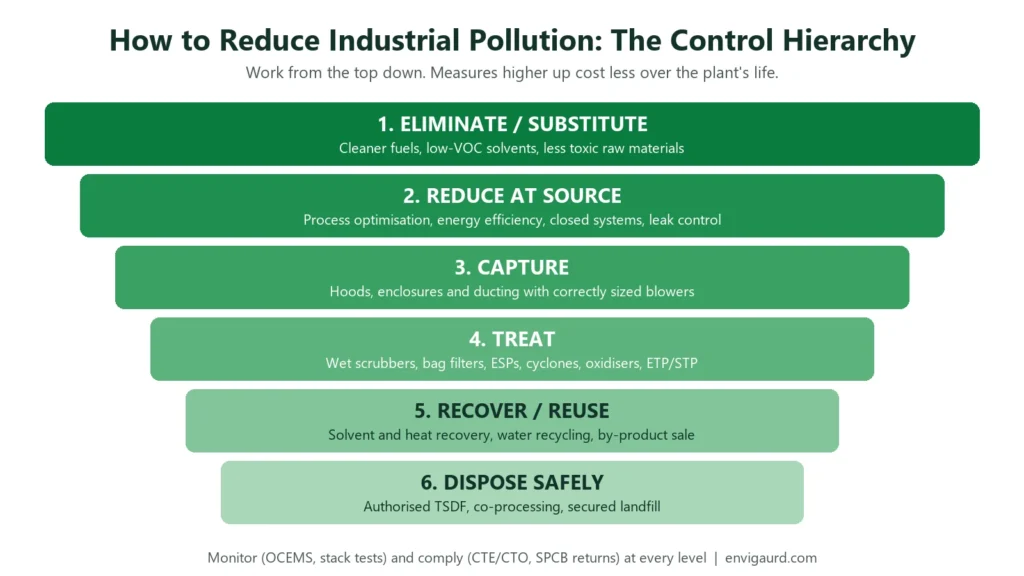
- The Industrial Pollution Control Hierarchy
- 12 Measures to Reduce Industrial Pollution
- Which Control Equipment for Which Pollutant?
- Industrial Pollution Control in India: Rules You Must Meet
- 5 Ways to Reduce Industrial Pollution (Short Answer)
- A 90-Day Action Plan for Plant Managers
- Frequently Asked Questions
- Sources and Further Reading
- Conclusion
Key Highlights
- Prevention at source (fuel, process, materials) is cheaper over a plant’s life than end-of-pipe control.
- End-of-pipe control must match the pollutant: scrubbers for gases, filters and ESPs for dust, oxidisers for VOCs.
- Capture comes before treatment: a good scrubber cannot clean fumes that a poorly designed hood never collects.
- In India, every polluting unit needs Consent to Establish and Consent to Operate from its State Pollution Control Board.
- Highly polluting industries must run online continuous emission and effluent monitoring linked to CPCB and SPCB servers.
- Monitoring and maintenance keep control equipment working; most failures at stack tests are maintenance failures.
The Industrial Pollution Control Hierarchy
Environmental engineers use a simple ranking to decide where to spend money. Measures at the top remove the problem; measures at the bottom manage what is left. A plant that jumps straight to buying equipment, without first looking at fuel and process, usually ends up with a larger, costlier system than it needs.

| Level | What it means | Example in an Indian plant |
|---|---|---|
| Eliminate / substitute | Remove the pollutant or replace it with something less harmful | Boiler moved from coal to PNG; chrome plating replaced by trivalent chrome |
| Reduce at source | Generate less pollutant per unit of product | Closed-loop solvent handling in a pharma API plant |
| Capture | Collect what is released before it spreads | Lip-extraction hoods on pickling tanks |
| Treat | Remove or destroy the pollutant in the captured stream | PP-FRP packed bed scrubber on the pickling exhaust |
| Recover / reuse | Turn waste into a resource | Spent acid sold for recovery; condensate reused as boiler feed |
| Dispose safely | Send what remains to an authorised facility | ETP sludge sent to a TSDF with manifest |
12 Measures to Reduce Industrial Pollution
The measures are grouped by the hierarchy. Each one names the equipment or practice that delivers it, so you can turn this list into a project plan.
1. Switch to cleaner fuels
Fuel choice decides most of a boiler’s or furnace’s emissions. Coal and petcoke produce particulate, SO2 and NOx; furnace oil adds more SO2. Moving to piped natural gas, LPG or well-made biomass briquettes cuts SO2 and particulate sharply. Several Indian regions, including the Delhi NCR, already restrict which industrial fuels may be used, so check your SPCB’s approved fuel list before planning a change.
2. Optimise processes and energy efficiency
Every unit of fuel saved is pollution that never forms. Common wins are tuning burners for correct excess air, insulating hot surfaces, recovering condensate, fitting variable frequency drives on fans and pumps, and fixing compressed-air leaks. Process changes such as better reaction yield or tighter temperature control also reduce off-spec batches that would otherwise become waste.
3. Substitute hazardous raw materials
Ask whether a less toxic input will do the job. Water-based paints and coatings in place of solvent-based ones cut VOC emissions. Low-sulphur raw materials reduce SO2. Where substitution is not possible, reduce inventory and keep hazardous chemicals in closed, vented storage.
4. Use closed systems and control leaks
Open tanks, open transfers and leaking flanges release fumes all day. Closed-loop transfer, vapour-balance lines on storage tanks, sealed pumps and a regular leak detection and repair round prevent these fugitive emissions. Vents that must stay open can be routed to a single treatment point, which is far cheaper than treating a whole building’s air.
5. Capture fumes at source with hoods and ducting
Capture is the step most plants get wrong. A hood that is too far from the tank, a duct that is undersized or a blower that cannot overcome system pressure drop means fumes escape into the shop floor before any equipment sees them. Design capture velocity for each source, balance the duct network and select a corrosion-resistant industrial blower sized for the full system resistance.
6. Treat acid gases, ammonia and fumes with wet scrubbers
Where the exhaust carries soluble or reactive gases such as HCl, SO2, NH3, chlorine, H2S or nitric acid fumes, a wet scrubber system is usually the most reliable treatment. The gas passes through a packed bed or spray zone where a scrubbing liquid absorbs and neutralises the pollutant. Well-designed units typically achieve 95 to 99 percent or higher removal. Envigaurd builds gas-specific units, including HCl scrubbers, ammonia scrubbers, chlorine scrubbers and SO2 scrubbers.
7. Remove dust with bag filters, ESPs and cyclones
Dry particulate from crushers, kilns, dryers and boilers is best handled by fabric filters (bag houses) or electrostatic precipitators, both of which can exceed 99 percent capture of fine dust when well maintained. Cyclones are cheaper but only efficient for coarse particles, so they are normally used as pre-cleaners ahead of a bag filter. Where dust is sticky, hot or mixed with acid gas, a wet scrubber may handle both in one unit; see our comparison of wet scrubbers vs dry scrubbers.
8. Desulphurise boiler and furnace flue gas
Coal-fired boilers, furnaces and incinerators that cannot change fuel need flue gas desulphurisation (FGD). Wet limestone, lime or caustic scrubbing captures SO2 before the stack. For thermal power plants, the SO2 norms were revised by MoEFCC on 11 July 2025: plants within 10 km of the NCR or million-plus cities must comply by December 2027, plants near critically polluted areas or non-attainment cities are decided case by case, and the rest are now exempt from the SO2 limit. Process-industry boilers and furnaces remain bound by the emission limits in their own consent orders. Read more about flue gas scrubber systems.
9. Destroy VOCs and odours
Solvent vapours from pharma, paint, printing and chemical plants can be condensed and recovered, adsorbed on activated carbon, or destroyed in a thermal or catalytic oxidiser. Odorous gases such as H2S and mercaptans are often handled by chemical scrubbing. The right choice depends on concentration, flow and whether the solvent is worth recovering.
10. Treat and recycle wastewater
Industrial effluent must be treated in an effluent treatment plant (ETP) to meet discharge standards, or to zero liquid discharge where the SPCB requires it. Recycling treated water reduces both fresh-water demand and discharge volume. Remember that scrubbers themselves produce a liquid bleed that must go to the ETP; plan the two together.
11. Manage solid and hazardous waste
Segregate waste at source, recover what can be reused, and send hazardous waste only to authorised treatment, storage and disposal facilities (TSDFs) with the required manifest, as set out in the Hazardous and Other Wastes (Management and Transboundary Movement) Rules, 2016. Cement kiln co-processing is an accepted route for many high-calorific wastes.
12. Monitor, maintain and green the boundary
Control equipment only works if it is maintained. Track scrubber pH and liquid flow, bag filter differential pressure and ESP voltage every shift. Online continuous emission monitoring systems (OCEMS) give early warning before a breach. A green belt around the plant boundary does not replace control equipment, but it helps reduce dust and noise and is a consent condition for many units.
Not sure which control system your plant needs?
Envigaurd designs and manufactures wet scrubbers, fume extraction systems and complete air pollution control systems in PP, FRP and stainless steel for chemical, pharma, metal, fertiliser and process plants across India. Share your process and stack details for a free technical recommendation. Call +91-8147606843 or email contact@envigaurd.com.
Which Control Equipment for Which Pollutant?
Use this table as a first filter. Final selection should always come from a measured gas analysis: flow rate, temperature, moisture and pollutant concentration. For a deeper equipment comparison, see our guide to industrial air pollution control systems.
| Pollutant | Typical sources | Primary control options |
|---|---|---|
| Coarse dust (PM10 and above) | Crushers, grinding, material handling | Cyclone, multicyclone, bag filter |
| Fine dust (PM2.5) | Boilers, kilns, furnaces, dryers | Bag filter, ESP, venturi scrubber |
| SO2 | Coal and oil-fired boilers, smelters, sulphuric acid plants | FGD / wet scrubber with lime, limestone or caustic |
| HCl, HF, acid mist | Pickling, galvanising, chemical synthesis, incinerators | Packed bed wet scrubber (PP / FRP) |
| NH3 | Fertiliser, refrigeration, pharma, textile | Acid wet scrubber |
| Cl2 | Chlor-alkali, water treatment, pharma | Caustic wet scrubber |
| NOx and nitric acid fumes | Metal etching, nitration, combustion | Multistage wet scrubber, SCR/SNCR for combustion |
| VOCs and solvents | Pharma, paint, printing, chemicals | Condenser, activated carbon, thermal or catalytic oxidiser |
| Odour (H2S, mercaptans) | ETP, tanneries, food processing | Chemical scrubber, biofilter, carbon adsorber |
Envigaurd’s industrial scrubber range covers the gas-phase rows of this table, and our team can advise on dust and VOC equipment as part of a complete system.
Industrial Pollution Control in India: Rules You Must Meet
Reducing pollution is also a legal obligation. The main framework is:
- Water (Prevention and Control of Pollution) Act, 1974 and Air (Prevention and Control of Pollution) Act, 1981: require Consent to Establish (CTE) before construction and Consent to Operate (CTO) before production, renewed periodically.
- Environment (Protection) Act, 1986: lets the government notify industry-specific emission and discharge standards, which CPCB publishes.
- Industry categorisation: CPCB classifies industries as Red, Orange, Green or White by pollution potential. Red-category units face the strictest conditions; practically non-polluting White-category units do not need Consent to Operate and only need to inform their SPCB.
- Online monitoring: Since 2014, CPCB has directed the 17 categories of highly polluting industries to install online continuous emission and effluent monitoring connected to CPCB and SPCB servers.
- Annual environmental statement: units file Form V each year reporting their consumption, emissions and waste.
State boards enforce these rules, and their contact details and functions differ. Our list of pollution control boards in India covers every SPCB and PCC.
5 Ways to Reduce Industrial Pollution (Short Answer)
If you need a short answer for an exam or a quick briefing, these five measures cover the essentials:
- Use cleaner fuels and technology, such as natural gas instead of coal.
- Install pollution control equipment, such as scrubbers, bag filters and electrostatic precipitators, on chimneys and vents.
- Treat industrial wastewater in effluent treatment plants before discharge, and recycle it where possible.
- Reduce, reuse and recycle waste, and dispose of hazardous waste only at authorised facilities.
- Follow pollution laws and monitor emissions, with industries located away from residential areas and surrounded by green belts.
A 90-Day Action Plan for Plant Managers
| Timeline | Action | Output |
|---|---|---|
| Days 1 to 15 | List every emission source, vent and discharge point; collect last stack and effluent test reports | Source inventory with current values vs consent limits |
| Days 16 to 30 | Walk the plant for fugitive emissions, poor capture and leaks; review fuel and raw materials | Quick-win list (housekeeping, leaks, hood repairs) |
| Days 31 to 60 | Commission gas analysis on non-compliant or borderline stacks; get equipment proposals | Technical specification for each control system |
| Days 61 to 90 | Approve budget, apply for consent amendment if needed, schedule installation and OCEMS calibration | Approved project plan with dates |
Frequently Asked Questions
What are 5 ways to reduce industrial pollution?
Five practical ways are: (1) switch to cleaner fuels such as natural gas or biomass briquettes instead of coal or furnace oil, (2) improve process and energy efficiency so less fuel and raw material is wasted, (3) capture fumes at source with hoods and ducting, (4) treat emissions with air pollution control equipment such as wet scrubbers, bag filters and electrostatic precipitators, and (5) treat and recycle wastewater through an effluent treatment plant.
How can industrial pollution be controlled in India?
In India, industrial pollution is controlled through a mix of law and technology. Units must obtain Consent to Establish and Consent to Operate from their State Pollution Control Board under the Air Act, 1981 and the Water Act, 1974, meet CPCB emission and discharge standards, install control equipment, run online continuous emission monitoring where required, and file annual environmental statements.
What is the best equipment to control industrial air pollution?
There is no single best device; it depends on the pollutant. Bag filters and electrostatic precipitators suit dry dust, wet scrubbers suit acid gases, ammonia and sticky or hot particulate, cyclones work as pre-cleaners for coarse dust, and thermal or catalytic oxidisers destroy VOCs and odours. Start from a stack gas analysis, then select.
What is the difference between pollution prevention and pollution control?
Pollution prevention stops pollutants from forming in the first place, for example by changing fuel or raw material. Pollution control treats pollutants after they are formed, for example by scrubbing a gas stream before it leaves the stack. Prevention is usually cheaper over the life of a plant; control is still needed for what cannot be prevented.
Does a wet scrubber reduce industrial air pollution?
Yes. A correctly designed wet scrubber typically removes 95 to 99 percent or more of soluble gases such as HCl, SO2, NH3 and chlorine, and also captures particulate. It is one of the most common control devices in chemical, pharma, metal finishing and fertiliser plants.
How can individuals help reduce industrial pollution?
Individuals can choose products from companies with good environmental records, reduce and segregate waste so less goes to industrial processing, save electricity (power generation is a major industrial emitter), and report visible violations such as black smoke or illegal dumping to the State Pollution Control Board.
Sources and Further Reading
- Central Pollution Control Board (CPCB): industry-specific emission standards, Red/Orange/Green/White categorisation (2016) and OCEMS directions (2014)
- India Code: full text of the Water Act 1974, Air Act 1981 and Environment (Protection) Act 1986
- Ministry of Environment, Forest and Climate Change: Hazardous and Other Wastes Rules 2016 and the 11 July 2025 notification on SO2 norms for thermal power plants
- Commission for Air Quality Management (CAQM): approved fuel list for industries in the NCR
Conclusion
Reducing industrial pollution is not one purchase; it is a sequence. Prevent what you can at source, capture the rest close to where it forms, treat it with equipment matched to the pollutant, and monitor so you know it keeps working. Plants that follow this order spend less, pass inspections more easily and protect the people who work and live around them.
If your plant releases acid gases, ammonia, chlorine, SO2 or chemical fumes, talk to Envigaurd. We design, manufacture, install and service wet scrubbers and air pollution control systems for industries across India.