
Key Highlights
Before diving into the full comparison, here are the five things you need to know:
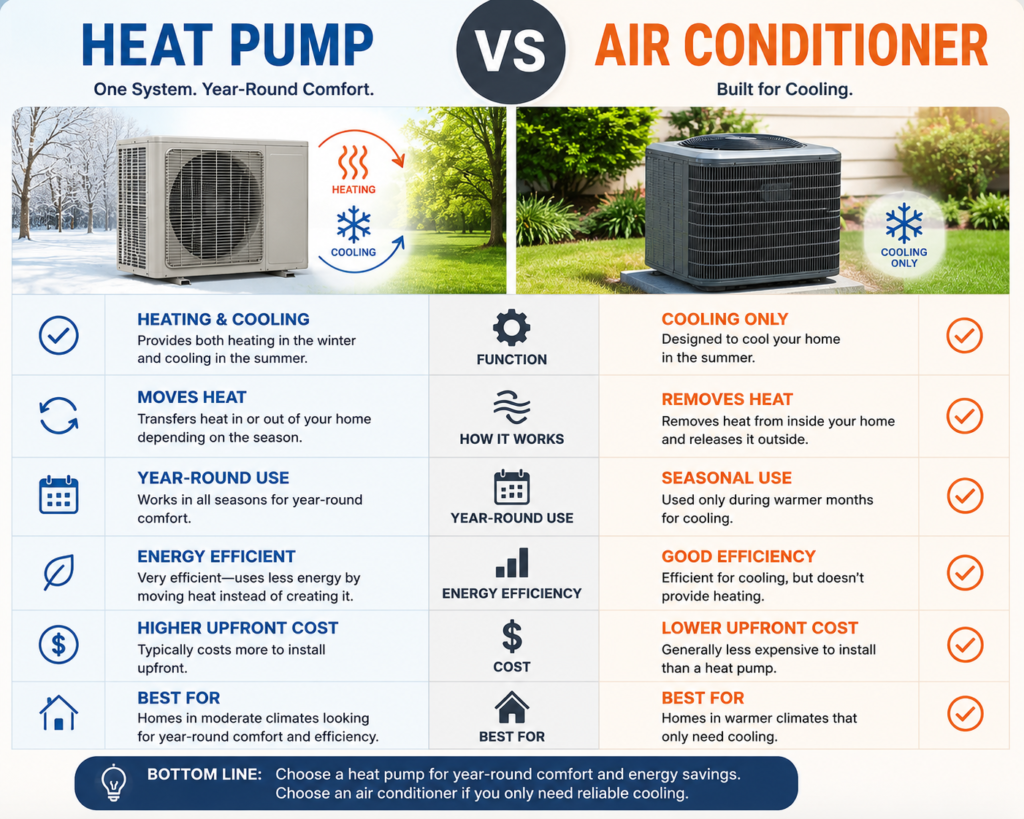
Heat Pumps Do Both A heat pump cools AND heats your space using a single system. An air conditioner can only cool, meaning you need a separate heater for winter months.
Heat Pumps Are More Efficient Heat pumps deliver 3 to 5 units of energy for every 1 unit of electricity consumed (COP 3-5), making them 2-4x more efficient than electric resistance heating and marginally better than AC in annual energy use.
ACs Cost Less Upfront A standard inverter AC costs 30-60% less to purchase and install than a comparable heat pump. For cooling-only applications in warm Indian climates, an AC remains the budget-smart choice.
Heat Pumps Win Long Term Over a 5-10 year lifecycle, heat pump users in moderate Indian climates (North and Central India) typically save 20-40% on combined heating and cooling energy bills compared to running separate AC and heating systems.
Climate Determines the Winner In consistently hot climates (South India), a high-star BEE inverter AC is perfectly adequate. In regions with cool winters (North India, hill stations), a heat pump delivers clear advantages in comfort and cost.
Introduction: A Question Every Property Owner Faces
Whether you are upgrading an ageing system, constructing a new building, or simply trying to cut monthly energy bills, the heat pump vs air conditioner debate is one of the most important HVAC decisions you will make. Both systems cool your space effectively, yet they differ fundamentally in how they work, what they cost, and where they perform best.
In India, where summers are brutal, energy costs are rising, and sustainability targets are tightening, choosing the wrong system means years of overspending. This guide breaks down every dimension of the comparison so you can make a data-driven decision.
At Enviguard, India’s experienced HVAC contractor, we help residential and commercial clients navigate these decisions every day. Here is everything you need to know.
| Quick Answer: A heat pump both cools AND heats, making it more versatile and energy-efficient than a standalone air conditioner. However, air conditioners remain the right choice in consistently hot climates or tight-budget installations. Read on for the full picture. |
1. What Is an Air Conditioner?
A conventional air conditioner (AC) is a one-directional cooling system. It absorbs heat from indoor air, transfers that heat to refrigerant, and expels it outside via a condenser unit. The result is cool, conditioned air circulated back into your space.
According to the U.S. Department of Energy, central air conditioning systems account for a significant portion of annual home energy use, making efficiency ratings a critical purchase factor.
Key Components of a Standard AC Unit
- Evaporator coil (indoor): absorbs heat from room air
- Compressor: pressurises the refrigerant
- Condenser coil (outdoor): releases absorbed heat to outside air
- Expansion valve: reduces refrigerant pressure before the evaporator
- Blower or air handler: circulates conditioned air
Standard AC systems include split ACs, window ACs, cassette ACs, central air conditioning, and VRF/VRV systems. They are designed exclusively for cooling; a separate furnace or boiler is needed for winter heating.
2. What Is a Heat Pump?
A heat pump is a two-directional HVAC system capable of both cooling and heating a space. During summer it functions exactly like an air conditioner, extracting indoor heat and rejecting it outside. During winter the refrigeration cycle reverses: it extracts heat from outdoor air (even at low temperatures) and transfers it indoors.
The International Energy Agency (IEA) reports that heat pumps are among the most critical technologies for decarbonising the buildings sector globally, with efficiency advantages across most climate zones.
Key Components of a Heat Pump System
- Reversing valve: the component that differentiates a heat pump from a standard AC; it reverses refrigerant flow
- Outdoor unit (heat exchanger): acts as condenser in summer, evaporator in winter
- Indoor unit or air handler: distributes conditioned air
- Compressor: the heart of the refrigerant cycle
- Expansion device: metering refrigerant flow
The most common type is the air source heat pump, which exchanges heat with outdoor air. Ground source (geothermal) heat pumps exchange heat with the earth and offer even higher efficiency, though at a higher upfront cost.
Enviguard designs and installs both types across India. Explore our HVAC contracting services.
3. Heat Pump vs Air Conditioner Efficiency: The Core Difference
Is a heat pump more efficient than an air conditioner? The short answer is yes, and here is exactly why.
Understanding COP and EER
Efficiency in HVAC systems is measured by:
- Coefficient of Performance (COP): ratio of heat energy moved per unit of electrical energy consumed
- Energy Efficiency Ratio (EER) and Seasonal EER (SEER): cooling output (BTU) per watt-hour of electricity input
A typical air conditioner has a COP of 2.5 to 3.5 in cooling mode. A heat pump in heating mode achieves a COP of 3 to 5, meaning it moves 3 to 5 units of heat energy for every 1 unit of electrical energy consumed. Electric resistance heaters, by comparison, have a COP of exactly 1. This is why heat pumps are more efficient than air conditioners when the full-year system is considered.
The ASHRAE Handbook of HVAC Systems and Equipment provides detailed guidance on COP benchmarks for both systems across climate zones.
Efficiency Comparison Table
| Parameter | Air Conditioner | Heat Pump |
| Cooling COP | 2.5 to 3.5 | 2.5 to 4.5 |
| Heating COP | Not applicable (no heating) | 3.0 to 5.0 |
| Typical SEER Rating | 14 to 20 | 15 to 22+ |
| Annual Energy Use (Heating + Cooling) | High (separate furnace needed) | Lower (single system) |
| Efficiency in Mild Climate | Adequate | Excellent |
| Efficiency Below -5 Celsius | Not applicable | Reduced (aux heat needed) |
Conclusion on efficiency: Heat pump efficiency vs air conditioner leans heavily in the heat pump’s favour, particularly for climates with moderate winters, which describes a large portion of India.
4. Heat Pump vs AC Cost: Upfront, Installation and Monthly Bills
4.1 Upfront Equipment Cost
In India, equipment pricing varies significantly by brand, capacity, and technology tier:
| System Type | Air Conditioner | Heat Pump |
| 1.5 TR Split Unit | Rs 35,000 to Rs 75,000 | Rs 55,000 to Rs 1,30,000 |
| 2 TR Commercial Unit | Rs 70,000 to Rs 1,50,000 | Rs 1,00,000 to Rs 2,20,000 |
| Central Air System (per TR) | Rs 30,000 to Rs 60,000 | Rs 45,000 to Rs 80,000 |
| Installation (typical) | Rs 5,000 to Rs 20,000 | Rs 8,000 to Rs 25,000 |
4.2 Monthly Operating Cost
The heat pump vs AC monthly cost gap becomes apparent over time. An air conditioner only handles cooling; you still need a separate water heater or gas furnace for winter. A heat pump replaces both.
- A 1.5 TR inverter AC running 8 hours per day costs approximately Rs 2,800 to Rs 4,500 per month at Rs 8 per unit
- An equivalent heat pump in cooling mode costs similarly, but eliminates your winter heating electricity bill
- Over 12 months, heat pump users in moderate climates report 20 to 40 percent lower combined energy costs
The Bureau of Energy Efficiency (BEE), Government of India star rating system helps consumers compare running costs between models before purchase.
4.3 Maintenance Cost
Both systems require similar routine maintenance: filter cleaning, refrigerant checks, coil cleaning, and electrical inspection. Heat pumps have slightly more components (reversing valve, defrost cycle controls), but the service intervals are comparable.
Contact Enviguard for an annual maintenance contract (AMC) tailored to your HVAC system.
5. Heat Pump vs Central Air: Climate Suitability Across India
One of the biggest misconceptions is that heat pumps work poorly in hot climates. Modern inverter-driven heat pumps maintain excellent cooling performance even when outdoor temperatures exceed 45 degrees Celsius, common across Rajasthan, Gujarat, and Delhi-NCR in peak summer.
According to GRIHA (Green Rating for Integrated Habitat Assessment), heat pump systems contribute significantly to energy credits in green building certification across Indian climate zones.
Regional Climate Guide
| Region | Climate | Recommended System | Reason |
| South India (Kerala, Tamil Nadu, Karnataka) | Hot and humid year-round | Either; AC if no heating needed | Heat pump for energy savings |
| West India (Maharashtra, Gujarat) | Hot summers, mild winters | Heat pump ideal | Heat pump strongly preferred |
| North India (Delhi, Punjab, UP) | Hot summers, cold winters | Heat pump with aux heat backup | Heat pump offers dual benefit |
| Northeast India (Assam, Meghalaya) | Moderate, rainy | Heat pump very efficient | Heat pump preferred |
| Hill Stations and High Altitude | Cold year-round | Heat pump (ground source preferred) | Heat pump essential |
Unlike in Canada or Scandinavia where extreme cold below minus 15 degrees Celsius limits heat pump efficiency, India’s climate is highly favourable for air source heat pumps across most of its geographic range.
6. Difference Between Heat Pump and Air Conditioner: Technical Deep Dive
Beyond the reversing valve, several technical distinctions separate the two systems:
6.1 Refrigerant Flow Direction
In an AC, refrigerant always flows in one direction: evaporator to compressor to condenser to expansion valve and back to evaporator. In a heat pump, the reversing valve flips the direction of flow, swapping which coil acts as the evaporator and which acts as the condenser.
6.2 Defrost Cycle
Heat pumps operating in heating mode can develop ice on the outdoor coil in cold or humid conditions. Modern heat pumps include an automatic defrost cycle that temporarily reverses operation to melt this ice, a feature completely absent from standard AC units.
The Air-Conditioning, Heating, and Refrigeration Institute (AHRI) sets performance testing standards for both heat pumps and air conditioners, including defrost cycle efficiency benchmarks.
6.3 Heat Exchanger vs Condenser Design
The outdoor coil of a heat pump, functioning as both condenser and evaporator depending on season, is typically larger and designed with enhanced fin-and-tube geometry to maximise bi-directional heat exchange. AC condensers are optimised for one-way heat rejection only.
6.4 Controls and Inverter Technology
Modern heat pumps increasingly use variable-speed inverter compressors that modulate output between 20 and 100 percent of capacity. This is far more efficient than fixed-speed operation and is now also common in premium inverter AC units, but the heat pump’s dual-mode capability remains the differentiator.
7. Pros and Cons of Heat Pump vs AC
Heat Pump: Pros
- Single system for both cooling and heating, reducing equipment footprint
- Significantly higher energy efficiency over the full year
- Lower carbon footprint: no combustion, runs entirely on electricity
- Eligible for green building certifications such as LEED and GRIHA in India
- Quieter operation due to variable-speed compressors in modern units
- Better humidity control in both heating and cooling modes
Heat Pump: Cons
- Higher upfront equipment cost compared to a comparable AC
- Slightly more complex installation requiring an experienced HVAC contractor
- Efficiency drops below minus 5 degrees Celsius outdoor temperature; aux heat may be needed
- Less familiar to some service technicians in smaller Indian cities
Air Conditioner: Pros
- Lower purchase price and simpler installation
- Extremely well-understood technology with service available everywhere in India
- Excellent cooling performance in consistently hot climates
- Wide variety of brands, capacities, and form factors available
- Lower complexity means lower chance of mechanical issues
Air Conditioner: Cons
- No heating function: requires separate heater in winter
- Higher combined energy cost when heating system is factored in
- Greater environmental impact if paired with gas or fossil fuel heating
- Two separate systems to maintain, service, and eventually replace
8. Heat Pump vs HVAC: Understanding the Terminology
There is common confusion around the terms heat pump vs HVAC. HVAC stands for Heating, Ventilation, and Air Conditioning and is a broad umbrella term covering all systems that control indoor climate. A heat pump IS an HVAC system. So is a traditional AC paired with a furnace.
| Heat Pump | HVAC System (AC + Furnace) |
| A type of HVAC system | A category that includes heat pumps, ACs, furnaces, chillers, AHUs, and more |
| Handles heating + cooling in one unit | May involve multiple separate components |
| Always uses refrigeration cycle | May use refrigeration, combustion, or both |
| Increasingly preferred for green buildings | Entire system must be specified for energy compliance |
As an HVAC contractor, Enviguard designs complete HVAC systems including heat pumps, chillers, AHUs, VRF systems, ducting, and controls, all to ASHRAE 62.1 and NBC compliance standards.
9. Should You Get a Heat Pump or Air Conditioner? Scenario-Based Guidance
Scenario 1: New Construction in a Metro City (Delhi, Mumbai, Bengaluru)
Recommendation: Heat pump system integrated with central air. Metro cities have reliable electricity supply, good service networks, and often require green building compliance. A heat pump gives you cooling plus heating (useful in Delhi winters), better SEER ratings, and qualifies for GRIHA credits.
Scenario 2: Retrofit in an Existing Home with a Limited Budget
Recommendation: Inverter AC. If budget is the primary constraint and winters in your location are mild, a high-star BEE-rated inverter AC is the practical choice. You get great cooling performance at a manageable upfront cost.
Scenario 3: Commercial Building or IT Park
Recommendation: VRF heat pump system. Large commercial spaces benefit enormously from VRF (Variable Refrigerant Flow) heat pump technology, which simultaneously heats and cools different zones, a feature unique to heat pumps. Speak to Enviguard’s design team about VRF heat pump design for your facility.
Scenario 4: Pharma or Cleanroom Facility
Recommendation: Precision heat pump AHU with redundant systems. Pharmaceutical manufacturing requires tight temperature and humidity control year-round. Heat pump-based air handling units offer better psychrometric control than cooling-only systems. Read more about cleanroom classification standards from ISO 14644, which Enviguard designs to on all pharma projects.
Scenario 5: Hill Station or Resort above 1,000 m Altitude
Recommendation: Ground source heat pump or cold-climate air source heat pump. High-altitude properties need reliable heating. Ground source heat pumps maintain consistent performance regardless of outdoor temperature and are the gold standard for mountain properties.
10. Do Heat Pumps Cool as Well as Air Conditioners?
Do heat pumps cool as well as air conditioners? The answer is yes in standard conditions. The cooling performance of a heat pump is functionally identical to that of an equivalently sized air conditioner. Both use the same vapour compression cycle, and modern heat pumps are rated on the same SEER and EER scales as AC units.
However, there is a nuance: very high ambient temperatures above 47 degrees Celsius can marginally reduce heat pump cooling output compared to a dedicated AC condenser optimised purely for heat rejection. In Indian peak summer conditions, this is worth discussing with your HVAC engineer.
For most Indian climates and building types, the answer to ‘is a heat pump better than an AC’ is yes, because you get equal cooling performance plus heating capability at comparable or better efficiency. The Energy Conservation Building Code (ECBC) of India now recognises heat pumps as a preferred system for mixed-climate zones.
11. Are Heat Pumps Quieter Than Air Conditioners?
Are heat pumps quieter than air conditioners? Generally, yes. Modern heat pumps use inverter-driven variable-speed compressors that operate at lower noise levels, as low as 19 to 25 dB for indoor units and 45 to 55 dB for outdoor units, compared to fixed-speed AC compressors at 55 to 70 dB outdoors.
The inverter compressor avoids the loud start-stop cycling of older fixed-speed units. For noise-sensitive environments like hospitals, hotels, and premium residences, this matters significantly.
12. Heat Pump vs AC Power Consumption: What the Numbers Say
Does a heat pump use more electricity than an air conditioner? In cooling mode, power consumption is similar for the same capacity. The key difference emerges in heating mode: a heat pump uses 50 to 70 percent less electricity than electric resistance heaters to deliver the same heat output, because it moves heat rather than generating it.
Example: A 1.5 TR heat pump consuming 1.5 kW delivers 4.5 to 5 kW of heating energy (COP 3 to 3.5). An electric heater of 1.5 kW delivers exactly 1.5 kW of heat (COP 1). Over a winter month, this difference adds up to thousands of rupees in saved electricity.
The Bureau of Energy Efficiency’s ECBC Compliance Guide outlines minimum efficiency standards for HVAC systems installed in commercial buildings across India.
13. Replacing Central Air with a Heat Pump: Is It Worth It?
Many building owners with ageing central AC systems consider upgrading to heat pumps during replacement cycles. Key considerations:
- Ductwork compatibility: Existing duct systems designed for central AC typically work well with heat pumps; your HVAC engineer should verify duct sizing and insulation
- Electrical capacity: Heat pumps, especially larger central units, may require electrical panel upgrades
- Payback period: In Indian conditions with electricity at Rs 6 to Rs 10 per unit, payback on the premium is typically 3 to 6 years
- Long-term value: As India pushes for net-zero buildings and green certifications, heat pump systems increase property value
The National Building Code (NBC) of India provides guidelines on HVAC system design that are relevant when planning a central system replacement or upgrade.
Consult Enviguard’s HVAC team for a site-specific retrofit assessment and ROI calculation.
14. Is a Heat Pump an Air Conditioner? Clearing the Confusion
Is a heat pump the same as an air conditioner? Not exactly, but they are closely related. Every heat pump contains an air conditioning system. In cooling mode, a heat pump IS an air conditioner. The distinction is that a heat pump adds a reversing valve and the capability to also heat.
So: all heat pumps can act as air conditioners, but not all air conditioners are heat pumps. Think of a heat pump as a superset of the conventional AC.
15. Why Choose Enviguard for Your HVAC Project?
Enviguard is a leading HVAC contractor in India with multi-vertical expertise spanning:
- Turnkey HVAC design, supply, installation, and commissioning
- Heat pump system design for residential, commercial, and industrial applications
- Cleanroom HVAC (ISO 14644 compliant, GMP-ready)
- MEP integration: Mechanical, Electrical and Plumbing coordination
- Central air conditioning systems, VRF/VRV, chillers, AHUs
- Ducting fabrication and installation (GI, pre-insulated, FRP)
- Annual Maintenance Contracts (AMC) for all HVAC equipment
We work with ASHRAE, NBC, and BEE standards to ensure your system is compliant, energy-efficient, and future-ready.
| Ready to choose between a heat pump and an air conditioner? Get a free consultation from Enviguard’s HVAC engineers. Visit https://envigaurd.com/hvac-contractors/ or WhatsApp us today. |
16. Frequently Asked Questions: Heat Pump vs Air Conditioner
Q1. What is the main difference between a heat pump and an air conditioner?
The primary difference is directionality. An air conditioner can only move heat in one direction, out of your space. A heat pump can reverse this process, extracting heat from outside air and bringing it indoors for heating. Both use the vapour compression refrigeration cycle; the heat pump adds a reversing valve to enable dual-mode operation. Learn more from the U.S. Department of Energy’s heat pump overview.
Q2. Is a heat pump more efficient than an air conditioner?
Yes, when evaluated over an entire year. In cooling mode, efficiency is comparable. In heating mode, a heat pump is 2 to 4 times more efficient than electric resistance heating, delivering a COP of 3 to 5 versus 1 for resistive elements. For buildings that need both cooling and heating, a heat pump system has a lower total annual energy cost.
Q3. Are heat pumps more expensive than air conditioners?
Upfront, yes. Heat pumps cost 30 to 60 percent more than comparable air conditioners. However, because they replace both the air conditioner and the heater, the total system cost is often comparable. Monthly savings on heating, especially replacing LPG or electric resistance heating, typically recover the premium within 3 to 6 years in Indian conditions.
Q4. Do heat pumps work well in India’s hot climate?
Yes. Modern heat pumps are rated to operate in ambient temperatures up to 50 degrees Celsius. For the vast majority of Indian cities and seasons, heat pump cooling performance is equal to that of a dedicated AC. The real bonus in India is the mild-to-moderate winter benefit in northern and central states.
Q5. Can I replace my central air conditioner with a heat pump?
In most cases, yes. If your building has existing ductwork, a central heat pump can often be installed using the same duct system. Your HVAC contractor will assess duct sizing, electrical supply, and outdoor unit placement before recommending a replacement. Enviguard offers free retrofit assessments across India.
Q6. Are heat pumps quieter than air conditioners?
Modern inverter-driven heat pumps tend to run quieter than older fixed-speed AC compressors. Outdoor units typically operate at 45 to 55 dB, similar to a quiet conversation, compared to 60 to 70 dB for some older AC condensers. However, premium inverter ACs are also quiet, so this advantage is narrowing.
Q7. What is the difference between a heat pump and central air conditioning?
Central air conditioning refers to a system that distributes cooling throughout a building via a central AHU and duct network. It can be powered by a heat pump or a traditional AC condenser. When people say ‘central air,’ they usually mean a central AC without heating. A central heat pump system uses the same duct distribution but adds heating capability, providing year-round comfort from a single system.
Q8. Does a heat pump replace a furnace and an air conditioner?
Yes. A heat pump with adequate heating capacity can replace both a furnace and an air conditioner in moderate climates. In very cold regions below minus 10 degrees Celsius sustained, a heat pump is often paired with a backup electric resistance heater or gas auxiliary heater for peak winter days, but it still handles 80 to 90 percent of the annual heating load.
Q9. Is central air the same as a heat pump?
No. Central air refers to a centralised distribution system using ducts, AHU, and diffusers. A heat pump is the type of refrigerant machine doing the heating or cooling. A central air system can use either a heat pump or a traditional AC as its source.
Q10. How do I know which system is right for my building?
The right answer depends on your climate zone, building size, budget, energy tariff, and sustainability goals. Enviguard’s HVAC team offers free site assessments and load calculations to recommend the optimal system for your specific situation.
17. Final Verdict: Heat Pump vs Air Conditioner: Which Should You Choose?
| Use Case | Choose AC | Choose Heat Pump |
| Budget-first, cooling-only, warm year-round climate | Best: Standard Inverter AC | |
| Moderate climate, want heating + cooling | Best: Air Source Heat Pump | |
| Commercial building needing zone control | Best: VRF Heat Pump System | |
| Pharma or cleanroom needing precision control | Best: Heat Pump AHU | |
| New green building targeting GRIHA or LEED | Best: Heat Pump | |
| Tight retrofit budget, mild winters | Best: Inverter AC | |
| Hill station or cold region | Best: Heat Pump (GSHP preferred) |
The heat pump vs air conditioner decision is not simply about technology. It is about matching the right system to your climate, building, and budget. For India’s rapidly evolving energy landscape, heat pumps represent the future of efficient, dual-purpose HVAC. But for budget-conscious cooling-only applications, a high-BEE-star inverter AC remains a perfectly valid choice.
Whatever you choose, professional system design and quality installation are non-negotiable. Enviguard brings the engineering depth and project execution capability to deliver the right system, on time, on spec, and on budget.
| Get a Free Consultation: Visit https://envigaurd.com/hvac-contractors/ | Chat with our HVAC engineers | WhatsApp us for a quick response |