

An air handling unit (AHU) is a large metal box that cleans, cools or heats, humidifies or dehumidifies, and moves air through a building. Inside that box are more than 30 parts, each with a specific job. If you know the AHU parts names and their functions, you can read a specification sheet, talk confidently to a contractor, plan spare parts and spot problems before they turn into breakdowns.
This guide gives you the complete AHU parts list section by section, explains how each part works, includes a labelled AHU parts diagram, lists the most common AHU spare parts, and compares the main types of AHU. You can also download the AHU parts list as a PDF.
Table of Contents
- Key Highlights
- What Is an AHU and How Does It Work?
- AHU Parts Diagram
- AHU Parts List at a Glance
- AHU Parts and Their Functions in Detail
- AHU Spare Parts List
- Types of AHU and Their Functions
- How the AHU Parts Work Together
- Common AHU Part Problems and What They Mean
- Buying AHU Parts: OEM vs Aftermarket
- Download the AHU Parts List PDF
- Frequently Asked Questions
- Conclusion
Key Highlights
- A typical AHU has nine groups of parts: casing, mixing section, filters, coils, humidification, heat recovery, fan section, accessories, and controls and safety.
- The main parts of an AHU are the casing, dampers, filters, cooling coil, heating coil, drain pan, fan (blower), motor and control panel.
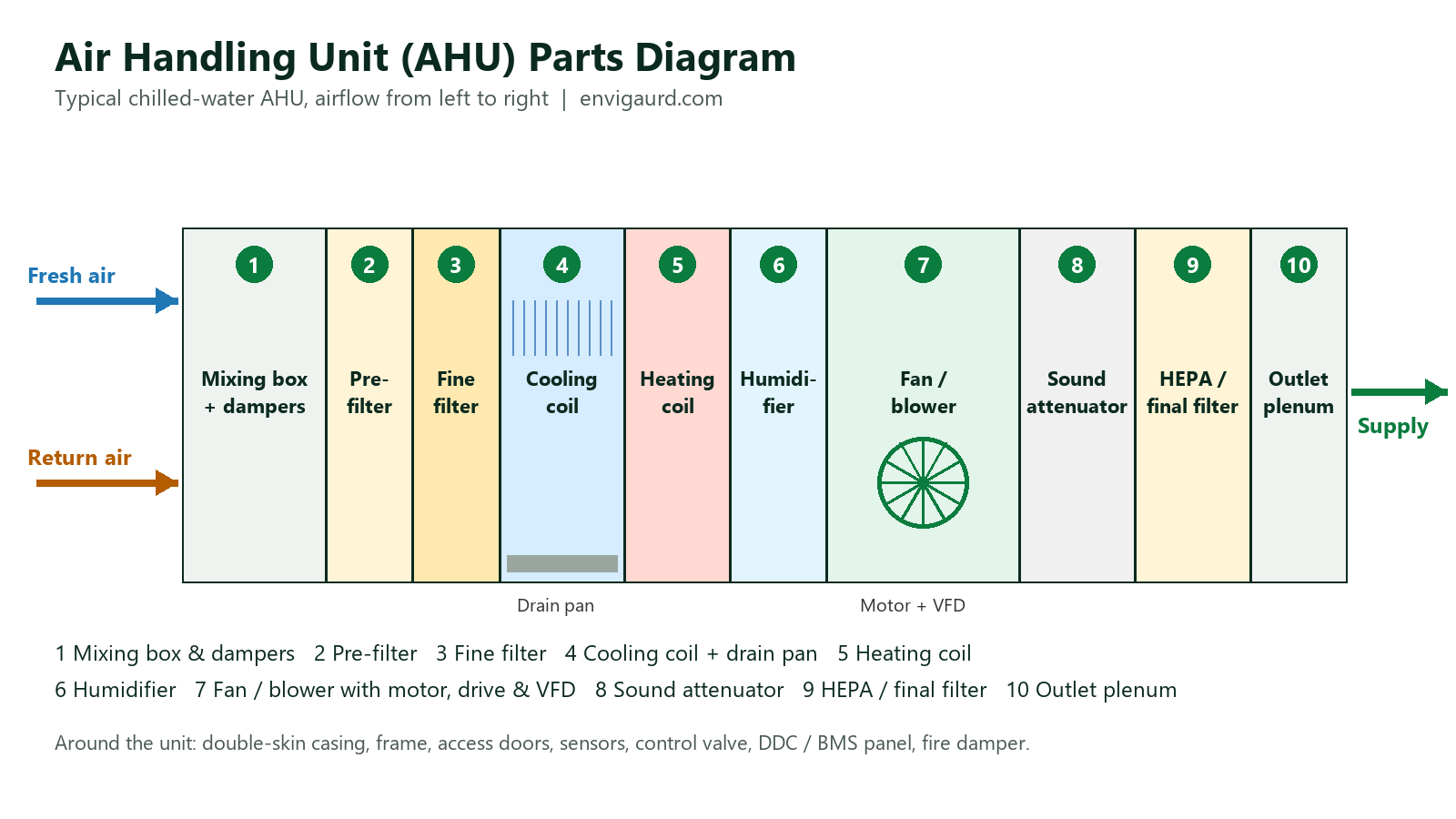
- Air moves through the parts in a fixed order: mixing box, pre-filter, fine filter, coils, humidifier, fan, attenuator and final filter, then out to the supply duct.
- Filters, belts, bearings, actuators and sensors are the AHU spare parts replaced most often.
- Choosing the right AHU type (chilled water or DX, TFA/fresh air, hygienic, heat recovery, rooftop) matters as much as the parts inside it.
What Is an AHU and How Does It Work?
An AHU takes in a mix of fresh outdoor air and return air from the rooms, filters it, brings it to the required temperature and humidity, and pushes it through ducts to the spaces it serves. A fan inside the unit creates the airflow. Chilled or hot water, refrigerant or steam from the central plant does the actual heating or cooling inside the coils. The controls decide how much fresh air to bring in, how far to open the water valves and how fast to run the fan.
If you are new to the term, our explainer on the AHU full form in HVAC covers the basics. This article goes one level deeper, into the parts of an AHU and what each one does.
AHU Parts Diagram
The diagram below shows the parts of a typical chilled-water AHU in the order air flows through them. Real units vary: some skip the heating coil or humidifier, and pharma units add HEPA filters and more filter stages. The sequence, though, is broadly the same in most AHUs.
AHU Parts List at a Glance
Here are all the main AHU parts names, grouped by section, with a one-line function for each.
| # | AHU part name | Section | Main function |
|---|---|---|---|
| 1 | Casing / cabinet (double-skin panels) | Housing | Encloses every section, keeps conditioned air in and outside air, dust and moisture out. |
| 2 | Frame / profile (aluminium, with thermal break) | Housing | Structural skeleton that holds the panels. |
| 3 | Base frame / skid | Housing | Steel channel base that supports the AHU, spreads its weight and allows lifting and levelling. |
| 4 | Fresh air (outdoor air) damper | Mixing | Admits outdoor air for ventilation. |
| 5 | Return air damper | Mixing | Controls how much room air is recirculated back into the unit. |
| 6 | Exhaust / relief air damper | Mixing | Lets excess air out of the building so fresh air can come in without over-pressurising the space. |
| 7 | Mixing box / plenum | Mixing | Chamber where fresh air and return air blend before filtration and conditioning. |
| 8 | Damper actuator | Mixing | Motor that opens and closes dampers on command from the controller or BMS. |
| 9 | Pre-filter (primary filter) | Filtration | First filter stage. |
| 10 | Fine filter (secondary / bag filter) | Filtration | Removes fine particles such as pollen and smoke. |
| 11 | HEPA filter (terminal or in-unit) | Filtration | High-efficiency particulate filter, typically H13 or H14 (EN 1822), used for cleanrooms, operation theatres and pharma areas. |
| 12 | Filter frame and holding clips | Filtration | Holds filters in place and seals them so air cannot bypass the media. |
| 13 | Differential pressure gauge (e.g. Magnehelic) | Filtration | Shows the pressure drop across a filter so you know when it is loaded and needs replacing. |
| 14 | Cooling coil (chilled water or DX) | Thermal | Copper tubes with aluminium fins that cool and dehumidify air. |
| 15 | Heating coil (hot water, steam or electric) | Thermal | Heats air in winter, or reheats over-cooled air to control humidity in precision applications. |
| 16 | Drain pan (condensate tray) | Thermal | Collects water condensed on the cooling coil. |
| 17 | Condensate drain and trap | Thermal | Carries condensate away. |
| 18 | Moisture eliminator | Thermal | Blades downstream of the coil that catch water droplets so they are not carried into the ductwork. |
| 19 | Humidifier (steam, pad or spray) | Thermal | Adds moisture when air is too dry, important in hospitals, pharma, textiles and data centres. |
| 20 | Heat recovery device (wheel, plate or heat pipe) | Energy recovery | Transfers heat (and, with a wheel, moisture) between exhaust and fresh air to cut cooling and heating energy. |
| 21 | Fan / blower (centrifugal or plug fan) | Air movement | The heart of the AHU. |
| 22 | Fan motor | Air movement | Drives the fan. |
| 23 | Drive (belt and pulley, or direct drive) | Air movement | Transfers power from motor to fan. |
| 24 | Variable frequency drive (VFD) | Air movement | Varies motor speed to match airflow demand, saving energy and allowing soft start. |
| 25 | Vibration isolators (spring or rubber mounts) | Air movement | Stop fan and motor vibration from travelling into the casing and building structure. |
| 26 | Flexible connection (canvas connector) | Air movement | Flexible joint between the fan outlet or AHU and the duct to isolate vibration. |
| 27 | Sound attenuator (silencer) | Air movement | Absorbs fan noise before it travels down the duct to occupied spaces. |
| 28 | UV-C lamp (UVGI) | Accessories | Ultraviolet lamps that reduce microbial growth on coils and drain pans. |
| 29 | Access doors, viewing ports and inspection lights | Accessories | Allow safe inspection and maintenance of each section without dismantling panels. |
| 30 | Sensors (temperature, humidity, pressure, CO2) | Controls | Measure supply, return and room conditions so the controller can modulate valves, dampers and fan speed. |
| 31 | Control valve and actuator (2-way or 3-way) | Controls | Modulates chilled or hot water flow through the coil to hold the set temperature. |
| 32 | Control panel / DDC controller / BMS interface | Controls | Starts and stops the unit, runs the control logic, provides safeties and links the AHU to the building management system. |
| 33 | Fire damper and smoke detector | Safety | Close off the duct and shut down the AHU in a fire so smoke does not spread through the building. |
AHU Parts and Their Functions in Detail
Now let’s look inside the AHU, section by section, in the order the air sees it.
1. Casing, Panels and Frame
The casing is the outer shell of the AHU. Most commercial and industrial units use double-skin panels: two metal sheets (galvanised, pre-coated or stainless steel) with insulation between them, typically polyurethane foam (PUF) or rockwool, 25 mm or 50 mm thick. The panels sit on an aluminium or steel frame, often with a thermal break so the cold inner frame does not make the outer surface sweat.
A good casing has low air leakage and low thermal bridging. Poor casing construction is one of the most common hidden causes of energy loss and condensation problems. The unit stands on a base frame or skid, and each section has access doors so filters, coils and fans can be serviced.
2. Mixing Box and Dampers
The mixing box is where fresh air from outside and return air from the rooms meet. Dampers control the proportion of each:
- Fresh air damper: admits outdoor air for ventilation and air quality.
- Return air damper: recirculates room air, which saves energy because it is already close to the target temperature.
- Exhaust or relief damper: releases excess air so the building is not over-pressurised.
- Damper actuators: small motors that position the dampers on a signal from the controller.
Dampers come in opposed-blade designs (better for flow control) and parallel-blade designs (common for open/close duty). In an economiser setup, the controller opens the fresh air damper wider when outside air is cool enough to provide free cooling.
3. Filter Section: Pre-Filter, Fine Filter and HEPA
Filters protect both the people in the building and the AHU itself. A dirty cooling coil loses capacity and grows bacteria, so filtration is always placed before the coil. Most AHUs have two or three stages:
| Filter stage | Typical rating | What it captures | Where it is used |
|---|---|---|---|
| Pre-filter | G4 (EN 779), MERV 8, ISO Coarse / ePM10 | Coarse dust, lint, insects | Every AHU, protects downstream filters |
| Fine filter (bag or box) | F7–F9 (EN 779), MERV 13–15, ISO ePM1 | Fine dust, pollen, smoke | Offices, hospitals, hotels, labs |
| HEPA filter | H13–H14 (EN 1822) | Very fine particles, including most bacteria | Cleanrooms, operation theatres, pharma |
A differential pressure gauge across each filter bank shows how loaded the filter is. When the pressure drop reaches the manufacturer’s recommended final resistance, the filter should be replaced. For a deeper look at choosing filter grades, see our AHU component selection guide.
4. Cooling Coil
The cooling coil is a bank of copper tubes with thin aluminium fins. Cold fluid flows through the tubes and the air passes over the fins. There are two kinds:
- Chilled water coil: connected to a central chiller, common in large buildings. A 2-way or 3-way control valve modulates water flow to hold the supply temperature.
- DX (direct expansion) coil: carries refrigerant directly from a condensing unit, common in smaller systems.
The coil also dehumidifies: as the air cools below its dew point, moisture condenses on the fins. That is why coil face velocity matters. If air moves too fast across the coil, water droplets get blown off the fins and into the ducts. Many designers keep face velocity at or below about 2.5 m/s (500 fpm) for this reason.
5. Drain Pan, Condensate Drain and Eliminator
Condensed water drops into the drain pan under the coil. Pans are usually stainless steel and sloped so water drains fully. Standing water in a flat pan is a classic source of odours and microbial growth. The condensate drain line carries water away, and a correctly sized trap keeps air from being drawn in or pushed out through the drain. A moisture eliminator downstream of the coil catches any droplets the air carries.
6. Heating Coil
Heating coils warm the air. They may use hot water, steam or electric resistance elements. In India’s climate, heating is often used less for winter comfort and more for reheat: pharma, hospital and precision spaces over-cool the air to remove moisture and then reheat it to the right temperature. Electric heaters need safety thermostats and airflow interlocks.
7. Humidifier
When air is too dry, a humidifier adds moisture. Steam humidifiers (electrode or resistance), evaporative pads and spray or ultrasonic systems are all used. Humidity control is critical in hospitals, pharma and electronics manufacturing, data centres and textile plants. Water quality and scale control are the main maintenance points.
8. Heat Recovery Section
Energy-efficient AHUs recover energy from exhaust air before it leaves the building. The common options are:
- Heat recovery wheel (enthalpy wheel): a rotating wheel that transfers heat and moisture between exhaust and fresh air.
- Plate heat exchanger: transfers heat only, with the two airstreams kept separate. Preferred where cross-contamination must be avoided.
- Heat pipe or run-around coil: used for pre-cooling and reheat, and in applications where airstreams must be fully separated.
9. Fan (Blower) Section
The fan is the heart of the AHU. It produces the airflow (CFM or m³/h) and the static pressure needed to overcome the resistance of filters, coils and ductwork. Most AHUs use a centrifugal fan, either a double-inlet scroll fan or a plug (plenum) fan. EC fan arrays are becoming common for their efficiency and redundancy. Learn more in our guides on types of centrifugal blowers and what CFM means.
AHU blower parts include:
| Blower part | Function |
|---|---|
| Impeller (fan wheel) | Rotating blades that move air; forward-curved, backward-curved or airfoil designs |
| Scroll housing (volute) | Guides air from the impeller to the outlet and builds pressure (not used on plug fans) |
| Inlet cone / inlet ring | Guides air smoothly into the impeller |
| Shaft | Connects the impeller to the drive |
| Bearings (pillow block) | Support the shaft; need periodic greasing or replacement |
| Pulleys and V-belts | Transfer power from motor to fan on belt-driven units |
| Motor and motor base | Drives the fan; the adjustable base allows belt tensioning |
| Variable frequency drive (VFD) | Adjusts fan speed to match demand and saves energy |
| Vibration isolators | Spring or rubber mounts that stop vibration reaching the casing |
| Flexible connection | Canvas joint between fan and duct to isolate vibration |
10. Sound Attenuator
Fans make noise, and ducts carry it. A sound attenuator (silencer) contains acoustic media that absorbs noise before it reaches offices, hotel rooms or hospital wards. In hygienic AHUs, the media is protected by a facing so fibres cannot enter the airstream.
11. Accessories: UV Lamps, Access Doors and Lights
Useful AHU accessories include UV-C lamps (UVGI) that limit microbial growth on the coil and drain pan, viewing ports and inspection lights in each section, filter pressure gauges, and safety interlocks on access doors.
12. Controls and Safety Parts
The AHU’s controls tie everything together:
- Sensors: supply and return temperature, humidity, duct static pressure, CO2 and filter differential pressure.
- Control valve and actuator: modulates chilled or hot water flow through the coils.
- DDC controller or control panel: runs the control sequence, starts and stops the fan, and handles alarms. It usually links to the building management system (BMS).
- Fire damper and smoke detector: shut down the unit and close off the duct in a fire so smoke does not spread.
Need an AHU installed, retrofitted or serviced?
Envigaurd designs, supplies, installs and maintains HVAC systems, including AHUs, ducting, chilled-water piping and controls, for offices, pharma plants, labs, hospitals and factories. Call +91-8147606843 or email contact@envigaurd.com.
AHU Spare Parts List
Some AHU parts wear out and are replaced routinely. Keeping these AHU spare parts in stock reduces downtime, especially for critical areas such as operation theatres, cleanrooms and data centres. Actual replacement intervals depend on operating hours, air quality and the manufacturer’s recommendations, so always go by filter pressure drop and inspection results rather than the calendar alone.
| Spare part | Why it is replaced | Typical practice |
|---|---|---|
| Pre-filters | Load up quickly with coarse dust | Clean or replace often, typically monthly to quarterly in dusty Indian cities |
| Fine / bag filters | Pressure drop rises as they load | Replace when differential pressure reaches the final resistance |
| HEPA filters | Loading or failed integrity test | Replace based on pressure drop and periodic leak tests |
| V-belts | Stretch, crack and slip | Inspect and re-tension regularly; replace as a matched set |
| Fan and motor bearings | Wear, noise, heat | Grease per manufacturer schedule; replace at signs of wear |
| Damper actuators | Motor or gear failure | Keep one spare of each type for critical units |
| Sensors and transmitters | Drift or failure | Calibrate periodically; replace failed units |
| Door gaskets and panel seals | Hardening and air leaks | Replace when damaged or leaking |
| UV-C lamps | Output drops over time | Replace at the lamp’s rated hours |
| Humidifier cylinders / pads | Scale build-up | Replace or descale based on water quality |
For a full routine, see our AHU maintenance checklist covering filter replacement, coil cleaning and performance checks.
Types of AHU and Their Functions
| Type of AHU | Function | Typical use |
|---|---|---|
| Chilled water AHU | Cools air with chilled water from a central chiller | Large offices, malls, hospitals, IT parks |
| DX AHU | Cools air with refrigerant from a condensing unit | Small to medium buildings without a chiller |
| Treated Fresh Air (TFA) / Make-up Air Unit | Conditions 100% outdoor air before supplying it | Ventilation air for offices, kitchens, labs |
| Hygienic / pharma AHU | Smooth-interior, easy-clean design with multi-stage filtration | Pharma, hospitals, food processing |
| Heat recovery AHU | Recovers energy from exhaust air | Buildings with high fresh-air demand |
| Rooftop unit (RTU) | Packaged unit installed on the roof | Retail, low-rise commercial |
| Ceiling-suspended / horizontal AHU | Compact unit hung from the slab | Where floor space is limited |
| Vertical / floor-mounted AHU | Sections stacked vertically on the floor | AHU rooms with limited footprint |
| Modular / custom AHU | Built from selectable sections to suit the application | Most commercial and industrial projects |
For pharma and cleanroom applications, AHU selection is closely tied to room classification. See GMP cleanroom grades explained and our pharma HVAC solutions.
How the AHU Parts Work Together
- Fresh air and return air enter the mixing box, where the dampers set the ratio.
- The mixed air passes through the pre-filter and fine filter.
- The cooling coil cools and dehumidifies the air; condensate drains to the drain pan.
- If needed, the heating coil reheats the air and the humidifier adds moisture.
- The fan pushes the conditioned air through the sound attenuator and any final or HEPA filter.
- Air leaves through the discharge into the supply duct. Sensors feed back to the controller, which adjusts valves, dampers and fan speed.
Common AHU Part Problems and What They Mean
| Symptom | Likely part involved | What to check |
|---|---|---|
| Low airflow | Clogged filters, slipping belt, dirty coil, closed damper | Filter pressure drop, belt tension, damper position |
| Water in the duct or ceiling | Blocked drain, missing trap, high coil face velocity | Drain pan slope, trap seal, airflow |
| Musty smell | Standing water in drain pan, dirty coil | Pan drainage, coil cleaning, UV lamp |
| Noise or vibration | Worn bearings, unbalanced impeller, failed isolators | Bearing condition, fan balance, mounts |
| Room too warm | Control valve not opening, fouled coil, chiller supply | Valve actuator, coil condition, water temperature |
| High humidity | Coil too warm, reheat or controls issue | Chilled water temperature, sensor calibration |
Buying AHU Parts: OEM vs Aftermarket
Filters, belts and bearings are standard items available from many suppliers. Model-specific parts such as fan assemblies, coils, controllers and actuators are best sourced as OEM (original equipment manufacturer) parts or exact-match equivalents. Before you order:
- Note the AHU’s make, model and serial number from its nameplate.
- Match sizes exactly: filter dimensions and grade, belt section and length, bearing number, motor kW, frame size and speed.
- For coils, confirm rows, fins per inch, tube diameter, circuiting and connection side.
- For branded units (for example York, which is part of Johnson Controls), order through the manufacturer’s authorised parts channel in India to protect warranty.
Finding AHU parts in India: for branded AHUs, start with the manufacturer’s authorised dealer or service partner in your city. For filters, belts, bearings, motors and blowers, an experienced HVAC contractor can source matched replacements and install them, which avoids the common problem of a part that fits but performs differently. If your AHU is old or the original manufacturer no longer supports the model, a retrofit (new fan section, EC fans, coil replacement) is often more economical than hunting for obsolete parts.
Envigaurd manufactures industrial blowers and centrifugal blowers in Bangalore, and provides HVAC contracting, AHU retrofits, replacement of AHU parts and AMC for commercial, pharma and industrial facilities across India.
Download the AHU Parts List PDF
Want the complete list offline? Download the AHU Parts List and Functions PDF. It covers all 33 parts, what each one does and what to check during maintenance, on printable A4 pages.
Planning a new AHU or upgrading an old one?
From load calculation and AHU selection to ducting, installation, commissioning and AMC, Envigaurd delivers complete HVAC projects across Bangalore and India. We have installed HVAC systems for R&D facilities of global technology companies in Bangalore.
Frequently Asked Questions
What are the main parts of an AHU?
The main parts of an AHU are the casing (double-skin panels and frame), mixing box with dampers, pre-filter and fine filter, cooling coil, drain pan, heating coil, humidifier, fan or blower with motor and drive, sound attenuator, and the control panel with sensors and valves.
What are the inside parts of an AHU?
Inside an AHU you will find dampers, filters, the cooling and heating coils, drain pan and eliminator, humidifier, heat recovery device (if fitted), the fan with its motor, belts and bearings, a sound attenuator and, in some units, HEPA filters and UV lamps.
What is the function of the blower in an AHU?
The blower (fan) creates the airflow and static pressure needed to move air through the filters, coils and ducts to the rooms. Its speed, often controlled by a VFD, determines how much air the AHU delivers.
AHU ke parts name kya hain?
AHU ke main parts hain: casing (double-skin panel), mixing box aur dampers, pre-filter, fine filter, cooling coil, drain pan, heating coil, humidifier, blower (fan) aur motor, sound attenuator, HEPA filter aur control panel. Har part ka kaam hai hawa ko saaf karna, thanda ya garam karna, nami control karna aur hawa ko duct tak pahunchana.
Which AHU spare parts should I keep in stock?
Keep spare pre-filters and fine filters, V-belts, at least one set of bearings, a damper actuator, key sensors, and door gaskets. For critical areas such as cleanrooms and operation theatres, also consider a spare motor and HEPA filters.
What is the difference between an AHU and an FCU?
An AHU is a large central unit with multiple filtration stages, fresh-air handling and often humidity control, serving large zones through ducts. A fan coil unit (FCU) is a small unit, usually with one coil, one filter and a fan, serving a single room or small area.
How often should AHU filters be changed?
It depends on air quality and running hours. Pre-filters are often cleaned or replaced every one to three months in Indian cities; fine and HEPA filters are replaced when the differential pressure reaches the recommended final resistance or when they fail an integrity test.
What is a TFA unit?
A TFA (treated fresh air) unit is an AHU that handles 100% outdoor air. It filters, cools and dehumidifies fresh air before supplying it to the building or to other AHUs and FCUs. It is also called a make-up air unit or DOAS.
Conclusion
Every AHU, from a small ceiling-hung unit to a 50,000 CFM pharma air handler, is built from the same family of parts: casing, dampers, filters, coils, fan, controls and safety devices. Knowing the AHU parts list and each part’s function helps you specify the right unit, keep the right spares and troubleshoot faster.
If you need help selecting, installing or maintaining an AHU in Bangalore or anywhere in India, contact Envigaurd. Our HVAC team handles design, supply, installation, commissioning and AMC.