
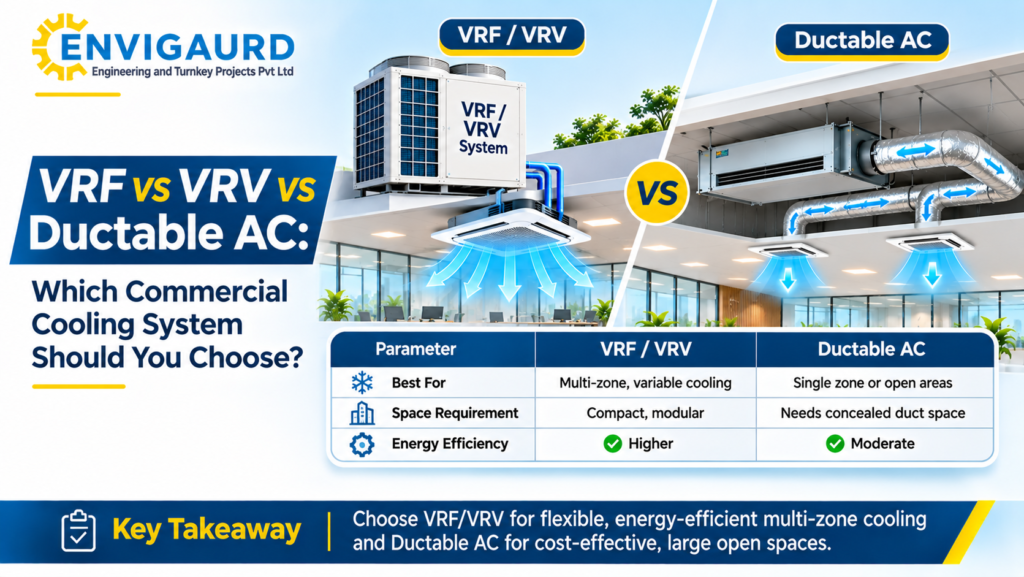
VRF, VRV and ductable AC all solve the same basic problem, cooling a commercial space without a dedicated central plant, but they fit different buildings. VRF and VRV are the same underlying refrigerant-based technology (VRV is simply Daikin’s brand name for VRF), offering independent, room-by-room zoning with no ductwork. A ductable AC hides its indoor unit above the ceiling and spreads air through a duct network to several outlets instead. Choosing between them comes down to how many independent zones a building actually has, and how much ceiling depth is available.
Quick Comparison
| Factor | VRF / VRV | Ductable AC |
|---|---|---|
| How it distributes air/cooling | Refrigerant piped directly to each indoor unit | One indoor unit, air distributed via ducting to several outlets |
| Zoning granularity | Independent, per indoor unit | Per duct run / outlet grouping, coarser than VRF |
| Typical ceiling depth needed | Refrigerant piping only, generally shallow | Deeper, for duct runs and insulation |
| Best suited to | Multi-tenant offices, hotels, buildings with many independently-used zones | Showrooms, boardrooms, interiors needing a fully concealed finish with a few outlets |
| Relative upfront cost | Higher per indoor unit, scales with zone count | Generally lower for a small number of outlets from one unit |
| Servicing | Brand-trained VRF/VRV technician | General AC technician, though duct design still needs checking |
For the full technical picture of how VRF works, see our guide, What Is a VRF System? and for ductable systems, What Is a Ductable AC?
When VRF or VRV Is the Better Fit
VRF (or VRV, if the project specifically calls for Daikin equipment) tends to win when a building has many genuinely independent zones: different tenants on different floors, a hotel where every room needs its own thermostat, or a retail building fitted out in phases by different shop owners. It also wins when ceiling depth is tight, since VRF only needs refrigerant piping rather than insulated ducting.
When Ductable AC Is the Better Fit
Ductable AC tends to win in a smaller, more contained space that needs a completely concealed finish and only a handful of outlets, such as a boardroom, showroom, or reception area, where the ceiling void is deep enough for duct runs and a single indoor unit comfortably covers the whole space. It is rarely the right call for a large building split into many separately-controlled zones, since one ductable unit cannot zone as finely as several independent VRF indoor units can.
A Simple Way to Decide
Ask three questions before deciding: how many genuinely independent zones does the building actually have (not just rooms, but zones that need separate control); how much ceiling void is available for ducting versus just refrigerant piping; and is a fully concealed finish with no visible panel a hard requirement. A building with many independent zones and limited ceiling depth usually points to VRF; a smaller space needing a clean, concealed finish with few outlets usually points to ductable. A proper site survey and load calculation is still the only reliable way to confirm this for a specific building.
Frequently Asked Questions
Is VRF always more expensive than ductable AC? Per indoor unit, VRF is generally more expensive, but the comparison depends on how many zones and outlets each system needs to cover; a ductable unit serving many outlets from one unit can sometimes cost more overall than expected, while VRF scales cost with the number of zones.
Can VRF and ductable AC be mixed in the same building? Yes. It is common to use VRF for independently-zoned floors or tenant spaces and a ductable unit for a specific area like a boardroom or showroom that needs a fully concealed finish, as long as the design accounts for both systems’ outdoor unit and piping/ducting needs.
Is VRV the same choice as VRF for this comparison? Functionally yes; VRV is Daikin’s brand name for the same VRF technology, so the zoning and ceiling-depth trade-offs against ductable AC are the same regardless of which brand name is used.
Which system is easier to retrofit into an existing building? VRF is often easier to retrofit since it needs only refrigerant piping rather than the larger ducting a fully ductable system requires, though both still need enough ceiling void and should be checked against the specific building’s structure.
If you are weighing VRF, VRV or ductable AC for a specific building, a short site assessment settles it faster than comparing spec sheets. Get a free system-selection consultation.