
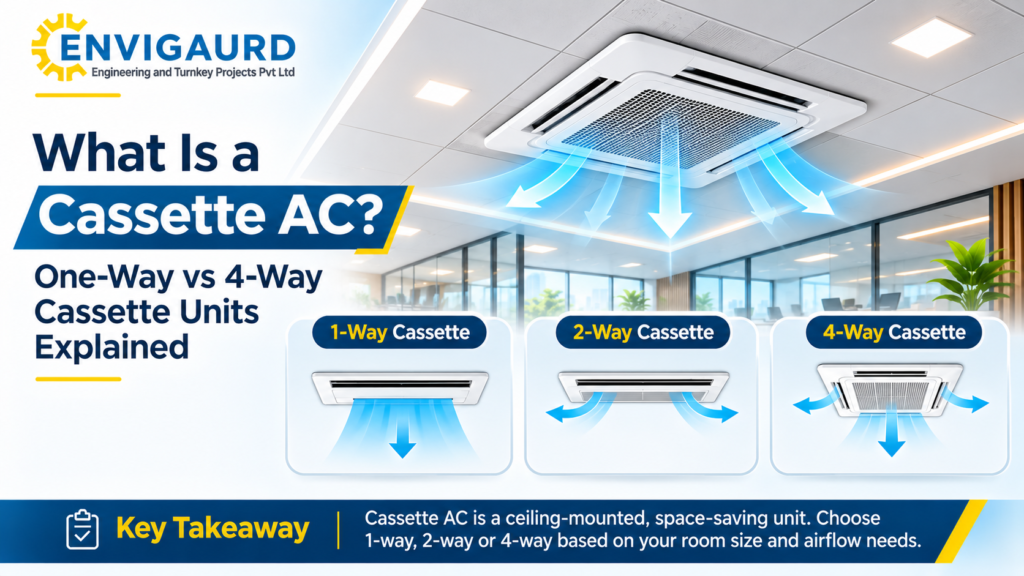
A cassette AC is an indoor air conditioning unit that sits inside a false ceiling, flush with the ceiling tiles, so that only a flat panel and a grille are visible from the room below. Instead of throwing air in one direction like a wall-mounted split unit, a cassette draws room air in through a centre grille and pushes cooled air back out through vents around the edge of that same panel, usually in two, three, or four directions at once. It is the ceiling-mounted answer to the same basic question a split AC answers for a wall: how do you get refrigerant-based cooling into a room without it being the first thing anyone notices.
Think of a cassette unit as a showerhead recessed flush into a ceiling rather than a garden hose pointed at one corner of a room. A 4-way cassette sprays conditioned air outward on all four sides from one central point, which is why it tends to cool a room more evenly than a single wall unit blowing air across it from one side only.
In one sentence: a cassette AC hides the indoor unit inside the ceiling void and distributes air symmetrically around a room, which is why it has become the standard choice for offices, retail floors, and showrooms where a visible wall-mounted unit would look out of place.
How a Cassette AC Actually Works
The indoor unit itself sits above the false ceiling, connected the same way any split-type indoor unit is: a refrigerant pipe pair running to an outdoor condensing unit, a condensate drain line to carry away the water the coil pulls out of the air, and a power/control cable. What makes a cassette different is only the box it sits in and the direction air moves through it. A fan inside the unit pulls warm room air upward through the centre grille, passes it over the cooling coil, and pushes it back out through louvres on the visible panel’s edges, which swing to spread air across the room rather than in a single fixed stream.
Because the whole mechanism sits inside the ceiling void, the only parts a person in the room ever sees are the flat panel, the grille, and the louvres, usually finished in white or a colour matched to the ceiling tile. This is the entire reason cassette units exist as a category: to get cassette-style even distribution and a ducted-split level of discretion without the cost and ceiling depth a fully ducted system needs.
One-Way, Two-Way, Three-Way and Four-Way Cassette Units Explained
Cassette units are classified by how many sides of the panel actually blow air, which is usually called the throw pattern. This single detail matters more than brand or capacity when deciding which type suits a given room, because it decides how evenly a space gets cooled.
| Type | Air direction | Best suited to | Typical limitation |
|---|---|---|---|
| 1-way (corner) cassette | Air blows out of one side only | Narrow rooms, corridors, or a unit mounted against one wall of the ceiling | Weaker throw into the far side of a wide room |
| 2-way cassette | Air blows out of two opposite sides | Long, rectangular rooms such as a narrow meeting room or a strip of retail frontage | Still leaves the two unserved sides cooler more slowly |
| 3-way cassette | Air blows out of three sides | L-shaped or irregular rooms where one side is against a wall or obstruction | Less common; fewer model options than 2-way or 4-way |
| 4-way cassette | Air blows out on all four sides | Open, roughly square or rectangular rooms: open-plan offices, large retail floors, boardrooms | Needs a centred ceiling position and enough clearance on all four sides to be effective |
A 4-way unit is the one most people picture when they hear “cassette AC,” and it is the most commonly specified type in open commercial layouts because it covers the largest, most even floor area from a single ceiling point. A 1-way unit is not a lesser version of a 4-way unit; it is the correct choice for a space where three of those four directions would simply be blowing air at a wall, a window, or an adjoining unit’s zone.
Where Cassette AC Fits Among Other Ceiling-Mounted Options
Cassette AC sits between a fully ducted system and a single wall-mounted split in terms of both ceiling depth required and how evenly it distributes air. A ducted system needs the most ceiling void, since it routes air through a network of ducts to several outlets; a cassette needs only enough depth to fit the unit body itself, typically less than a ducted system but more than nothing; a wall split needs no ceiling depth at all but throws air in one direction from one side of the room. We’ve covered the detailed trade-offs between cassette and split AC specifically, including cost and maintenance access, in our dedicated cassette AC vs split AC comparison, so this guide will not repeat that comparison here.
Advantages and Limitations
Advantages: a flush ceiling finish that keeps walls completely free for furniture, shelving, or glazing; even air distribution across a room from a single unit, especially with a 4-way throw pattern; a smaller visible footprint than a wall-mounted unit of similar capacity; and a ceiling void requirement that is usually shallower than a fully ducted system needs.
Limitations: the false ceiling has to be deep enough and structurally able to carry the unit’s weight, which is worth confirming at design stage rather than discovering during installation; the condensate drain needs a proper fall or a condensate pump, since gravity drainage is not always available inside a ceiling void; servicing access means removing or opening ceiling tiles rather than simply reaching a wall unit; and a 4-way unit genuinely needs to sit near the centre of the room it serves to cool evenly, which can conflict with lighting layouts, sprinkler heads, or structural beams already fixed in the ceiling plan.
Common Myths About Cassette AC
“A 4-way cassette is always the best choice.” Not for every room. A narrow corridor or a space with one side against a wall is usually better served by a 1-way or 2-way unit, since a 4-way unit’s extra throw directions would just blow air at an obstruction.
“Cassette AC needs no ceiling depth.” It needs less than a fully ducted system, but it still needs a real void, enough to fit the unit body, the drain line, and usually a condensate pump, which has to be checked against the actual false-ceiling depth planned for a project, not assumed to be negligible.
“One cassette unit can always cool an entire open floor.” Coverage depends on the unit’s throw radius and the room’s heat load, not just its visible size. A large open floor may genuinely need two or more cassette units rather than one oversized unit pushed beyond its effective coverage area.
How to Know If Cassette AC Is Right for Your Space
Cassette AC is worth specifying when a space has a false ceiling with adequate void depth, a roughly square or rectangular open layout that suits a centred unit, and a visible-wall-free aesthetic that matters to the space, such as a showroom, reception area, or open-plan office. It is worth looking at ductable AC instead if the layout is irregular, cooling needs to reach several separated small rooms from one indoor unit, or the ceiling void is too shallow for a cassette body but can still take a slimmer ducted unit. The reliable way to settle this for a specific room is an actual site check of ceiling depth and a heat-load calculation, not a general rule of thumb.
Frequently Asked Questions
What is the difference between a 1-way and a 4-way cassette AC? A 1-way cassette blows conditioned air out of only one side of the ceiling panel, suiting narrow rooms or spaces against a wall, while a 4-way cassette blows air out of all four sides for even coverage in an open, centrally-mounted layout.
How much false ceiling depth does a cassette AC need? It varies by model and brand, but a cassette unit typically needs noticeably less depth than a fully ducted system, though the exact figure should always be confirmed against the specific unit’s datasheet and the project’s actual false-ceiling design before finalising the ceiling plan.
Can a cassette AC be installed without a false ceiling? No. A cassette unit is designed to sit inside a ceiling void and show only its flush panel below; a room without a false ceiling would need a wall-mounted split, a floor-standing unit, or a ductable unit with its own concealed mounting instead.
Does a cassette AC cool a room more evenly than a wall-mounted split? Generally yes, particularly with a 4-way throw pattern, because air is distributed from a central ceiling point in multiple directions rather than blown across the room from one side.
How many cassette units does a large open office need? That depends on the room’s actual heat load and each unit’s effective coverage area, not just floor area in isolation; a proper load calculation and layout plan is the only reliable way to confirm whether one or several units are needed.
If you are planning a cassette AC layout and want to confirm throw pattern, unit count, and ceiling clearance before finalising your interior design, a short site visit settles it faster than guesswork. Talk to our HVAC design team.