
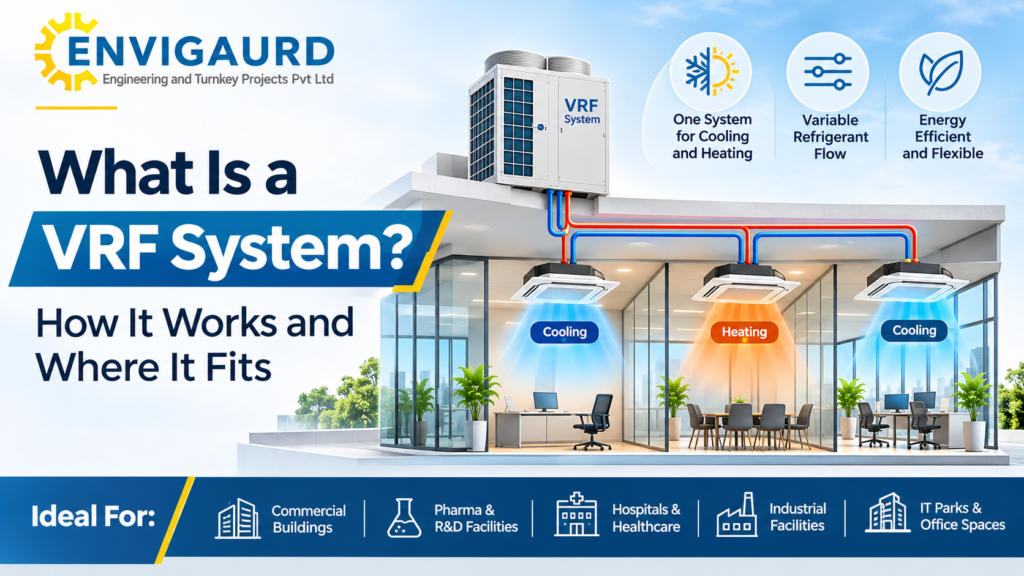
VRF stands for Variable Refrigerant Flow. In plain terms, it is a commercial air conditioning setup where one outdoor unit supplies several indoor units at once, and each indoor unit can be turned up, turned down, or switched off on its own, without affecting the rooms around it. Instead of chilled water or ducted air carrying the cooling or heating, VRF moves refrigerant directly to each room through copper piping, adjusting how much refrigerant each room gets based on what that room actually needs right now.
Think of it like the water supply in a large building. One main line feeds the whole building, but every tap opens and closes independently. Nobody has to run the whole system just to fill one glass. VRF works the same way with cooling and heating: one outdoor source, many independent taps.
In one sentence: VRF lets a single outdoor unit cool or heat many rooms independently, which is why it has become the standard choice for offices, hotels, and retail spaces that need room-by-room control without a full chiller plant.
Where VRF Came From
VRF is not a new idea. Daikin introduced it in 1982 under the brand name VRV (Variable Refrigerant Volume), which is why “VRV” still shows up in India, usually when a quote specifies Daikin equipment. Every other manufacturer, such as Mitsubishi, Carrier, LG, Toshiba, or Gree, calls the same underlying technology VRF, since VRV is a Daikin trademark, not the generic term. Over four decades, it has moved from a niche Japanese building technology to the default commercial cooling choice across Asia and the Middle East, as buildings shifted toward multi-tenant, multi-zone designs rather than single open floors. VRF is recognized as a distinct, standardized equipment category: AHRI Standard 1230, “Performance Rating of Variable Refrigerant Flow (VRF) Multi-split Air-Conditioning and Heat Pump Equipment,” defines how VRF systems are classified and rated, and is the standard referenced by ASHRAE 90.1 for this equipment category.
How a VRF System Works
The three main parts. Every VRF system is built from the outdoor unit (compressor, condenser coil, and control electronics, the only outdoor equipment needed no matter how many rooms it serves), the refrigerant piping network (copper pipes running from the outdoor unit through branch-selector boxes that direct the right amount of refrigerant down each branch), and the indoor units themselves, which can be a different type and size in every room: ceiling cassettes for open offices, slim ducted units hidden above a false ceiling, wall-mounted units in small offices, or floor-standing units in a lobby.

The refrigerant circuit, explained simply. Picture the outdoor unit as a pump pushing refrigerant around a loop of pipes. At every indoor unit sits a small electronic expansion valve, which is what makes VRF genuinely independent: it opens wider when a room needs more cooling and closes down as the room nears its target temperature, with no signal needed to or from neighbouring rooms. The outdoor unit’s compressor watches the combined demand from every valve and adjusts its own output to match it in real time, rather than simply switching between fully on and fully off.
Why the compressor “listens” to every room. The compressor in a VRF outdoor unit is an inverter compressor, meaning its speed varies rather than staying fixed. A basic, non-inverter AC compressor can only run at one speed, so it switches on and off to control temperature, wasting energy at every restart. An inverter compressor speeds up or slows down smoothly instead, which is a large part of why VRF tends to be more efficient than older fixed-speed technology, especially when different rooms rarely need full cooling at the same exact moment.
Heat-pump VRF vs heat-recovery VRF. A heat-pump VRF system can produce either cooling or heating, but the whole system does one or the other at a time; it cannot heat one room while cooling another. A heat-recovery VRF system removes that limit: it can cool some rooms and heat others simultaneously, on the same outdoor unit, by moving the heat taken out of the cooled rooms into the rooms being heated instead of rejecting it outside. That matters in a building where, for example, a server room needs constant cooling year-round while a reception area near a glass facade needs heating on a cold morning. Heat-recovery systems cost more, so they are chosen specifically where a building has that kind of mixed, simultaneous demand.
Mixing Indoor Unit Types on One System
One underrated advantage of VRF is that its indoor units do not all have to match. A single outdoor unit can run ceiling cassette units in an open office, concealed ducted units above a boardroom’s false ceiling for a completely clean look, wall-mounted units in a small private office, and a floor-standing console unit in the lobby, all at once, all controlled independently. This flexibility is one reason architects and interior designers lean toward VRF once a building has more than a couple of room types to cool.
Where VRF Makes the Most Sense
VRF tends to be the right call in buildings with many rooms used differently by different people on different schedules, rather than one shared climate zone: a multi-storey office building with several independent tenants, each wanting their own thermostat and energy billing; a boutique hotel where every guest room needs independent control; a retail building with several shop units fitted out at different times; or a mixed-use building combining ground-floor retail, office floors, and a rooftop function space with different occupancy patterns.
VRF vs VRV vs Central AC vs Ductable Split
| Factor | VRF | VRV | Central (chilled-water) plant | Ductable split |
|---|---|---|---|---|
| What it is | Generic term for this technology | Daikin’s trademark for the same technology | Chilled water/air from one central plant room | One indoor unit per duct run, cooling a small group of rooms |
| Zoning | Independent, per indoor unit | Independent, per indoor unit | Zoned by air-handling unit, coarser | Zoned per duct run, less granular than VRF |
| Best suited to | Multi-tenant offices, hotels, retail | Same as VRF | Large single-owner buildings with uniform load, hospitals | Single open-plan floors, showrooms, small offices |
| Space needed | Refrigerant piping only | Same as VRF | Dedicated plant room plus risers | Ceiling void for duct runs |
| Heat/cool different zones at once | Yes, heat-recovery VRF only | Yes, heat-recovery VRV only | Rarely, without a more complex design | No |
| Typical servicing need | Brand-trained VRF technician | Daikin-trained technician | Plant/chiller technician | General AC technician |
The decision usually comes down to building scale and tenancy pattern rather than upfront cost alone: a single large owner running one uniform load over a huge floor area often finds a central plant more economical, while a building split into many independently-used zones tends to favour VRF.
Advantages and Limitations
Advantages: independent zoning, with every room controlled on its own; no large ductwork, since only refrigerant piping and control wiring are needed; strong efficiency at partial load, because the inverter compressor matches real demand instead of cycling fully on and off; and easier phased installation, since indoor units can often be added to an outdoor unit with spare capacity as a fit-out continues.
Limitations: higher equipment cost per ton than a basic split or window AC, though usually offset over time by lower running costs; strict piping length and height-difference limits set by the manufacturer, which is a real design constraint, not a formality; a stronger dependence on installation quality, since poorly executed piping work causes problems that are harder to diagnose than a simple split AC fault; and the need for brand-specific, specially trained technicians rather than a general AC repair contractor.
VRF is not automatically the right answer everywhere. A single large warehouse or factory floor with one uniform temperature requirement rarely needs VRF’s room-by-room independence, and is often served more simply by a central plant or large packaged units instead.
Common Myths About VRF
“VRV and VRF are different technologies.” They are not; VRV is simply Daikin’s brand name for VRF, and every manufacturer’s equivalent system works on the same underlying principle.
“VRF always costs more to run than a central plant.” Not necessarily. A building where different zones are occupied at different times tends to run more efficiently on VRF, because unused zones can genuinely idle rather than being cooled as part of one shared system.
“VRF cannot be retrofitted into an older building.” It usually can. Because VRF needs only refrigerant piping rather than large ducts, it is often easier to retrofit than a full ducted or central-plant solution, though existing electrical capacity and piping routes still need checking.
“Bigger is always better when sizing VRF.” Oversizing wastes money upfront and can hurt comfort, since an oversized system spends more time at an inefficient part-load. Correct sizing, based on an actual heat-load calculation, matters more than picking the largest available outdoor unit.
Sizing Basics, in Plain Language
VRF capacity, like most air conditioning, is measured in tons of refrigeration, roughly the cooling effect of melting one ton of ice over 24 hours. The right tonnage depends on far more than floor area: occupancy, glass and sun exposure, heat-generating equipment inside the space, and local climate all shift the real load, which is why two identically-sized offices can need different tonnage if one has floor-to-ceiling west-facing glass and the other does not. Tonnage should never be estimated from a flat rule of thumb; the reliable method is a proper heat-load calculation, zone by zone, covered in our existing guide to HVAC load calculation basics.
Installation and Maintenance
A VRF system is only as good as its installation and its ongoing maintenance. Because the refrigerant circuit is sealed and pressurised, pipework has to be cut, brazed, and pressure-tested correctly, then properly evacuated and charged before commissioning; rushing this stage is the single most common cause of underperforming VRF systems. After installation, a planned maintenance routine, filter and coil cleaning, refrigerant leak checks, and periodic verification that every indoor unit is still communicating with the outdoor unit, keeps the system reliable for its working life. Buildings that treat this as a scheduled AMC item, rather than a reactive repair call after something breaks, generally get a longer, more dependable service life from the equipment.
How to Know If VRF Is Right for Your Building
VRF is worth evaluating seriously if your building has multiple independently-used zones that each need their own thermostat, no existing chilled-water plant the load could simply join, a ceiling void that cannot comfortably fit large ducting, or a phased fit-out where different tenants will be occupied at different times. It is worth a harder look at a central plant instead if the building is very large, single-owner, and will run a fairly uniform load across most of its floor area most of the time. The only way to settle this confidently for a specific building is a proper load calculation and a short site consultation, not a generic rule of thumb.
Frequently Asked Questions
Does VRF need less ceiling space than a fully ducted system? Generally yes, since VRF needs space for refrigerant piping and the indoor units themselves rather than the larger ducting and plenum a fully ducted system requires, though a ducted-type VRF indoor unit still needs a short duct run of its own.
Can one VRF outdoor unit really heat and cool different rooms at the same time? Only a heat-recovery VRF system can do this; a heat-pump VRF system heats or cools every connected zone together, not a mix of both at once.
Is VRF more expensive to run than a central AC plant? It depends on the building’s load profile. VRF tends to be more efficient when zones are used at different times and loads; a central plant can be more efficient at very high, constant, building-wide loads.
How long does a VRF system typically last? With correct installation and regular maintenance, VRF outdoor units commonly last in the range most commercial HVAC equipment shares, roughly 15 to 20 years, though the exact figure depends on usage intensity, local conditions, and how consistently maintenance is carried out.
Can VRF be used in residential buildings, or only commercial projects? It is used in residential high-rises and large villas too, though its cost and complexity mean it is usually reserved for larger buildings rather than a single apartment, where a simple split AC remains the more practical choice.
If your building has more than a few independently-used rooms and you are weighing VRF against a central plant or a ducted system, the fastest way to a clear answer is a short site assessment rather than more reading. Talk to our HVAC design team.