Industrial pollution is the release of harmful substances or energy, such as smoke, toxic gases, dust, chemical effluent, hazardous waste, heat and noise, from factories, power plants, mines and other industrial activities into the air, water and soil. It is one of the largest sources of environmental damage in India, and also one of the most controllable, because it comes from fixed, identifiable sources.
This guide explains what industrial pollution means, its five types, the industries and causes behind it, its effects on health and the environment, the laws that govern it in India, and how plants control it. If you are a plant engineer, jump to how industrial pollution is controlled. If you are a student, the short note near the end summarises everything in one place.
Table of Contents
- Key Highlights
- What Is Industrial Pollution?
- Types of Industrial Pollution
- Causes of Industrial Pollution
- Most Polluting Industries in India
- Effects of Industrial Pollution
- Industrial Pollution in India: The Current Picture
- Laws That Govern Industrial Pollution in India
- How Industrial Pollution Is Controlled
- Short Note on Industrial Pollution (For Students)
- Frequently Asked Questions
- Sources and Further Reading
- Conclusion
Key Highlights
- Industrial pollution comes from fixed sources such as chimneys, vents, drains and waste yards, which makes it measurable and controllable.
- There are five main types: air, water, soil or land, noise and thermal pollution.
- Burning fossil fuels, outdated processes and missing control equipment are the main causes.
- Thermal power, steel, cement, chemicals, pharma, fertiliser, textiles, tanneries and refineries are among the most polluting sectors in India.
- India regulates industrial pollution through the Water Act 1974, Air Act 1981 and Environment (Protection) Act 1986, enforced by CPCB and the state boards.
- Proven control technologies exist for every type, from wet scrubbers and bag filters to effluent treatment plants.
What Is Industrial Pollution?
Definition: industrial pollution is any contamination of the environment that is directly caused by industry. It includes pollutants released during production (process emissions), from burning fuel for energy (combustion emissions), from storage and handling (fugitive emissions) and from the disposal of waste (effluent, sludge and solid waste).
Unlike pollution from vehicles or households, which comes from millions of small, scattered sources, industrial pollution is concentrated. A single boiler stack or effluent outlet can carry a large share of a town’s pollution load. That is why regulators focus on industry first, and why fixing one source can produce a visible improvement in local air or river quality.
Industrial pollutants are commonly grouped as:
- Particulate matter: dust, soot, fly ash and fine particles (PM10 and PM2.5).
- Gases: sulphur dioxide (SO2), nitrogen oxides (NOx), carbon monoxide, hydrogen chloride, ammonia, chlorine, hydrogen sulphide.
- Volatile organic compounds (VOCs): solvent vapours from paints, pharma and chemical plants.
- Heavy metals: lead, mercury, cadmium, chromium and arsenic in effluent, sludge and dust.
- Energy: waste heat and noise.
Types of Industrial Pollution
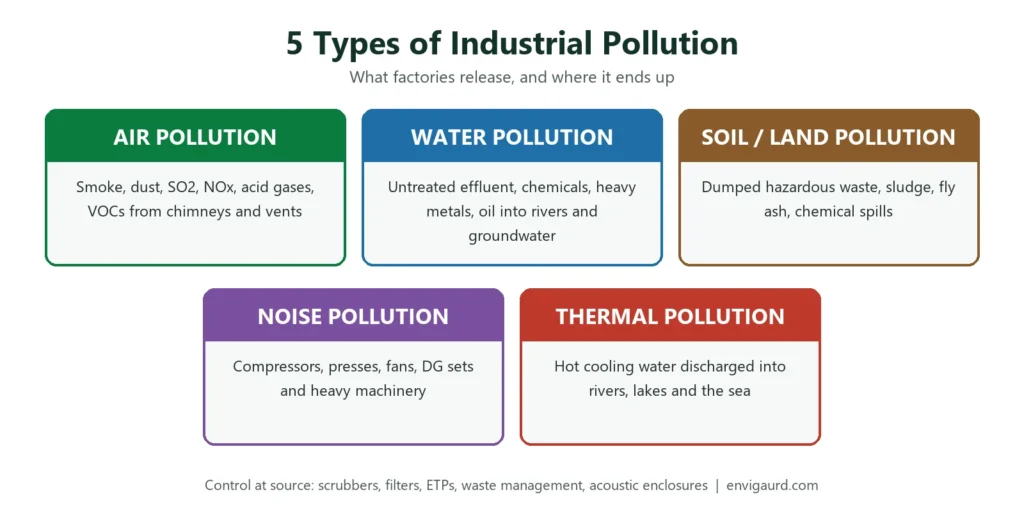
Industrial pollution is classified by the part of the environment it affects. These are the five types usually asked about in exams and the five that a plant’s consent conditions cover.

1. Industrial air pollution
The most visible type: smoke and gases from chimneys, dust from crushers and kilns, and fumes from process vents. Key pollutants are particulate matter, SO2, NOx, acid gases and VOCs. Air pollution from industry travels far beyond the plant boundary and contributes to smog and acid rain. Our guide to industrial air pollution control systems explains the equipment used to treat each pollutant.
2. Industrial water pollution
Caused by discharging untreated or partly treated effluent into rivers, lakes, drains or the ground. Effluent can carry acids, alkalis, dyes, oils, organic load (high BOD and COD) and heavy metals. Dyeing, tanning, distilleries, pulp and paper, and chemical plants are major contributors. Scrubber bleed and cooling tower blowdown also become effluent if not managed.
3. Industrial soil and land pollution
Happens when solid waste, ETP sludge, fly ash, slag or hazardous chemicals are dumped on land or stored without protection. Contaminants leach into soil and groundwater, making land unfit for farming or housing for decades. Chemical spills and leaking underground storage tanks are other sources.
4. Industrial noise pollution
Generated by compressors, presses, hammers, fans, blowers, DG sets and heavy vehicles. Long exposure causes hearing loss among workers and disturbs nearby residents. The Noise Pollution (Regulation and Control) Rules, 2000 set ambient noise limits for industrial, commercial, residential and silence zones.
5. Industrial thermal pollution
Occurs when power plants and factories return cooling water to a river, lake or the sea at a higher temperature. Warm water holds less dissolved oxygen, stressing fish and other aquatic life and changing the ecosystem around the outfall.
Causes of Industrial Pollution
Most industrial pollution traces back to a small set of causes:
- Burning fossil fuels: coal, petcoke and furnace oil in boilers, furnaces and captive power plants release particulate, SO2 and NOx.
- Outdated technology: old furnaces, open processes and inefficient equipment generate more waste per unit of product.
- Missing or poorly maintained control equipment: a scrubber with a failed pump or a bag filter with torn bags is as bad as having none.
- Untreated effluent discharge: bypassing or under-sizing the ETP to save cost.
- Improper waste disposal: dumping hazardous waste instead of sending it to an authorised TSDF.
- Leaks, spills and fugitive emissions: from open tanks, flanges, valves and material handling.
- Poor siting and weak enforcement: factories located next to homes or rivers, with limited inspection.
Most Polluting Industries in India
In 2014, CPCB directed 17 categories of highly polluting industries to install online continuous emission and effluent monitoring. The table below lists them with the pollutants each is best known for.
| Industry | Main pollutants | Main type |
|---|---|---|
| Thermal power plants | Fly ash, PM, SO2, NOx, mercury, hot water | Air, thermal, land |
| Integrated iron and steel | PM, SO2, CO, slag, phenolic effluent | Air, water, land |
| Cement | Dust, NOx, SO2 | Air |
| Oil refineries and petrochemicals | SO2, VOCs, H2S, oily effluent | Air, water |
| Fertilisers | Ammonia, fluorides, urea dust, nitrogen-rich effluent | Air, water |
| Pharmaceuticals | Solvent VOCs, HCl and other acid fumes, high-COD effluent | Air, water |
| Pesticides | Toxic organics, acid gases, hazardous waste | Air, water, land |
| Dyes and dye intermediates | Acid fumes, coloured and high-COD effluent | Air, water |
| Caustic soda (chlor-alkali) | Chlorine, mercury (older cells), brine sludge | Air, water, land |
| Aluminium, copper and zinc smelters | SO2, fluorides, metal dust, slag | Air, land |
| Pulp and paper | High-BOD and coloured effluent, H2S odour | Water, air |
| Sugar and distilleries | High-strength effluent (spent wash), boiler emissions | Water, air |
| Tanneries | Chromium, sulphides, high-TDS effluent | Water, land |
Many smaller units, such as electroplating, pickling, galvanising, foundries and brick kilns, are not on this list but are still significant local polluters. Our scrubber systems for chemical plants page covers the fume problems typical of these sectors.
Effects of Industrial Pollution
On human health
- Respiratory illness such as asthma, bronchitis and reduced lung function from particulate and acid gases.
- Heart disease and stroke linked to long-term exposure to fine particulate (PM2.5).
- Poisoning from heavy metals such as lead, mercury, arsenic and chromium in water and food.
- Cancers linked to certain industrial chemicals, such as benzene and hexavalent chromium.
- Hearing loss and stress from noise, especially among workers.
On the environment
- Acid rain: SO2 and NOx form acids that damage crops, forests, lakes and buildings.
- Smog and haze: reduce visibility and worsen urban air quality, especially in winter.
- Climate change: industry is a major emitter of carbon dioxide and other greenhouse gases.
- Dead rivers and lakes: effluent reduces dissolved oxygen and kills aquatic life.
- Loss of farmland: contaminated soil lowers crop yields and passes toxins into food.
On business
For plant owners, pollution has a direct cost: closure orders, environmental compensation, delayed consent renewals, lost export orders from customers who audit suppliers, and worker health claims. Investing in control is usually cheaper than any of these.
Industrial Pollution in India: The Current Picture
India’s rapid industrial growth has concentrated pollution in industrial clusters around cities and river basins. CPCB’s Comprehensive Environmental Pollution Index (CEPI) was developed to rank industrial clusters by their air, water and land pollution, and several clusters have been placed under action plans as critically or severely polluted areas. The National Clean Air Programme, launched in 2019, targets lower particulate levels in non-attainment cities, and industrial emissions are a key part of each city’s plan.
India also carries the memory of the 1984 Bhopal gas tragedy, when a methyl isocyanate leak from a pesticide plant killed thousands of people. It remains the most cited example of what happens when industrial safety and pollution control fail, and it shaped much of the country’s later environmental law, including the Environment (Protection) Act, 1986.
The trend is towards tighter limits, online monitoring and stronger enforcement. Units that plan control systems early avoid the cost of emergency retrofits.
Laws That Govern Industrial Pollution in India
| Law or rule | What it does |
|---|---|
| Water (Prevention and Control of Pollution) Act, 1974 | Created CPCB and SPCBs; requires consent for discharging effluent |
| Air (Prevention and Control of Pollution) Act, 1981 | Requires consent for air emissions; lets states declare air pollution control areas |
| Environment (Protection) Act, 1986 | Umbrella law; basis for industry-specific emission and discharge standards |
| Hazardous and Other Wastes Rules, 2016 | Governs storage, transport and disposal of hazardous waste |
| Noise Pollution (Regulation and Control) Rules, 2000 | Sets ambient noise limits by zone |
| EIA Notification, 2006 | Requires environmental clearance for listed projects before construction |
Every polluting unit needs Consent to Establish (CTE) and Consent to Operate (CTO) from its State Pollution Control Board. See our complete list of pollution control boards in India for contacts and functions.
How Industrial Pollution Is Controlled
Control follows a simple order: prevent pollution at source, capture what is released, treat it with the right equipment, and monitor results. The equipment depends on the pollutant:
| Pollutant | Control technology |
|---|---|
| Acid gases, ammonia, chlorine, SO2, fumes | Wet scrubbers (packed bed, spray tower, venturi) |
| Dust and fly ash | Bag filters, electrostatic precipitators, cyclones |
| Boiler and furnace SO2 | Flue gas desulphurisation scrubbers |
| VOCs and odours | Carbon adsorbers, thermal or catalytic oxidisers, chemical scrubbers |
| Effluent | Effluent treatment plants, zero liquid discharge systems |
| Hazardous waste | Segregation, recovery, authorised TSDF, co-processing |
| Noise | Acoustic enclosures, silencers, vibration isolation |
For a step-by-step plan with 12 specific measures, read our guide on how to reduce industrial pollution.
Need to control fumes or acid gases at your plant?
Envigaurd designs and manufactures industrial scrubber systems in PP, FRP and stainless steel for HCl, SO2, NH3, chlorine, H2S and mixed chemical fumes. Call +91-8147606843 or email contact@envigaurd.com.
Short Note on Industrial Pollution (For Students)
Industrial pollution is the pollution of air, water and land caused by industries. Factories release smoke, dust and harmful gases such as sulphur dioxide into the air, discharge untreated wastewater into rivers, and dump solid and hazardous waste on land. Machines also cause noise pollution, and hot water from power plants causes thermal pollution. Industrial pollution causes breathing problems, heart disease, water-borne illness, acid rain and damage to crops and aquatic life. It can be controlled by using cleaner fuels, fitting pollution control devices such as scrubbers, filters and electrostatic precipitators, treating wastewater before discharge, recycling waste, planting green belts and strictly following pollution laws.
Two types of industrial pollution (for a short answer): air pollution, caused by smoke and gases from factory chimneys; and water pollution, caused by untreated industrial effluent discharged into rivers.
Points for a pamphlet or poster on industrial pollution:
- Clean stacks, clean air: every chimney needs a control device.
- Treat every drop before it leaves the factory.
- Waste is a resource in the wrong place: recycle it.
- Healthy workers, healthy neighbours, healthy business.
- Report black smoke and illegal dumping to your State Pollution Control Board.
Frequently Asked Questions
What is industrial pollution in simple words?
Industrial pollution is the contamination of air, water, soil and the surroundings by waste, gases, chemicals, heat or noise released from factories, power plants, mines and other industrial activities.
What are the 5 types of industrial pollution?
The five main types are air pollution (smoke, dust and gases), water pollution (untreated effluent), soil or land pollution (dumped solid and hazardous waste), noise pollution (machinery) and thermal pollution (hot water discharged into water bodies).
Which industries cause the most pollution in India?
Thermal power plants, iron and steel, cement, oil refineries, petrochemicals, fertilisers, pharmaceuticals, pesticides, dyes, pulp and paper, sugar, distilleries, tanneries and non-ferrous smelters are among the most polluting. CPCB lists 17 categories of highly polluting industries that must run online emission and effluent monitoring.
What are the main causes of industrial pollution?
The main causes are burning fossil fuels, use of outdated technology, lack of pollution control equipment, untreated wastewater discharge, improper disposal of hazardous waste, leaks and spills, and weak enforcement or poor siting of industries near homes and water bodies.
What are the effects of industrial pollution on human health?
Industrial air pollution is linked to asthma, bronchitis, heart disease and lung cancer. Polluted water and soil can carry heavy metals such as lead, mercury and chromium into food and drinking water, causing kidney, nerve and developmental damage. Workers face the highest exposure.
How can industrial pollution be controlled?
By using cleaner fuels and processes, capturing emissions at source, treating them with equipment such as wet scrubbers, bag filters and electrostatic precipitators, treating effluent in ETPs, disposing of hazardous waste at authorised facilities, and complying with CPCB and SPCB standards.
What is an example of industrial pollution?
A coal-fired boiler releasing black smoke and sulphur dioxide from its chimney, a dyeing unit discharging coloured effluent into a river, or a chemical plant dumping sludge on open land are all examples. The 1984 Bhopal gas tragedy, caused by a methyl isocyanate leak, is the worst industrial pollution disaster in India’s history.
Is thermal pollution a type of industrial pollution?
Yes. Power plants and factories that use water for cooling often return it to rivers or the sea at a higher temperature. Warmer water holds less dissolved oxygen, which harms fish and other aquatic life.
Sources and Further Reading
- Central Pollution Control Board (CPCB): 17 categories of highly polluting industries, CEPI assessment of industrial clusters, emission and effluent standards
- India Code: Water Act 1974, Air Act 1981, Environment (Protection) Act 1986
- Ministry of Environment, Forest and Climate Change: National Clean Air Programme (2019), Noise Pollution Rules 2000, EIA Notification 2006, Hazardous and Other Wastes Rules 2016
- World Health Organization: air pollution and health
Conclusion
Industrial pollution affects the air we breathe, the water we drink and the land we farm, but it is also the most fixable form of pollution, because every gram comes from a known source. Cleaner fuels, efficient processes, correctly designed control equipment and honest monitoring can bring almost any plant within its limits.
If your plant needs to cut emissions of acid gases, ammonia, chlorine, SO2 or chemical fumes, contact Envigaurd. We design, manufacture and install wet scrubbers and air pollution control systems for industries across India.