
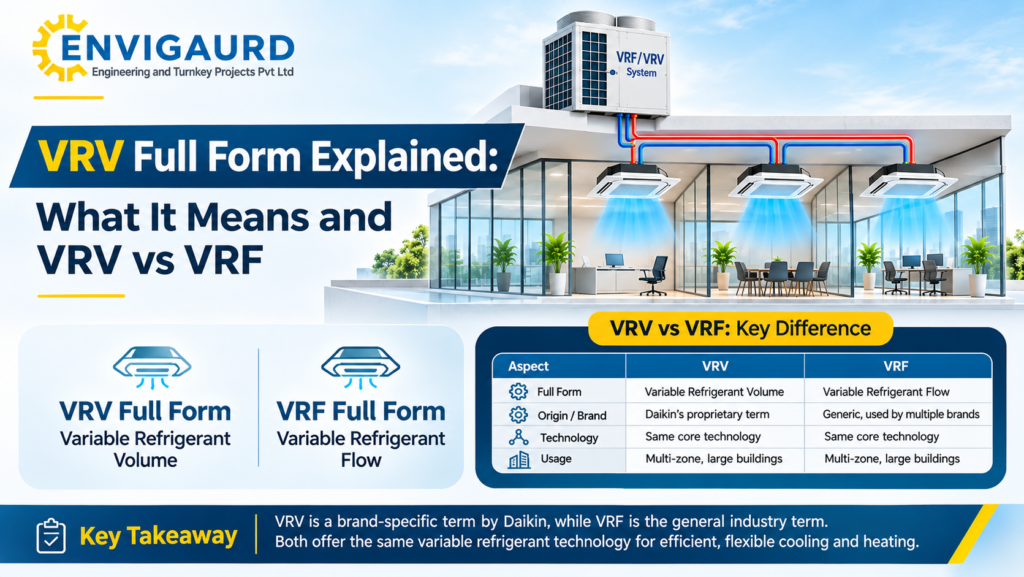
VRV stands for Variable Refrigerant Volume. It is Daikin’s own brand name for a multi-zone air conditioning technology that lets one outdoor unit independently cool or heat several indoor units at once. If that sounds identical to VRF, that is because it is: VRV and VRF describe the same underlying technology, and VRV is simply what Daikin calls it on its own product literature and in Daikin-specific quotes and tenders.
That one-line answer settles the naming question. The rest of this guide goes deeper into why two names exist for one technology, how VRV has evolved, how other major manufacturers brand the same idea differently, and what that naming difference actually means for you as a buyer. If you want the full explanation of how the refrigerant circuit, the compressor, and the indoor units physically work, that is covered in detail in our companion guide, What Is a VRF System?, which this article will not repeat.
Why Two Names Exist for the Same Technology
When Daikin introduced this refrigerant-based, independently-zoned cooling technology, it launched it under its own trademarked name, VRV, short for Variable Refrigerant Volume. Every other manufacturer that later built a system working on the same core principle, whether that is Mitsubishi, Carrier, LG, Toshiba, or Gree, needed a different name, since VRV belongs to Daikin. The industry settled on VRF, Variable Refrigerant Flow, as the generic, brand-neutral term for the whole category of technology. In practice, this means VRV is always a Daikin product, while VRF is the umbrella term that includes Daikin’s VRV alongside every other manufacturer’s equivalent system.
This is a common point of confusion in India specifically, because many of the earliest large commercial installations of this technology were Daikin systems, so a lot of site engineers, consultants, and even some tender documents still default to writing “VRV” even when the actual requirement is brand-neutral. If you see “VRV” in a boundary-of-work document or a tender, check whether it is being used as a generic placeholder term or as an actual Daikin-brand specification, since the two have very different procurement implications.
How VRV Has Evolved Since It Was Introduced
Daikin has continued to develop VRV technology in stages since it first brought the product to market in the early 1980s, moving through several generations of outdoor unit design. Broadly, each new generation has focused on the same handful of improvements: higher part-load efficiency from better inverter compressor control, longer allowable piping runs and greater height differences between the outdoor unit and the farthest indoor unit, improved heat-recovery performance for buildings with simultaneous heating and cooling needs, and smarter, more granular zone-level control through improved electronics. A VRV system specified today is a meaningfully more capable and more efficient piece of equipment than one from decades ago, even though the underlying principle, one outdoor unit serving many independently controlled indoor units, has not changed.
For a buyer, the practical takeaway is simple: if you are comparing a quote for a Daikin VRV system against an older installed base elsewhere, or against another brand’s equivalent, ask specifically which generation of the technology is being quoted, since efficiency, piping limits, and control sophistication can differ meaningfully between generations, not just between brands.
How Daikin’s VRV Differs in Practice from a Generic VRF System
Because Daikin designs, manufactures, and services its own VRV range end to end, a few things tend to be specific to the Daikin ecosystem rather than being guaranteed across every VRF-type system on the market.
Proprietary refrigerant control. Daikin’s VRV outdoor units use Daikin’s own compressor and refrigerant-flow control logic, which is not identical to how a Mitsubishi, Carrier, or LG system manages the same underlying task. This does not make one approach universally better, but it does mean components and firmware are generally not interchangeable across brands.
A centralised controller ecosystem. Daikin sells a range of centralised and networked controllers that let a facility manager monitor and schedule every indoor unit on a VRV system from one interface, often integrated with building management systems. Other manufacturers offer their own equivalents, but the specific interface, scheduling features, and integration options differ by brand, so a facility team trained on one brand’s controller software will usually need some retraining to operate another brand’s system fluently.
Dealer and service network. Because VRV is a Daikin product, only Daikin-authorized dealers and Daikin-trained technicians can properly service or extend a VRV installation under warranty. This is worth checking carefully in India, where the authorized-dealer network and spare-parts lead times can vary by region.
How Other Manufacturers Brand the Same Technology
VRV is only one of several brand-specific names covering essentially the same underlying idea. Knowing these helps when comparing quotes that use different terminology for what is functionally a similar system:
- Daikin calls its system VRV (Variable Refrigerant Volume).
- Mitsubishi Electric markets its equivalent range under the name City Multi.
- Toshiba uses the name SMMS (Super Modular Multi System) for its range.
- LG brands its system Multi V.
- Carrier, Gree, Voltas, Blue Star, and most other manufacturers generally describe their equivalent product simply as VRF, without a separate trademarked brand name for the core technology.
None of these is a fundamentally different technology from the others at a conceptual level; they are different manufacturers’ engineering implementations of the same variable-refrigerant, independently-zoned cooling and heating principle, each with its own compressor design, controls, piping limits, and indoor unit range. When you are comparing quotes across brands, it is worth asking each vendor to state their piping limits, minimum part-load efficiency, and controller capabilities side by side, rather than assuming one brand name is automatically superior to another.
2-Pipe vs 3-Pipe VRV Systems
One technical detail that is specific to how a VRV (or any VRF-type) system is actually piped, rather than to the brand itself, is whether the installation uses a 2-pipe or a 3-pipe configuration, and this is worth understanding before you compare quotes.
A 2-pipe heat-pump system uses two refrigerant pipes running between the outdoor unit and each indoor unit. It can deliver either cooling or heating to the whole system at a time, but every connected indoor unit does the same thing simultaneously. This is the simpler, less expensive configuration, and it suits buildings where all zones genuinely need the same mode at the same time, which describes most single-use commercial spaces.
A 3-pipe heat-recovery system adds a third refrigerant line, which is what allows some indoor units to cool while others heat, on the same outdoor unit, at the same time. The extra pipe and the additional control hardware needed to route refrigerant correctly make a 3-pipe system more expensive to install than a 2-pipe one, which is why it is specified deliberately for buildings with a genuine, simultaneous mixed demand, such as a building with a server room needing year-round cooling next to perimeter offices that need heating in winter, rather than as a default upgrade.
When comparing VRV quotes against VRF quotes from other brands, always confirm which configuration is being quoted. A lower-priced 2-pipe quote and a higher-priced 3-pipe quote are not directly comparable on cost alone, since they offer genuinely different capability.
Where You Will See “VRV” Used Specifically in an Indian Quote or Tender
In practice, you are most likely to encounter the term VRV, rather than the generic VRF, in a few specific situations: a tender or boundary-of-work document that has deliberately specified Daikin equipment by name, usually because the client or consultant already has Daikin systems elsewhere in the portfolio and wants a consistent service relationship; a quote directly from a Daikin dealer, which will naturally use Daikin’s own product terminology; or older project documentation and as-built drawings from a building that was fitted out when VRV was the dominant technology available in the Indian market. If a document mixes the two terms inconsistently within the same tender, it is worth clarifying with whoever wrote it whether a specific brand is actually required or whether any equivalent VRF system is acceptable, since that materially changes which vendors can competitively bid.
What This Means for You as a Buyer
If a consultant, contractor, or quote specifically says VRV, assume it is referring to Daikin equipment unless told otherwise, and factor in Daikin’s specific dealer network, controller ecosystem, and generation of technology into your decision. If your actual requirement is simply “a system that can independently zone-control many rooms from one outdoor unit,” and you are not tied to a specific brand for portfolio-consistency or existing-building reasons, it is worth evaluating VRF quotes from multiple manufacturers, including our own Carrier commercial AC range, rather than assuming VRV is a mandatory requirement, since several brands offer broadly comparable capability.
Frequently Asked Questions
What does VRV actually stand for? VRV stands for Variable Refrigerant Volume, Daikin’s trademarked name for its variable-refrigerant, multi-zone air conditioning technology.
Is VRV better than VRF? This is not a meaningful comparison on its own, since VRV is simply Daikin’s brand name within the broader VRF category. The real comparison that matters is between specific manufacturers and models, for example Daikin VRV against Mitsubishi City Multi or Carrier’s VRF range, not between the terms VRV and VRF themselves.
Can a non-Daikin technician service a VRV system? A general AC technician may be able to carry out basic tasks, but warranty-covered servicing, refrigerant work, and system extensions on a VRV installation should go through a Daikin-authorized dealer or technician, since the components, firmware, and refrigerant-charge procedures are brand-specific.
Why do some quotes say VRV and others say VRF for what looks like the same system? Because the vendor issuing the quote is naming their own equipment the way their brand markets it. A Daikin dealer will write VRV; a dealer for almost any other brand will write VRF, since only Daikin owns the VRV trademark.
Does a newer generation of VRV always outperform an older VRF system from another brand? Not automatically. Technology generation matters within a single brand’s own product line, but comparing a newer Daikin VRV generation against an older installation from a different manufacturer is not a fair like-for-like comparison; you would need to compare specific model-year specifications from both brands directly.
Should I specify VRV by name in my tender, or just ask for VRF? Specify VRV by name only if there is a genuine reason to require Daikin equipment specifically, such as matching an existing Daikin installation elsewhere in the building or portfolio. Otherwise, specifying VRF generically and evaluating quotes from multiple manufacturers on their actual specifications usually gives a more competitive result.
What is the difference between a 2-pipe and a 3-pipe VRV system? A 2-pipe system can only cool or only heat all connected zones at once, while a 3-pipe heat-recovery system can cool some zones and heat others simultaneously, at a higher equipment cost. Most buildings with a single, uniform usage pattern only need the simpler 2-pipe configuration.
If you are comparing a VRV quote against other VRF brands and want a straight, vendor-neutral read on which fits your building, a short consultation is faster than comparing spec sheets alone. Talk to our HVAC design team.