
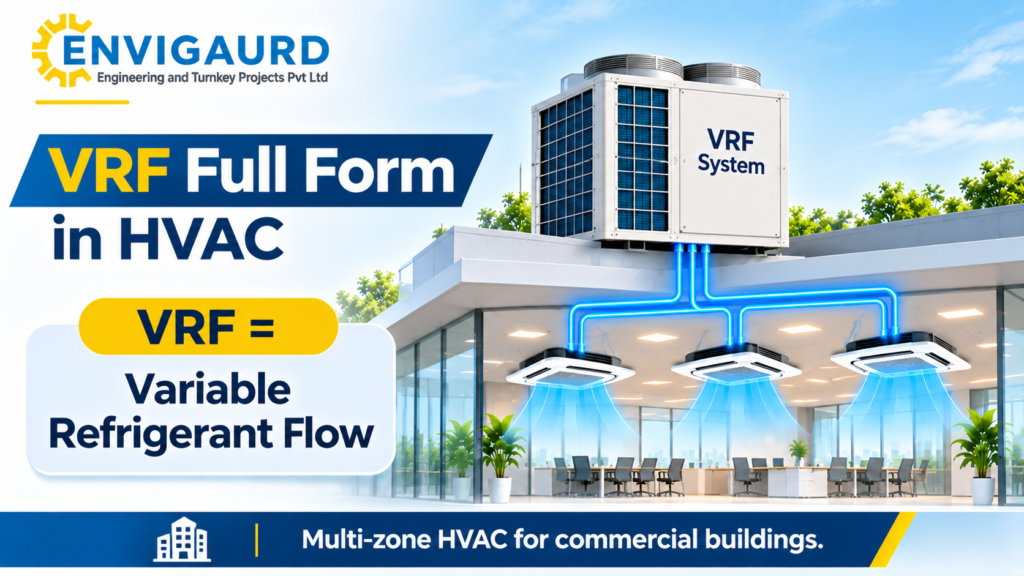
VRF stands for Variable Refrigerant Flow. It is a commercial air conditioning technology in which one outdoor unit supplies refrigerant directly to several indoor units at once, and each indoor unit can be adjusted or switched off independently without affecting the others. For the full explanation of how the refrigerant circuit, compressor, and indoor units work together, see our in-depth guide, What Is a VRF System?
Where the Term Is Used
VRF appears throughout commercial HVAC specifications, tenders, and equipment catalogues as the generic, brand-neutral name for this category of multi-zone, refrigerant-based cooling and heating technology. It is used by consulting engineers scoping a system for an office or hotel, by contractors quoting equipment, and in product literature from every major manufacturer except Daikin, which markets the same underlying technology under its own trademarked name, VRV (Variable Refrigerant Volume).
Why VRF and Not Simply “Multi-Split”
A basic multi-split system also lets one outdoor unit serve several indoor units, but typically with far less independent control and a tighter limit on how many indoor units and how much piping distance it can support. VRF specifically refers to systems capable of finely varying refrigerant flow to each indoor unit through electronic expansion valves and an inverter-driven compressor, supporting many more indoor units, longer piping runs, and genuinely independent zone-by-zone operation than a basic multi-split setup offers.
Frequently Asked Questions
What does VRF stand for? VRF stands for Variable Refrigerant Flow, a commercial air conditioning technology where one outdoor unit supplies and independently controls refrigerant flow to multiple indoor units.
Is VRF the same as VRV? Yes, functionally. VRV (Variable Refrigerant Volume) is Daikin’s trademarked name for the same underlying technology that every other manufacturer calls VRF.
Is VRF only used in large buildings? It is most common in mid-size to large commercial buildings such as offices, hotels, and retail spaces with many independently-used zones, though it is also used in some large residential and mixed-use projects.
How is VRF different from central air conditioning? VRF moves refrigerant directly to each indoor unit for independent, room-by-room control, while central air conditioning chills water at one plant and distributes it building-wide through air-handling units, typically with coarser, floor- or zone-level control.
For the full picture, including how VRF compares to central AC, ductable, and cassette systems, read our complete guide: What Is a VRF System?